

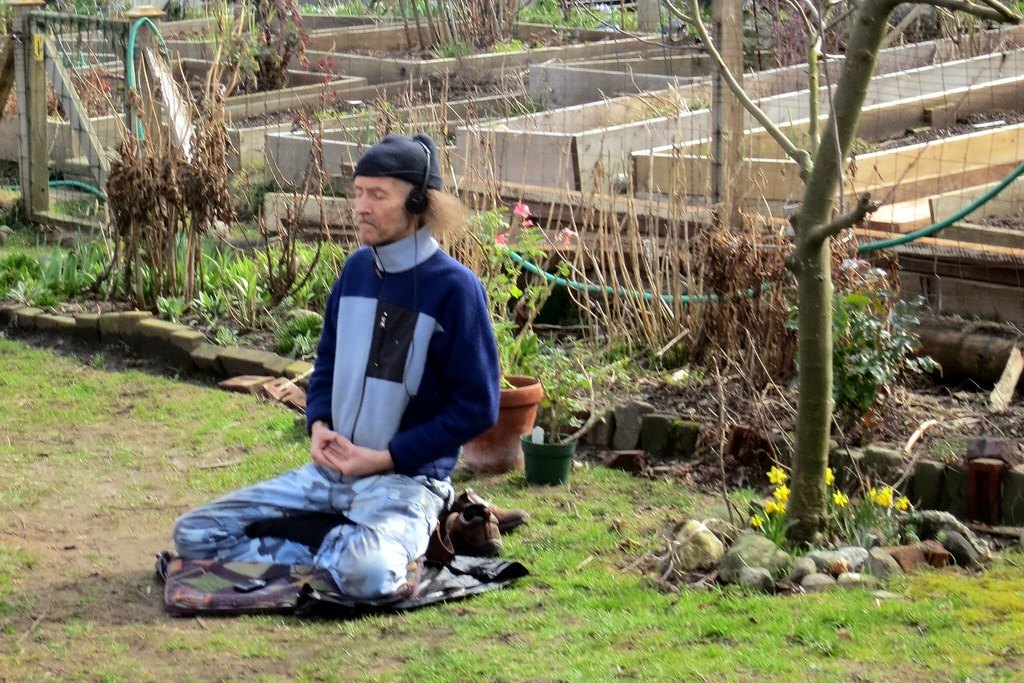
What we mean when we talk about meditation
Meditation, stripped of its ornaments, is as simple as focusing one’s attention. You choose a simple object—the breath, a sensation, a sound—and hold your internal gaze upon it steadily. The goal is not to magically empty your head, but to train the mind so it doesn’t get tangled in the first chain of thoughts that passes by, thereby gaining a small “maneuverable space” before reacting to the world.
That promise of stillness explains why, throughout history, various currents have sought shortcuts. And this brings us to the question that runs through this article: can a substance like cannabis facilitate that “letting go” of thoughts, or does it actually hinder it?
What cannabis does to attention
The best-documented acute effect of cannabis on cognition is an impairment of short-term memory. What is less clear is the mechanism: it is not known for certain if this is due to a direct alteration of memory circuits or if it is, above all, a consequence of fragmented attention. Whatever the explanation, the subjective result is a mental state different from the usual one.
Some traditions interpreted that state as an opportunity. If ordinary thought advances in “leaps”—intermittent discharges of neural circuits that consciousness perceives as a continuous flow—cannabis seems to loosen that thread. In theory, thoughts would continue to appear, but it would be easier to let them go, which in meditative terms would be equivalent to facilitating the “disengagement” of the focus of consciousness.
It is best to take this reading as a cultural hypothesis rather than an established neurological fact. It is a plausible rationalization for why certain Buddhist schools and some currents in the Middle East and Central Asia incorporated the plant into their practices, but the same alteration that “loosens” thought can, with equal ease, disperse it completely.
The background: an overactive mind
To understand why so many people seek to “stop their head,” it helps to look at the underlying problem. We live in reactive mode: for every stimulus, an immediate response. Judging, opining, solving. In principle, it is an adaptive mechanism, but when sustained chronically, it takes a toll.
Psychology groups part of this wear and tear under the label of “overactivation.” Stress, when disproportionate in intensity or duration, is associated with cardiovascular, digestive, metabolic, and immune problems. And it is not a blind automatism: stress is a transactional process, where the decisive factor is how we evaluate the situation. If we feel we have the resources, the negative reaction may not trigger; if we perceive that we lack them, it likely will.
That is where meditation fits in. By temporarily removing the content of consciousness, the emotional activation associated with that content is also weakened. What we call feelings are, to a large extent, bodily states—the “somatic marker”—that color our daily decisions. Training for calm is, in part, learning not to let thinking drag those unpleasant discharges along with it. That is what meditation is for, but so are diaphragmatic breathing, progressive muscle relaxation, or autogenic training: the important thing is to have a way to regulate excess activation.
An exercise to grasp the difficulty
Before fantasizing about altered states, it is worth checking how arduous it is to hold attention on something monotonous. Try this, without any substance:
- Sit comfortably, feet on the floor and hands in your lap. Close your eyes.
- Breathe normally, without forcing or modifying the rhythm.
- Count only the exhalations, from 1 to 5, and start over. If you get lost, return to 1.
- If you succeed without getting distracted, extend the cycle to 8.
The usual surprise is discovering how difficult it is to do something so simple in a sustained way. We are accustomed to focusing on what changes, not on what remains. And that is precisely the point: by occupying the “screen” of consciousness with neutral content, linked only to relaxation, you work simultaneously on attention and the deactivation of the emotional response.
Why order matters
Here is the central warning, and it is not rhetorical. It makes no sense to use cannabis or any other substance to meditate in the initial phases of practice. The logical approach is to first learn to discipline the mind to hold itself at a point; only later, if someone decides to experiment on their own, would it make sense to do so from an already consolidated base.
The reason is simple: without a firm capacity for concentration, it is most likely that cannabis will distort rather than help. The plant does not install mental discipline; at best, it modulates a previously cultivated terrain. And to cultivate that terrain, there is only one way: practice, practice, and more practice. Those who expect a chemical shortcut usually find more dispersion, not less.
There is also a key attitude that runs through any serious tradition: detachment. Meditation opens the door to an enormous diversity of mental states, but the goal is not to collect experiences or get hooked on this or that state, but to pass through them and let them go. Turning the “trip” into a goal is the surest way to lose your way.
Practical notes, not recipes
Some general guidelines on the practice itself—which is the only thing we recommend cultivating here: choose the time of day according to your level of activation; the morning or the end of the day usually work well, and it is advisable to avoid the time after heavy meals to avoid falling into drowsiness. Sessions of twenty to thirty minutes are a reasonable starting point. A useful posture is to sit on the edge of the chair, with your back straight, almost as if you were about to slide forward.
During the session, treat every distraction not as a failure, but as a signal to return. The circle is always the same: concentration on the exercise → distraction → return to concentration. At first, you may spend almost all your time returning; that constant return is, in fact, the training. The more you repeat it, the better you will get. The practice begins to bear fruit when you manage to simply be in what you are doing, without internal commentary.
Critical reading and harm reduction
It is worth separating what we know from what we only intuit. That cannabis alters attention and short-term memory is a reasonably established fact; that this alteration “favors” meditation is, however, an interpretation, and not without contradictions. The same plant can increase anxiety, rumination, or the feeling of being out of control—the exact opposite of what is sought when meditating—and its response varies greatly depending on the person, the dose, the context, and the life moment.
That is why this piece does not propose any consumption. Cannabis is not harmless: its regular use is associated with effects on motivation, sleep, and mental health, with a higher risk in young people or those with prior psychological vulnerability. If someone combines it with any contemplative practice, they do so at their own responsibility and within a legal framework that is worth knowing. Nothing written here replaces the judgment of a healthcare professional.
The historical testimony of some Buddhist schools has cultural value, but it does not constitute clinical validation. Relying on tradition to legitimize current use is a leap that should be viewed with distance. Meditation, by itself and without any substance, already offers most of what is pursued here: sustained attention, emotional regulation, and a little more space between stimulus and response.