

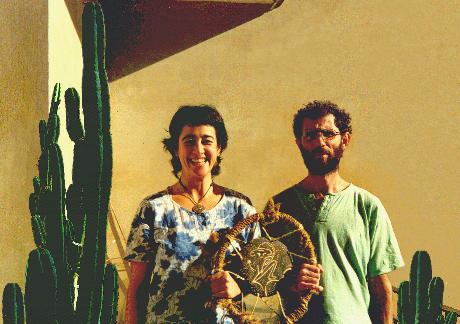
Interview With Juanjo Piñeiro in ULISES No. 3
(La Liebre de Marzo, 2000)
ULISES: We would like you to tell us what led you to do the interviews that make up your latest book: Psiconautas: Exploradores de la conciencia.
JUANJO PIÑEIRO: My partner Ana and I were traveling through Mexico, and we began recording conversations and interviews to distribute as audio over the Internet. We wanted to share with more people the varied encounters we were having in those lands. While we acquired the knowledge and technology needed to put sound on the Web, we thought that a book might serve to make known the ideas, experiences, and discoveries of people as interesting as the ones we had interviewed.
In my first two books—En busca de las plantas sagradas (In Search of the Sacred Plants, Gaia) and El despertar del Hongo (The Awakening of the Mushroom, Grijalbo)—I had already given a voice to shamans, and now it seemed interesting to give one to psychonauts, so we selected the interviews recorded at the Entheobotanical Meeting in Palenque, some from Mexico City and Puebla, and rounded out the book with a few others done by email and in Barcelona. We put the book together with the idea of making the psychonautic world known in people’s own voices, not only to those already interested in psychoactive substances but to those who are curious about exploring consciousness, art, spirituality, human evolution, new technologies, and so on.
It is a little hard for me to explain the origin of Psiconautas, because the book was really born before the idea of putting it together.
ULISES: Could you briefly tell us what you would highlight about each of the eleven people interviewed in your book: the points in common, the differences you have seen among them, and so on?
JP: Psiconautas is a polyphony in different keys. Its interest lies precisely in the variety of registers of people who, sharing one subject—psychoactive substances—approach it from as many different points of view as there are voices. While listening to the tapes, Ana and I realized the variety and richness of our community, something that perhaps not even psychonauts themselves are aware of. The writer and psychonaut Juan Carlos Usó stresses in the preface the practical nature of the information gathered in the answers. Throughout the book there are numerous fresh ideas that I am sure will strike most readers, psychonauts or not, as new and refreshing.
The interviewees agree in opposing the prohibition of entheodelics, in asking for more information and research about them, and there is almost total unanimity in considering shamanism a system poorly suited to Western psychonauts. There is also broad agreement on how to take these substances—with good information and preparation, taking care with context, company, dose, and so on—but they differ in explaining why they use them, and in the conclusions of their experiences. At times there is healthy controversy among them, a diversity of opinions, tactics, and interests. I don’t think the book is entirely exhaustive, but Psiconautas shows that entheodelics have to do with practically every field of human life.
To boil down to the extreme the content of far longer interviews: Sasha Shulgin talks to us about MDMA and the new substances he created, and his wife Ann about therapy, sexuality, and the spiritual transformations that psychedelics can catalyze; Richard Yensen agrees as he explains psychedelic therapy to us, and tells us about his apprenticeship with Stanislav Grof, Salvador Roquet, and the famous shaman María Sabina; Jonathan Ott reflects on the tactics of antiprohibitionism and entheogenic self-sufficiency, based, for example, on ayahuasca analogues; Giorgio Samorini describes his initiation in Gabon with iboga—which he considers the hallucinogen of the future—and Christian art with depictions of the psilocybin mushroom; Manuel Torres talks to us about visionary snuffs and the influence of psychedelics on art, both pre-Hispanic and contemporary; Álvaro Estrada remembers María Sabina, whose biography he wrote, and gives his opinion on the adaptation of shamanism to today’s world; Higinio González reviews the sixties in Mexico, comparing them with the entheogenic wave of the nineties, and tells us how he sees the impact of entheogens on human evolution today, an interest he shares with another interviewee: Terence McKenna, who also talks to us about psilocybin and DMT, and presents his Novelty Theory; Quim Tarinas defends home growing and reflects on the Internet; so does Douglas Rushkoff, who also talks to us about cyberdelia, new technologies, memes, and raves.
This summary is unfair for being incomplete, but it may give an idea of the points in common and the differences among the interviews. Each interview is like a piece of a puzzle, and the more voices you listen to, the more of the whole picture you will see. Because the book includes an index of names and substances, you can navigate it the way you navigate the Internet, with each reader following their own interests and intuitions, drawing whatever connections they like among the interviews.
Psiconautas is also a book that offers a good deal of information, with the Internet addresses and bibliography needed by anyone who wants to broaden it and go deeper into the entheodelic world, whether in a theoretical or a practical way.
New World Entheogens and the Planetarization of Substances
ULISES: Your book confirms once again that, if we except Giorgio Samorini’s comments on iboga, almost all the entheogens that appear belong to the New World (although there are now beginning to be some interesting studies on the famous ointments of European witches, and the possibility is raised that Australia is a continent yet to be discovered in this respect).
Do you think this is due to a lack of research on other continents, or has the New World really been naturally blessed with a greater proliferation of entheogens?
JP: Psiconautas doesn’t report only on plant-based entheogens, but on new or old visionary drugs, on the extraction of alkaloids from the sources nature offers us on any continent, and on the different chemical variations built on them.
Speaking of plant-based entheodelics, it is true that in Oceania there is currently great interest in the Acacias found there, because of their high DMT content. Every year more and more psychoactive mushrooms and plants are discovered on every continent, but the Americas—and Mexico in particular—are always at the top of the list. Nobody has really been able to explain why.
In any case, these days such species, wherever they are discovered, begin to be cultivated elsewhere by enthusiasts of entheobotany, and later their active principles are extracted, and their use spreads.
There is a growing planetarization of any substance discovered or created, whether in a Western laboratory, a Mexican mountain range, or at our geographic antipodes.
The Internet and specialized publications play an essential role here. Once something is discovered, its spread, and learning about its possibilities, is only a matter of time.
ULISES: Your book points to the relationship between entheogens and new technologies (the Internet, virtual reality, etc.). What is your view on this?
JP: One possibility is to use these technologies so that fans of these substances can connect with one another and expand or exchange information, experiences, ideas, projects, and so on. Seeds or legal compounds, which are more numerous than people think, are also sold in virtual smart shops. Another possibility is the one seen by people like Terence McKenna: to experience states similar to those reached with chemical catalysts, thanks to new technologies, or even to create or mutate into conscious beings without bodies, living in cyberspace, or traveling through the universe in nanotechnological ships.
To be honest with you, having seen what I have seen on my travels—war, economic and moral misery, fundamentalism of every kind, the subjugation of women, clitoridectomies, brutal dictatorships, and so on and so on—I feel a bit ashamed to talk about these things, although I imagine some of it will happen in the future. We will have to learn to live with these new possibilities, doing whatever is in our hands for the betterment of humanity and of the Earth as a global system, and not viewing them as an escape from our privileged position in a deeply unjust society. Still, I find simplistic attacks on the undeniable advances of science and technology absurd and sterile; it seems more effective to me to fight to make sure their benefits reach everyone, and to reduce their negative impact by making people understand the need for a respectful use of the whole ecological system. There are no easy solutions, and we cannot turn back; we can only correct course. In my opinion, entheodelics, science, and new technologies neither carry in themselves the solution to all our problems nor will they carry our doom. What happens tomorrow or the day after will depend on us, on the power of greater awareness, on the spiritual development of the human being, especially the Western one. These new tools, combined, can be evolutionary or involutionary instruments, or, most likely, both at once. The future is open.
The Legacy of the Sixties and Entheodelia Today
ULISES: Throughout your book there are interesting reflections on the possible mistakes of the 1960s with regard to entheogens and the need to learn from them now. Could you expand on that a bit?
JP: In the book, people who lived through those years, and who are better qualified than I am to take stock, give their opinions. In my generation we sometimes think it was a mistake to take psychedelics out into the streets en masse, but we also don’t know whether sooner or later they would have been banned anyway, and we would have missed the influence that this whole alternative culture had on the dominant one. We received a culture already steeped—for better and for worse—in those years. Perhaps today we have neither enough information nor the necessary perspective to take stock. There are still many untold or badly told stories. Perhaps in the sixties a cycle opened that has not yet concluded.
In any case, we are more prudent now, and less enthusiastic about the revolutionary possibilities of psychedelics: we don’t think of them as panaceas for all our problems, but we recognize their enormous potential and the achievements of earlier generations, which, for that matter, included all kinds of people and positions. Today there is again a large sector of psychonauts who prefer to learn to know and use these substances better, rather than devoting themselves militantly to promoting them; they choose to be discreet—though not timid—rather than taking them to the streets and trying to convince the uninitiated to use them. Even people like Timothy Leary at first thought it was better to be reserved, à la Huxley. It seems it was the Beat poet Allen Ginsberg who convinced him to start the psychedelic revolution. Others went from proselytizing to discretion, or from the university to the ashram, or from classical socialism and anarchism to the psychedelic party. There were all kinds of combinations. There were also those who understood that a society cannot be changed from top to bottom overnight, and who set up a tactic of infiltrating the dominant system, affecting mostly culture and the media. These people had and have a discreet but notable success. It is less spectacular, but the achievements are more lasting, because they permeate a culture transmitted through supposedly official channels, reaching even children.
I hope Storming Heaven, by Jay Stevens, a rather illuminating book about those years, appears in Spanish; many tendencies and tactical variants were already tried then, and it is interesting to know their effects today, even though circumstances are different. To understand the present situation, several books by Douglas Rushkoff will soon be available in our language, and his interview serves as an introduction to his work.
Here, the protagonists have not written much about the origins and experiences of psychedelia in the 1970s. Surely we could learn from everything they lived through, from its lights and its shadows. Because of the baneful presence of Francoism—from which I believe we have still not recovered—our case is quite particular, with the isolated exception of Ibiza, or perhaps Barcelona.
As for the present, the pace is now more measured, after the push of the sixties. Perhaps the wave that begins—or continues—in the nineties is slower, but it may have greater reach and scale in the long run. We know more now, and there are already irreversible achievements: some of them we owe to the generation of the sixties, now so vilified or so idealized, which, I insist, was varied and complex. At least they tried, but it was the first time—how could they not make mistakes?
Multiple Uses and the Future of the Entheogenic Universe
ULISES: Although there seem to be hopeful signs in studies of entheogens at present, don’t you think the subject still has an excessively medical orientation, leaving aside other possibilities such as recreation or artistic and spiritual exploration?
JP: Perhaps if you pay attention to certain publications or conferences you can get that impression, but reality is much richer. I don’t think there is a single direction in the real world. You have to try to have eyes and ears for everything that happens, not just for what is published in certain more or less official outlets.
I know quite a few artists who take on the creative possibilities of the states induced by entheodelics, usually with results worked out and materialized after the trip. There are a multitude of people making recreational, spiritual, or knowledge-seeking use of them, if those uses can be separated at all. A single experience—especially if it is powerful and lasts many hours—can let you explore sexuality or open yourself to the energy of love; contemplate a landscape, a painting, or a photograph in a new way; hear music, dance, or move in another state of consciousness; heal on an emotional and vital level; gain some intellectual, creative, or ecological understanding or insight into your past, some glimpse of the future or the mystical; it can become, in short, a transformative, deeply spiritual journey, whether through the impact of the experience itself or through the later integration into everyday life; let us remember that the real journey—life—continues between one experience and the next.
Psychedelic substances have so many possibilities that anyone who wants to limit them to just one is doomed to fail, just like anyone who wants to prevent—by banning them—other human beings from experimenting with them.
One day you may feel like one type of experience, and another day another, varying the context, the company, the entheodelic, or the dose. It seems to me that most of us alternate the different uses, sometimes whether we want to or not, because the substances are often unpredictable. They often surprise you, and that is one of the interesting things about them.
ULISES: Finally, we would like to know how you see the future of the entheogenic universe.
JP: Multiple, varied, diverse, unwritten: life offers almost infinite variations. We will have to learn to live with and enjoy the new possibilities opened by new discoveries in every field of human knowledge, without seeking security in the old way; perhaps we will come to glimpse or experience something we cannot doubt, but I can’t make bigger predictions: I’m not a futurologist, nor do I think anyone can be; there is human freedom, many variables, and unknown factors. We can only see the current trends and try to make out something of what the future holds for us. I am very curious to see how events unfold, the open and ongoing processes, whether a deep and elevated harmony will gradually flower from within or from out of apparent chaos.
In the entheodelic world, there will undoubtedly be more substances at our disposal, more information, greater interconnection among psychonauts, and we will be leaving the ghetto; this cycle opened in the sixties may end with legalization and normalization. That could have a key impact on individual and collective transformation, which are, besides, inseparable, as will be seen. With or without entheodelics, in the near future we will seek out more suitable environments to live in, and we will keep learning more about our own consciousness, trying to know a little more about it and about its relationship with our body and our life. Various multimodels will emerge, using Western models such as Grof’s or Wilber’s, Eastern ones such as Sri Aurobindo’s or Gopi Krishna’s, syntheses that are not a mere amalgam. From what I see, basic intuitions about humanity à la Teilhard de Chardin are gaining ever more currency, especially when one takes a long-range perspective.
A challenge for our world is to integrate wisdom and compassion, in the Buddhist sense of the term. Part of humanity has to solve basic problems; those of us who, whether we like it or not, are privileged, I hope will learn to be truly supportive, finding a point of effective action between charity and looking the other way. In these circles I miss a reminder of something elementary before tripping on spiritual science fiction: the hungry have to eat, even if they must later face our problems. Not all of us live in California, or in the nice neighborhoods of Madrid or Barcelona. As for those hungry in spirit, perhaps we will manage to find a dynamic, transformative method based on an integrated fusion of diverse ways of exploring consciousness, the body, and the energy of the universe, starting from and within our life experience, learning to affect our surroundings positively. The interaction of entheodelics and the body/consciousness pairing may make the direct experience of mystery and spirit accessible to thousands of Westerners eager for a concrete, real experience, beyond words. Spiritual experiences that reach the cells of our body and the world around us will perhaps be the fundamental ones.
However, before we talk about the evolution of our species, in my opinion elementary problems will have to be solved and the change in the cultural and vital vision of human beings now under way will have to be completed: a new vision based on a noncontradictory integration of matter and spirit, of science, art, and spirituality, of body and consciousness, of mind and heart, of woman and man; a transformative symbiosis of wisdom and compassion, of humanity, the plant and animal kingdoms, nature, and technology.
We don’t know what situation the girls and boys being born now will find when they come of age. Future psychonauts will perhaps be better prepared than we are to explore the immense world of human consciousness, and to succeed in building a society and a world better than the one we live in today.