

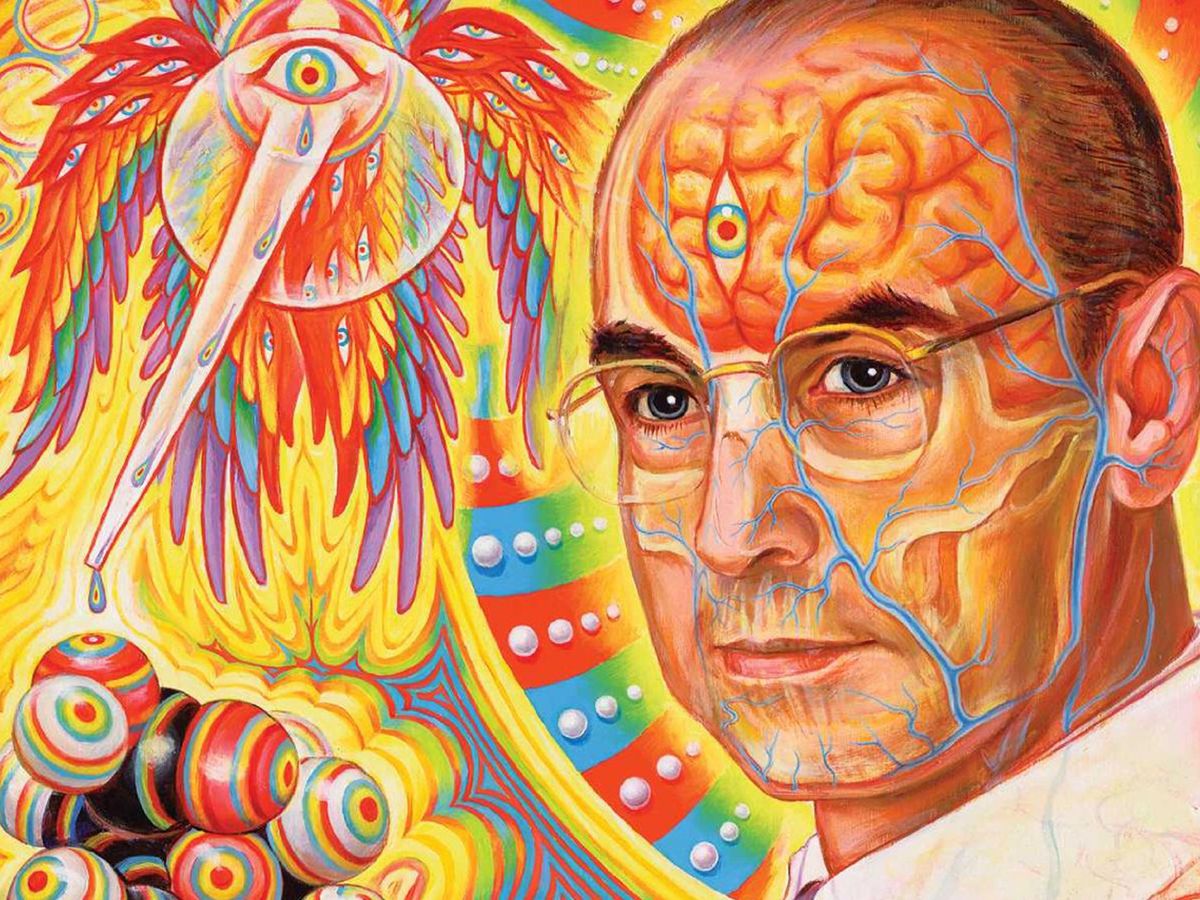
The chemist who wasn’t satisfied with chemistry
The name Albert Hofmann (1906–2008) will forever be linked to a compound he synthesized in the Sandoz laboratories in 1938, the effects of which he did not discover until 1943. That story, repeated to the point of cliché, often eclipses what truly makes the man interesting: a unique way of understanding his own profession. For Hofmann, chemistry was not just an accounting of atoms and bonds, but a realm of reactions, affinities, and transformations that he described in almost sensory terms.
Contrasting with the coldness he often attributed to physics, he defended an image of matter as something active, almost alive. This intuition—debatable, to be sure—linked him to a certain unorthodox materialism, closer to wonder than to reductionism. It is best taken for what it is: a personal sensibility, not a proven scientific thesis.
Consciousness, that elusive enigma
One of the threads running through Hofmann’s later thought is his perplexity regarding consciousness. It is the most intimate and everyday thing we possess and, at the same time, the most difficult to define. We can describe and measure objects, cells, or chemical reactions, but subjective experience—the fact that something “feels” like something from the inside—resists any attempt at complete objectification.
This difficulty is not just a psychonautical curiosity: in the philosophy of mind, it is known as the “hard problem of consciousness,” and it remains unresolved. For Hofmann, psychedelic experiences were a way to peer into that mystery, though a warning is necessary here: an intense experience of perceptual alteration is not the same as an explanation. Feeling that one understands something and actually understanding it are not the same, and a good portion of enthusiastic literature confuses the two.
Entheogens, Eleusis, and a critique of modernity
The term “entheogen”—which alludes to the divine awakening within—is used to designate substances and plants present in numerous cultures, from the Eleusinian Mysteries in ancient Greece to ritual practices in the Americas. Hofmann, along with scholars like Gordon Wasson and Carl Ruck, speculated that a psychoactive beverage may have been at the center of those Greek rites. It is a suggestive and frequently cited hypothesis, but it remains unproven; it deserves to be presented as a conjecture, not as an established fact.
Against this backdrop, Hofmann articulated a critique of modern civilization that still resonates: our estrangement from nature, ecological degradation, and the suspicion that an hypertrophied ego isolates us from the world. In response, he evoked the serenity in the face of death that, according to ancient sources, the mysteries offered. It is a spiritual perspective that is legitimate as testimony, though it idealizes a past that we only know in fragments.
The “world mind” and the limits of ideas
In his more metaphysical reflections, Hofmann toyed with the notion of a “world mind”: the idea that the extreme visions appearing in both psychedelic states and accounts like the intermediate state of Tibetan Buddhism are not mere individual projections, but something shared, animated by consciousness. It is a poetic speculation, related to old idealist traditions, and it should be read as such: as a fertile metaphor, not as a literal description of the cosmos.
The value of Hofmann’s legacy likely does not lie in these worldviews—which are difficult to sustain outside of personal faith—but in the questions he opens: what relationship do we want with nature, what place do we give the ego, and how far can science go when faced with the subjective?
Critical reading
Hofmann often mixed two planes: that of the rigorous chemist and that of the mystical thinker. Separating them helps to read him with honesty. His contributions to chemistry are historical; his ideas on consciousness and the “world mind” are philosophy and personal experience, valuable as testimony but lacking scientific status.
It is also worth remembering that a fascination with a substance does not make it harmless. LSD and other psychedelics can precipitate psychological crises, aggravate underlying vulnerabilities, and prove especially problematic for people with psychiatric histories. Furthermore, their use is regulated in most countries. This text is cultural and historical information, not an invitation to consume: if someone is experiencing psychological distress, the sensible path is to seek professional support, not answers in the internal laboratory.