

More than three millennia of ritual use
Few psychoactive plants can boast a history as long as that of the San Pedro. Andean iconography associates it with shamanic practices dating back more than three thousand years, and when the Spanish conquistadors arrived in Peru, its curative and magical-religious use was already deeply rooted. Far from disappearing, this tradition has survived colonization and today has spread far beyond its original area, integrating into psychedelic tourism circuits that should be viewed with a certain degree of skepticism.
The Christian name—San Pedro, “the one who holds the keys to heaven”—is a classic example of syncretism: a Catholic layer over pre-Columbian knowledge. That blend is part of its appeal, but it also serves as a reminder that the plant always arrives wrapped in stories, and that separating fact from myth is part of the work of any honest analysis.
What the cactus is like
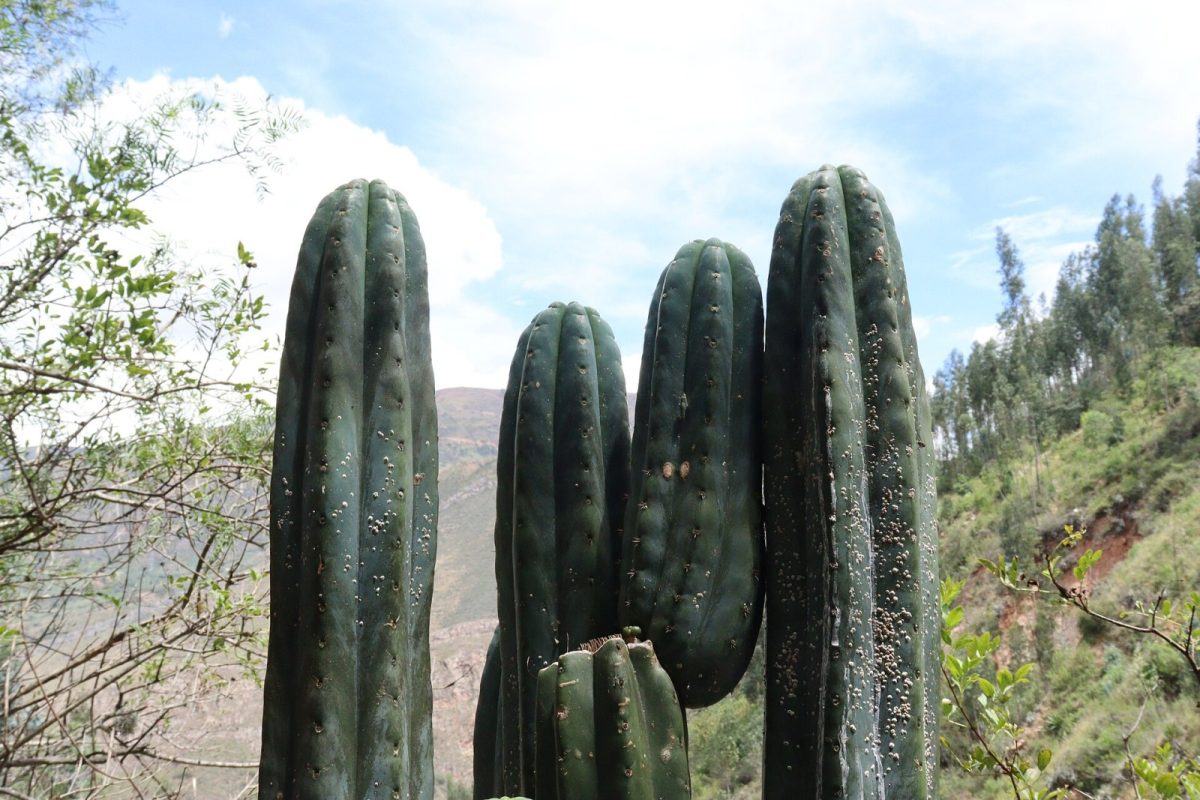
Trichocereus pachanoi is a columnar cactus with a characteristic blue-green color and rapid growth. It can reach several meters in height and, over the years, branch out to take on a candelabra shape. Its stems usually have between four and eight ribs; shamans have traditionally prized four-ribbed specimens, to which they attribute symbolic value linked to the cardinal points.
It grows wild and is cultivated in Ecuador, Peru, Bolivia, and northern Argentina, both in coastal areas and deep within the Andean mountain range. It is a hardy plant, capable of withstanding cold and drought better than many other cacti, which partly explains why it has easily acclimated to gardens and nurseries around the world.
Chemistry: mescaline, but how much?
The main alkaloid in San Pedro is mescaline, a psychedelic phenethylamine. Alongside it appear other related substances, such as hordenine or anhalonidine. But the most important piece of data for a critical reading is this: the concentration is enormously variable. Analyses published over the decades have yielded figures ranging from tiny percentages to values several times higher, meaning two identical-looking cacti can differ greatly in potency.
This variability depends on the species or variety (Trichocereus peruvianus is often cited as more potent, though also with inconsistent results), the age of the plant, the growing conditions, and the part being analyzed: the inner white pith contains practically no alkaloids. For the reader, the practical conclusion is not a recipe, but a warning: speaking of the “mescaline content of San Pedro” as if it were a fixed figure is misleading. That unpredictability is, precisely, one of the greatest risks associated with the plant.
An ornamental plant that is easy to grow
As an ornamental cactus, San Pedro is easy to grow and famous for its rapid growth, which can be around 8 to 12 inches (20 to 30 cm) per year in established specimens. It is propagated both by seed—which has slow germination and a modest success rate—and, above all, by cuttings, a method with which it roots easily. It prefers specific substrates for cacti, moderate watering that respects rest periods, and plenty of light; it also appreciates protection from excess humidity, which rots the roots.
It is worth emphasizing that possessing and growing the live plant as an ornamental is one thing, and extracting or concentrating its alkaloids is quite another from a legal and risk-based perspective. Here, we deliberately stick to the botany.
From ritual to decoction: how it has been used
In traditional Andean use, the green tissue of the cactus has been consumed fresh or dried, often in the form of a prolonged decoction that results in a very bitter drink, within ceremonies guided by a maestro or curandero. These sessions combine singing, rhythm, auxiliary plants, and a symbolic framework that structures the experience: context matters as much as the substance.
We are not going to detail quantities, recipes, or preparation methods: that is not the goal of Psiconáutica, nor would it be responsible. What is relevant to understanding the plant is that these are long experiences—lasting many hours—that are physically demanding and highly dependent on the state of mind and the environment of the person experiencing them.
Effects: “the hangover precedes the drunkenness”
The popular saying summarizes the experience with mescaline cacti well. The first phase, in the hours following ingestion, is usually unpleasant: nausea, vomiting, dizziness, sweating, palpitations, digestive discomfort, tremors, and an alternation between heat and cold. It is not uncommon for intense anxiety to appear, or even a distressing sensation of being close to death.
Once that phase is overcome, many describe a contemplative state of calm euphoria, sensory intensification, synesthesia, and, in some cases, visions—which not everyone experiences. Mescaline tends to produce a feeling of profound meaning and unity with the environment; Aldous Huxley left one of his most famous descriptions in The Doors of Perception. But that same erasure of habitual reference points can be experienced as unreality, nonsense, or panic, especially in inappropriate contexts.
An ambiguous legality in Spain
Here it is convenient to distinguish two levels. Mescaline, as a substance, is controlled, and its possession or extraction is illegal. The live cactus, on the other hand, has been sold for years as an ornamental plant in nurseries and garden centers, which creates a notable legal gray area: the same plant can be legal in a pot and problematic as soon as its purpose is interpreted.
That ambiguity has produced unedifying situations, such as police interventions in shops that marketed these cacti, while the same specimens sold under their scientific name in conventional garden centers went unnoticed. The result is considerable legal uncertainty, where labeling and context weigh more than the botany itself. Anyone approaching this plant should keep in mind that the legal boundary is not marked by the cactus, but by the use attributed to it.
Critical reading and harm reduction
Some ideas to contextualize the information above with a clear head:
- Unpredictable potency. Due to chemical variability, there is no reliable way to know “how much” mescaline a specific specimen contains without laboratory analysis. This makes any homemade estimation a blind bet.
- Real physical risk. The initial phase of discomfort and palpitations makes its use especially inadvisable for people with cardiovascular problems. Interactions with medications—particularly antidepressants and other serotonergic drugs or MAOIs—can be dangerous.
- Psychological risk. Psychedelic states can destabilize people with psychiatric histories or those in fragile life moments. The “bad trip” is not a myth.
- Commercial mythology. Shamanic tourism and the ethnobotanical market tend to romanticize the plant. It is best to be wary of promises of healing and stories that confuse tradition with safety.
- Legal framework. Before making any decision, remember that mescaline is a controlled substance and that the gray area of the cactus does not equate to impunity.
Regarding sources: this text summarizes data and descriptions collected over decades in the ethnobotanical and psychoactive culture literature in Spanish. For a first-hand reading on the phenomenology of mescaline, The Doors of Perception by Aldous Huxley remains a reference; in the ethnopharmacological field, the encyclopedic work of Christian Rätsch offers a broad overview, although it should also be read with a critical spirit.