

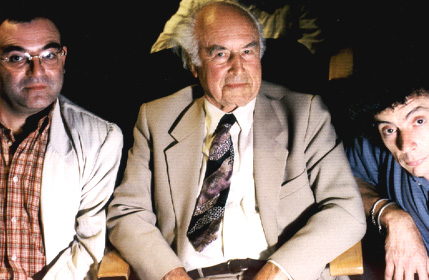
On June 27 and 28, the II Conference on Entheogens (hallucinogens) was held in Barcelona. The most endearing star of the event was the universal Dr. Albert Hofmann, the chemist who discovered LSD-25, the drug that revolutionized the Western world, our art, our way of understanding life and death, our social relationships…
I don’t think it is necessary to elaborate on this substance, ingested casually by Dr. Hofmann in April 1943, which turned out to be the chemical key that gave birth to Pop art, the interest in Eastern philosophies, and a set of other elements that today form the deepest foundation of our world and our idiosyncrasy. Albert Hofmann is 91 years old, but he doesn’t look it at all. He is elastic in his movements and jovial until any hour of the night, without a cane, glasses, or other artificial aids. He loves red wine and claims that drinking a glass every night extends one’s life by two years; he knows how to treat others with exquisite respect, and he is attracted to beautiful women and an intense life. He hasn’t taken LSD in more than twenty years (“Why? LSD already gave me everything it could give me; I don’t need to take more,” he replies when we discuss it), and his gaze is firm, inquisitive, and ironic toward everything around him. He is one of the few people I know who, when looking at you, does so directly; he is totally present and knows how to listen—a virtue, unfortunately, on the decline! He is also spontaneously careful and weighs each of his actions. He reminds me of the Swiss peasants from his home country, where he has lived his entire life: strong, healthy, cheerful, and at the same time attentive, perceptive, and direct-eyed.
What follows is a summary of a long chat between friends, on a Sunday afternoon, after a tasty paella prepared with love.
Josep Mª Fericgla: Albert, is there any question you would have liked to be asked that no one has ever posed to you?
Albert Hofmann: (He thinks for a second and responds with confidence): Yes! Why I studied chemistry. No one has ever asked me that.
J.Mª F.: Well, then… why did you become a chemist?
A.H.: I studied chemistry because it was a strange thing. It is surprising that when I was 19, I was studying literature, history, art… that was what I liked! I asked myself, “What is the material world? What is the science of the material world?” It was for that philosophical reason that I studied chemistry. My former philosophy teacher often repeated that I should do something in this field, which surprised me then because I knew nothing about chemistry—I had done my high school studies in Latin! I only knew that it was the science of the material world, and this is a true mystery, but it is something that… had to be valid, because the material world exists and we cannot change it just by discussing opinions. In literature or art, there are always different ideas, but the material world is strict; it is rigid. This was the reason I studied chemistry. Of course, I must also tell you that without that strange idea, I would never have discovered LSD, and when that happened, the mystery I had in my mind at 19 reappeared. I was always asking myself, “Why did you end up studying chemistry?” And now I think that was probably my destiny; I had to discover LSD, but for that, I needed to study chemistry…
Matter, Spirit, and Consciousness
J.Mª F.: There are chemists who argue that human beings are nothing more than a complex bag of chemicals. Do you think that too?
A.H.: No, no!! Our body is. That is chemistry, of course. We all contain the same elements: carbon, hydrogen, oxygen, nitrogen… that is why we are part of the material Universe. We are an individual part of that material Universe, and as conscious beings, we are an individual part of Universal Consciousness. That is my way of seeing it. Everything in the universe has a material part and a spiritual one, everything! The spiritual Universe could not exist without the material, and vice versa.
J.Mª F.: That is something defended by almost all religions, but the problem is not the duality, but how or where the conjunction between spirit and matter is found.
A.H.: You are right. I can show you exactly where it is: in the centers of the brain. For example, look at visual experiences. What are they? How can we see something? For that, there must be something outside, an object. But then we can only see it if there is light. Light is energy, electromagnetic waves that penetrate our eye. Then, these waves produce a nervous image in the eye, and from there, the optic nerve sends them to the centers of the brain. We know this entire geography of the brain perfectly. But then something happens: from this energetic event—that is, material—vision is produced, and vision is something spiritual; it is not material. Nothing more can be explained about this. Seeing is seeing, and it is not material. We could not see without matter, without energy, but this energy would not produce any image without the spiritual world. Seeing is something absolutely spiritual. Natural sciences cannot provide any explanation for this. We always have an external impulse, perhaps chemical if we eat something, and this chemistry inside me produces an impulse that reaches the brain, and my mind says, “sweet, sweet…” Thus, this entire connection between the material and spiritual worlds happens in our brain, in the centers of the brain. Up to that point, we can trace the energetic waves coming from the outside… but there the spiritual world begins because, for example, sound does not exist outside; there, only vibrations of air exist. Sound, as we perceive it, is spiritual; the same goes for flavors and images.
J.Mª F.: I have read these arguments in your last book, Inner World, Outer World, but I would like to know your opinion beyond that. This boundary between the material and the spiritual, how do you conceive it translated into the life-death phenomenon?
A.H.: I like this question; it is interesting! Both the material and spiritual worlds come from the same origin. Matter is basically chaos, then a spiritual force arrives that, so to speak, produces a very intelligent chemistry and organizes the material elements to form all living organisms. In the same principle, there is a spark of life that we cannot explain, which is located in the seed, in the fertilized cell. It is like a cell of Universal Consciousness. There is something mysterious: consciousness. It is what builds a living being out of dead matter. It is the force of life, the same one that creates a plant, a flower, or a human being… everything. When we die, this element of consciousness disappears. We can no longer see or hear… all these functions that are directed by the life force no longer occur. Our body returns to the form from which it originated—water, carbon…—it returns to Universal Consciousness. It ceases to be an individualized part of this Universal Consciousness and becomes part of the universal material world, the elements. It is evident to the natural sciences that although we cannot explain why these things happen, if there is no energy, if this creative force that originates plants and higher beings is not present, everything returns to the base elements, to chaos. We can call this creative force God or creative Spirit, or whatever one wants; it is a mystical force that uses the material world to manifest its spirituality. I would dare to say that the material world is the representation, like the image, of the spiritual world.
J.Mª F.: If you don’t mind, let’s change the subject. After all the recent history, have you ever regretted having discovered and publicized LSD-25?
A.H.: No, never! I was trying to prepare a medicine and I discovered the effects of LSD, this substance that has a spiritual effect. It cannot be anything bad! It was not my intention to discover it either. Let’s say it must have been the idea of some generous spirit. I cannot feel regret at all; in any case, it should be life that feels regret. You must do what depends on you, and probably everything that will happen later is already planned.
J.Mª F.: You seem very deterministic with that statement, Albert. To speak of your old acquaintance C.G. Jung, perhaps he would say that our actions are mostly determined by the unconscious, which is the one that plans. What do you think of that? Do you share the rejection of the idea of the existence of a human unconscious, as some positivist scientists do?
A.H.: I have a fairly clear opinion on that. I don’t understand how one can deny the unconscious; it is so obvious! We have dreams, memories that we have forgotten and then recover again—that is also what LSD is for. All of that is unconscious. Right now, I am conscious of this moment, but I cannot be conscious of everything that happened to me yesterday or the day before. When we are healthy, consciousness is always here and now; the rest is unconscious. It is as if we record images on a video tape and then we can play them over and over. Whatever it was happened only once, but you cannot say that the video does not exist.
Entheogens, Visions, and Culture
J.Mª F.: Do you think that every entheogen generates similar images in every person who consumes it?
A.H.: It is an inner experience, in the unconscious. But that does not mean it is always the same. I didn’t always see flowers or psychedelic shapes when taking LSD. I had very, very diverse experiences. Some strange and others very close to daily consciousness.
J.Mª F.: Ayahuasca is the center of the symbolic culture of the indigenous world in the Amazon. Once, I conducted an experiment offering LSD to a remote indigenous Amazonian shaman with no contact with 1960s California, and he said he saw flowers and colorful skies—images that never appear with ayahuasca and that he was unfamiliar with. What chemical possibilities are there that this imagery, which seems to come from the unconscious, comes “inserted” in LSD?
A.H.: I don’t know, but there is something curious about this connection. When I experimented with hallucinogenic mushrooms for the first time, I had obtained them to analyze them, but I wanted to test the effect before starting the research in the laboratory. So I chewed those dried mushrooms and had a very strange experience. Everything changed and acquired an Indian character: the colors, the figures, my room had changed. I had never been to Mexico, but I had the feeling that it must be like ancient Mexico. One of my colleagues who was there to supervise while I ingested the mushrooms approached. He is a blond man, but I saw him as an Aztec priest. I had read about those priests, and the atmosphere and the room were truly typically Indian. It is said that these images are typical of psilocybin. There, I do see a connection between Indian art and the visions they have with mescaline or psilocybin. The same thing happened to me as in my experience with María Sabina. She asked me what I had seen, and I replied that I had seen images that were difficult to describe. Later, we took a tour visiting old churches from the first Christianization of Mexico, built by Indian workers. Upon entering, I saw represented what had appeared to me in the psilocybin mushroom visions. It has always been said that Mexican art has been heavily influenced by this type of vision.
J.Mª F.: Given the enormity of your personal experiences and the important role you have played in current culture, what would you recommend to young people, in general?
A.H.: In the prologue of my book on LSD, I described a vision of an experience I had as a child that was repeated under the effects of LSD. This means that we can have spontaneous visionary experiences; they are natural. The possibility is inside the human being, even if these substances help to provoke it. That is why, at first, I was surprised that one could provoke these experiences with chemical substances. But I would tell young people: try to open your eyes, try to look—just look! There are those who say it is dangerous, but that is because they look and think with words. And the important thing is to see without thinking, so you can think afterward. Seeing and thinking! You cannot do both at the same time. At the entrance to an old Swiss city, it is written: “Open your eyes.” It means that you should try to see what is real and not think that this is the sky, or a tree, or a cloud. No. Look at the tree without thinking. Look at all the living things that are not made by human beings. Just look at them; that is what I tell young people. Afterward, and if one wants to, of course, one can provoke the images with the help of substances, but first, one must look. I had a discussion with Leary because he gave entheogens to young people, and I told them that before trying to see more, they simply had to see. You don’t have to disturb them with too many thoughts. It is important that young people go out into the forests, into Nature… and look! That is what we should teach in schools, in addition to thinking and naming. One ends up thinking about the names of things and not about the things themselves. With writers, the same thing happens: there are those who express themselves in abstract terms and others who try to describe the images, and that is important because many of us think in images. Abstract thinking is very difficult for me; I could not think the way lawyers or philosophers do.
Psychotherapy, Health, and the Future
J.Mª F.: Nietzsche said that the last century was the century of salvation, people oriented their lives toward it, but that the present century would be that of healing, people would seek to heal themselves, and it seems he was right. What would you suggest to current psychotherapists?
A.H.: I think psychotherapy is on the right track. Transpersonal psychotherapy is coming more and more, and when it is done well—something very few know how to do yet—it means that instead of looking inside and analyzing everything, one must try to open up to the outside. Transpersonal means that you don’t just look at yourself, but you look outward. Here lies the future of LSD; it helps to look and to see outward. I’ll tell you an example: the son of a friend of mine was a medical student and was not feeling psychologically well. He continued with his usual work but started having problems, seeing things in the room, and he couldn’t sleep. He went to a psychiatrist who did tests looking for what his problem was, then they sent him to me. I asked him, and he told me, but he couldn’t say exactly what problem he was suffering from. The situation is that he was 20 years old, and in Switzerland, at that age, you have to do Military Service. My friend asked me if he could send his son in that state. I replied that yes, he should do it! There, they woke him up at 5 in the morning; he always had to scrub. Two months later, he returned with his problems cured. It is not always good to look inside; one must force oneself to look outside. An activity with a concrete goal and meaning is the best cure for psychic problems. You have to look outward so that the ego comes out and is in communion with the outside world. Looking inside drives you crazy; it makes people egocentric and foolish. Goethe said that the only way to get rid of psychic suffering is to find an activity directed by a goal.
J.Mª F.: This seems quite contrary to what Freud proposed.
A.H.: I think Freud was not a good man, no, not at all.
J.Mª F.: We are happy to see you, at over 90 years old, in this physical and mental state. In confidence, and if you want to explain it to me, what is your secret?
A.H.: Ha, ha, ha…! It’s that I have my eyes open. Many things come in from the outside, and I forget about myself, and I feel that life is beautiful. That is the most important thing. I am not a health fanatic, but I have a meta-sense of what is good for my body. When I was 50, I had pain in my arm and went to the doctor. I discovered that hanging by my feet upside down was very good because of its anti-gravity effect, and since then, I do it every day. I cannot swallow anything if I don’t chew it a lot; that way, you also enjoy the food more while it is in your mouth. Many people swallow too quickly, and people work the same way they eat. I eat slowly, I work slowly… I am a lazy man! But the important thing to be well is the spiritual world. Before, I also ran through the forest; I liked it very much, and when I was young, I practiced several sports. Now I walk quite a bit.
J.Mª F.: How does a person like you, who remembers when the first car arrived in the city of Basel and has lived through the transformation of the world, imagine the future?
A.H.: The near future will be a terrible time with an incredible crisis. But we can look at history, at previous crises, and we see that life is much stronger than things. We will survive, but we will have to go through very, very bad times. Now we are trying to destroy Nature, but before we can destroy it, we will have finished ourselves off. Also, on a social level, it is disastrous; even in Switzerland, there are very poor people and very rich people. The capitalist system is terrible. We have to learn to change things; we must be in harmony with Nature. The source of life is not in what we human beings do, but in Nature, and we are part of it. People will return to the countryside, as in the old days, and will live in small towns. The problems of cities with millions of inhabitants living in a dead environment will disappear. I think that, deep down, I have a positive image because we know what must be done to be happy. We know it, even if we don’t do it. But in the end, there is no other choice; we will have to do it.