

One name, several distinct things
Few botanical labels are as misunderstood as “blue lotus.” Anyone typing it into a search engine will find, in roughly equal measure, panels from Hergé’s comics, photographs of aquatic flowers, Egyptian frescoes, and dubious-looking powders sold as “x25 extract.” Behind that amalgam are three things that should be separated before proceeding: a work of fiction, a plant, and a legend of effects.
The first is The Blue Lotus (Le Lotus bleu), the fifth album of The Adventures of Tintin, serialized by the Belgian cartoonist Hergé between 1934 and 1935 in the supplement Le Petit Vingtième. Its plot—the search for an antidote and the backdrop of the opium trade in China—takes place largely in an opium den that gives the story its title. It is a relevant cultural fact, but it is worth clarifying immediately: that “blue lotus” is a fictional establishment, not a plant. The coincidence of the name with the Egyptian water lily is a purely linguistic accident.
The plant: Nymphaea caerulea
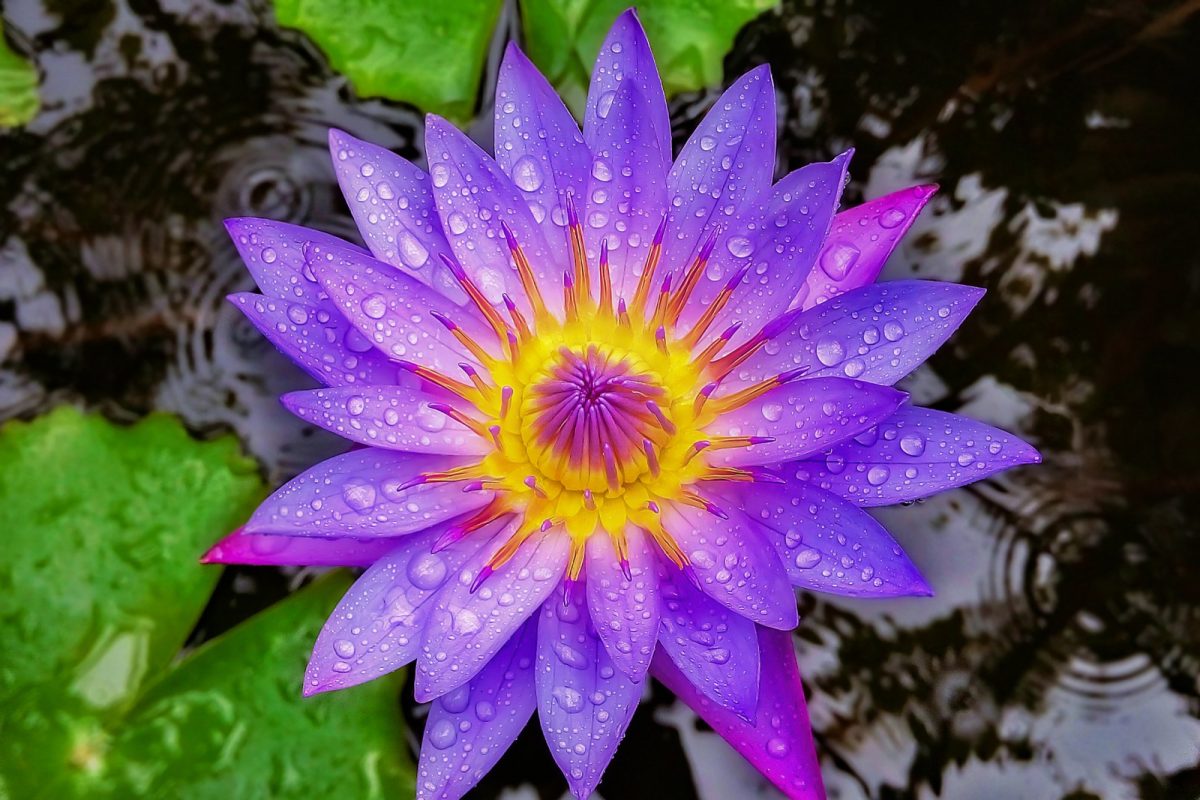
Nymphaea caerulea—the “Egyptian lotus,” “blue water lily,” or “blue lotus”—is an aquatic plant of the Nymphaeaceae family. Despite its common name, it is botanically not a true lotus: lotuses of the Nelumbo genus belong to a different family. Its original range is located in the Nile and other areas of East Africa, and since antiquity, it has spread to Thailand and the Indian subcontinent. Its leaves are broad and rounded, and its flowers, about 10–15 cm (4–6 inches), open with the daylight and close at dusk.
That daily cycle explains much of its symbolic weight. In ancient Egypt, the flower that emerges each morning from the dark water was associated with renewal and rebirth. In the cosmogony of the Hermopolitan Ogdoad, it is linked to the emergence of the sun god Ra, and the plant is associated with the figure of Nefertum. It appears recurrently in banquet paintings, funerary scenes, and ritual objects, to the point that its presence in Egyptian art is difficult to overstate. Hence, also, its historical use in perfumery and aromatics.
Its relative: the sacred lotus Nelumbo nucifera
The other regular protagonist in this story is Nelumbo nucifera, the sacred lotus of Asia, a central plant in Hindu and Buddhist imagery. Although it shares a certain aesthetic and part of its chemical profile with the blue water lily, it belongs to a different group. Both plants contain aporphine-type alkaloids—nuciferine and apomorphine/aporphine and related compounds are commonly cited—and their supposed action on the nervous system is attributed to these active principles.
It is precisely this chemical kinship that has fueled the lotus’s candidacy as the famous fruit of the lotus-eaters in The Odyssey, the food that, according to Homer, made those who tasted it never want to return. The image is powerful and ancient, but it should be read for what it is: a literary motif, not a pharmacological report.
What does the evidence actually say?
This is where the popular narrative gets ahead of the data. In forums and shops, it is repeated that the blue lotus is “psychoactive,” inducing mild euphoria, sedation, or perceptual changes, and specific gram dosages are even cited. It is advisable to treat these claims with caution for several reasons:
- The identification with “soma” or ancient ritual psychotropics is a hypothesis, not a fact. There are works that reinterpret Egyptian and Mayan iconography by proposing an entheogenic use of the lotus, but these are debated readings within Egyptology and ethnobotany, not settled consensuses.
- The pharmacology of nuciferine and related compounds is poorly characterized in humans. Much of what is claimed comes from preclinical studies or extrapolations, not from robust trials on subjective effects and dosages.
- Personal testimonials are highly contradictory. In repositories like Erowid, accounts of “somatic ecstasy,” opioid-like sedation, and a total absence of effect coexist. That dispersion is exactly what one would expect when a product has a weak effect, variable composition, and a strong component of expectation.
In other words: the cultural footprint of the blue lotus is enormous and well-documented; its psychoactive profile, however, is modest, poorly studied, and often exaggerated by those who market it.
Critical reading and harm reduction
Beyond historical curiosity, there are some points to keep in mind:
- “Natural” does not mean “harmless” or “intense.” The fact that a plant appears in pharaonic tombs says nothing about its safety or what it will do in a specific organism.
- The extract market is opaque. The advertised concentrations (“x25,” “x50”) are rarely verified, and the actual composition of a powder sold as lotus may not correspond to the label.
- Interactions matter. Mixing any substance with a sedative effect with alcohol, opioids, or other central nervous system depressants multiplies risks, no matter how mild each element may seem separately.
- Be wary of the magic number. When a source states with certainty that “X grams produce such an effect,” it is usually relaying an anecdote as if it were clinical data.
The blue lotus is a good example of how a symbol charged with poetry—water, sun, rebirth, Homeric oblivion—ends up being turned into a commercial claim. It is worth preserving the cultural fascination while maintaining skepticism about promises of effects. The flower the Egyptians painted and the one advertised as a “mild entheogen” share a name, but not the same weight of evidence.


