
A mushroom, many myths
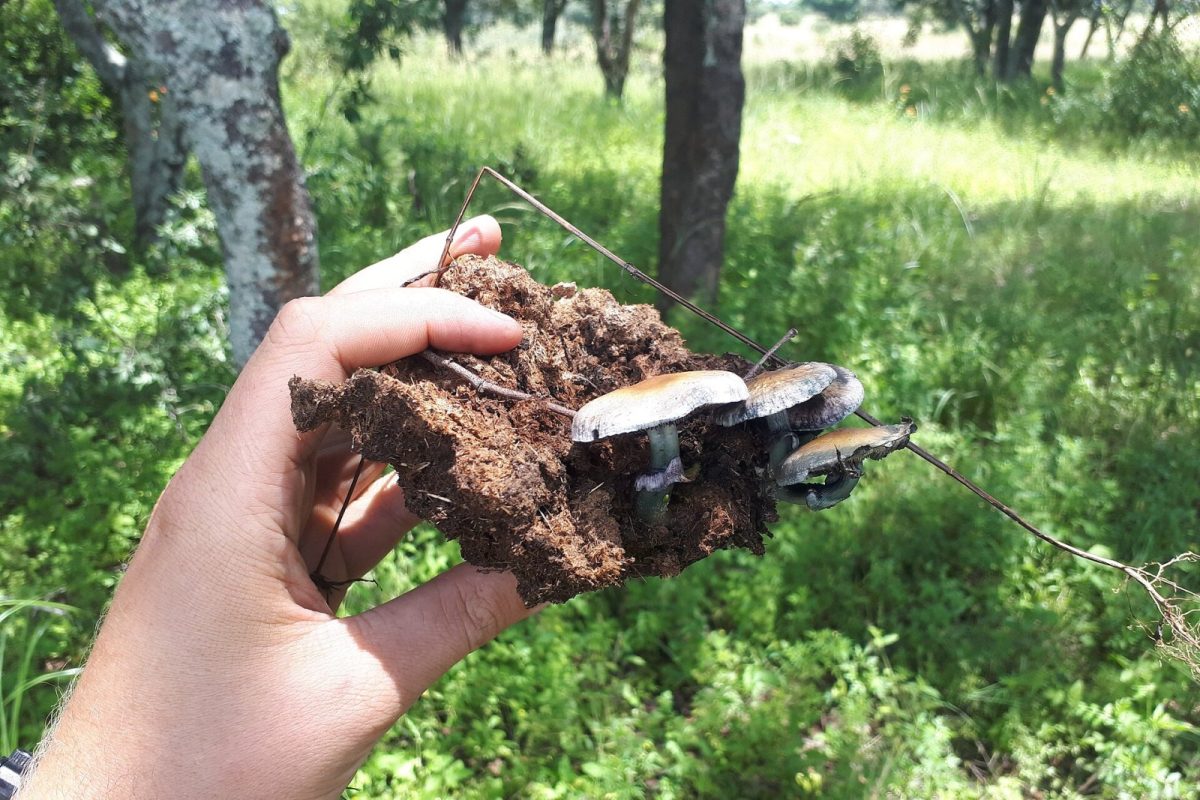
Psilocybe cubensis is likely the best-known psilocybin species in the world, not because it is the most potent, but because of the ease with which it colonizes grain-based substrates and the abundance of amateur guides that have circulated since the 1970s. This popularity has generated a curious mix of solid biological information and home recipes passed from hand to hand, with data repeated without verification.
At Psiconáutica, we are interested in the phenomenon rather than the procedure. Understanding how the organism works and what it actually entails to manipulate it helps one read that ecosystem of manuals, forums, and videos with a critical eye, rather than taking them at face value.
How the fungus really lives
What we call a “mushroom” is only the fruiting body: the visible and ephemeral part of a much larger organism. The true structure is the mycelium, a network of white filaments that colonizes the substrate and upon which growth and reproduction depend. When people talk about “growing mushrooms,” they are actually talking about keeping a mycelium healthy long enough for it to decide to fruit.
The fungus feeds on starch-rich plant substrates—traditionally grains like brown rice—and the mycelium can take several weeks to colonize them completely. Fruiting responds to environmental changes: a drop in temperature, increased humidity, and the presence of light and fresh air. At its core, it is an organism that reacts to environmental cues, not a predictable machine.
There are numerous varieties of cubensis—Cambodian, B+, Mexican, and others—that differ primarily in temperature ranges and vigor, not in some mystical “quality.” That variability is precisely one of the factors that makes any home result unpredictable.
Why contamination is the real protagonist
If there is one fact that all amateur literature repeats—and which should be taken seriously—it is that the nutrient medium that feeds the fungus is just as attractive to molds and bacteria. Healthy mycelium is a clean white; any other hue indicates colonization by competing organisms.
Herein lies one of the most serious and poorly understood risks: a contaminated culture cannot be “recovered.” Consuming material that has grown alongside unknown molds or bacteria can cause severe poisoning, and the presence of psilocybin does not “disinfect” anything. The line between a home biology experiment and a real health problem is thinner than forums suggest.
The problem of identification
Beyond cultivation, it is worth remembering the risk surrounding any mushroom: species confusion. The genus Psilocybe and other similar ones share physical traits with toxic mushrooms, some of which are potentially lethal. Identification based on photographs or general descriptions is notoriously unreliable, and mistakes in mycology are costly. No guide replaces the judgment of an experienced mycologist.
Legal framework in Spain
This is where many amateur guides go silent. In Spain, psilocybin and psilocin are controlled substances included in international conventions, and the cultivation of mushrooms for the purpose of obtaining these substances is not a legal activity. The sale of spores and kits operates in a commercial gray area, but that does not extend any legality to the final product or the act of cultivating for consumption.
It is best to be wary of messages that present these crops as an innocuous hobby without consequences: the actual legal framework is significantly less friendly than the tone of the tutorials.
What research says (and what it doesn’t)
Psilocybin is experiencing a moment of intense scientific interest. Clinical trials are underway studying its use, always in controlled settings, for treatment-resistant depression, anxiety associated with serious illnesses, and other conditions. It is a promising field, but it is still open: speaking of “medicine” outside of a regulated trial is getting ahead of the evidence.
That research enthusiasm does not equate to an endorsement of home cultivation or self-consumption. Studies work with standardized doses, professional support, and prior screening of participants—precisely what is missing in any improvised home experience.
Critical reading
Cultivation guides circulating on the internet tend to share three biases: they present the process as “easy,” minimize health risks, and omit the legal framework. It is advisable to read them with caution. Some points to keep in mind:
- “It’s easy” is a half-truth. Maintaining the necessary sterility is demanding, and most amateur failures are due to contamination.
- Production figures are indicative and optimistic. Data on yields or equivalencies between fresh and dried material vary enormously and are rarely verified.
- Potency is not stable. Psilocybin content fluctuates between varieties, individual specimens, and even parts of the same mushroom, making any estimation of effect unreliable.
- Real psychological risk. Beyond the physical, these substances can trigger intense reactions, especially in people with a history of or predisposition to psychotic disorders.
Harm reduction
From a harm reduction perspective, honest information is more useful than an enthusiastic manual. If someone decides to learn about this field, it is worth being clear that there is a restrictive legal framework, that the risk of poisoning from contamination or species confusion is real, and that no anonymous internet source is equivalent to the judgment of a healthcare professional or a mycologist. In the event of any discomfort after consuming mushrooms, going to the emergency room is always the correct decision.