

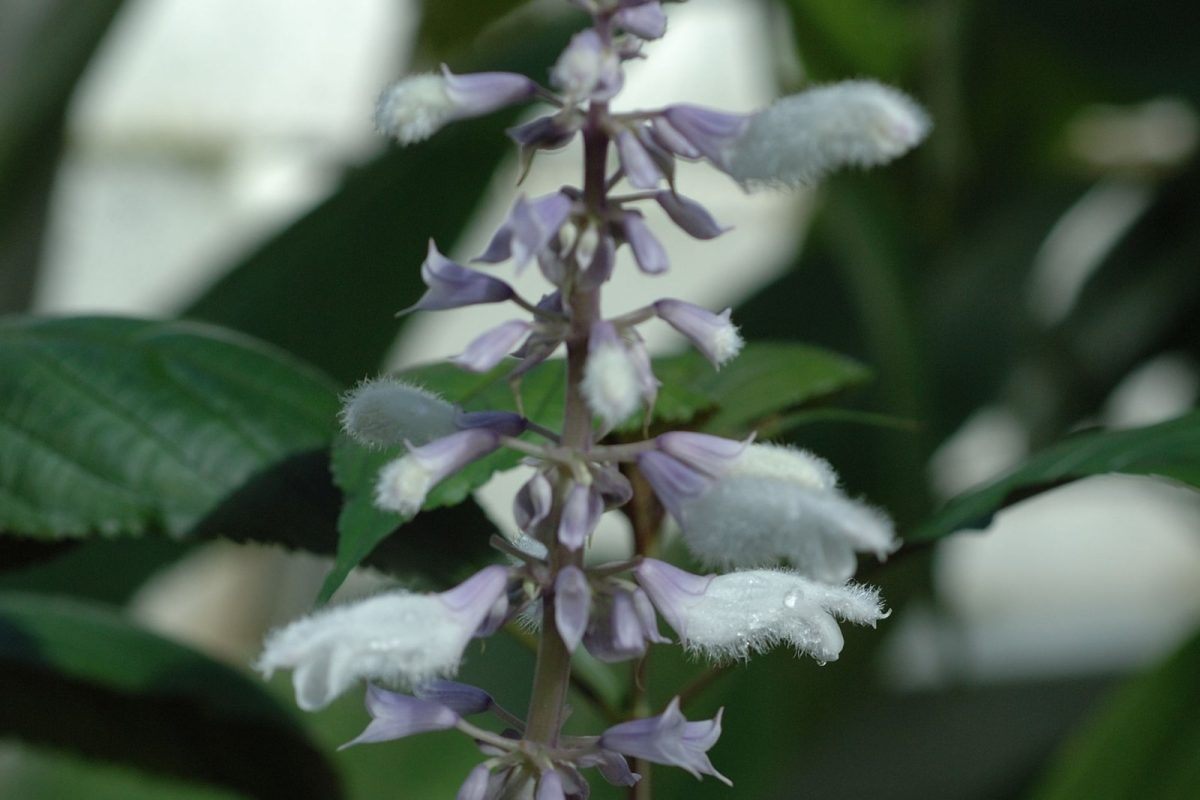
A Botanical Sacrament for Divination
Throughout the rugged Sierra Mazateca of northeastern Oaxaca, Mexico, Salvia divinorum is reverently referred to as ska pastora (“herb of the shepherdess”) or “leaves of the Virgin.” It constitutes an essential component of the sacred botanical pharmacopeia that Mazatec curanderos—most famously Maria Sabina—have cultivated for generations. Ethnographic accounts document that salvia was historically utilized as a sacramental alternative during the dry season, when psilocybin mushrooms were unavailable in the wild.
This historical role as a ritual substitute reveals much about how the plant was traditional understood: not as a recreational intoxicant, but as a specialized spiritual diagnostic tool within a strict ceremonial framework, guided by experienced healers. Severing the plant from this ceremonial context—as occurred following its modern dissemination throughout the West—radically transforms the character of the experience.
Salvinorin A: A Pharmacological Anomaly
The chemical compound responsible for the plant’s visionary effects, salvinorin A, was isolated in the early 1980s. It proved extraordinarily active at minute thresholds measured in fractions of a milligram, an active microgram potency rivaling LSD. Chemically, it is a remarkably stable neoclerodane diterpene that preserves its potency across years when stored properly.
What sets salvinorin A completely apart is its unique pharmacological mechanism. Classic psychedelics (LSD, psilocibina, mescalina) act primarily as agonists at 5-HT2A serotonin receptors. In contrast, salvinorin A is a potent, highly selective agonist of kappa-opioid receptors (KOR) and completely lacks nitrogen atoms—an unprecedented molecular profile among hallucinogens. This novel mechanism explains why subjects describe the salvia experience as radically distinct from traditional psychedelics: intensely dissociative, abruptly rapid in onset, and exceedingly brief.
Botanical Architecture of the Plant
The plant is a semi-tropical perennial herb reaching up to a meter and a half in height. It features large, delicate ovate leaves and square, hollow, succulent stems characteristic of the mint family (Lamiaceae). While related to other sage species native to Mexico, its distinct leaf profile and vegetative architecture set it apart.
Wild, naturally occurring populations are extraordinarily scarce; it grows primarily under semi-cultivation in humid ravine beds and cloud forests between 750 and 1,500 meters of elevation. Virtually all living plants cultivated outside Mexico are direct cuttings descending from a few clonal strains collected by R. Gordon Wasson and contemporaneous ethnobotanists, resulting in extremely limited genetic diversity within Western collections.
Phenomenology of the Subjective Experience
Subjective trip reports vary drastically: for some, the state is overwhelming and disorienting, while for others it remains subtle. Frequently reported phenomena include profound spatial distortions, shifts in color perception, cascading geometric lattices, intense dream-like immersion, and at high doses, radical dissociation: dissolution of physical body awareness, sensations of fusing with furniture or foliage, temporal paralysis, or encounters with autonomous visionary entities. Peak states frequently involve absolute spatial amnesia.
A notable feature is the brevity and clean resolution of the state: effects typically fade within ten to twenty minutes without a lingering hangover. Ethnobotanist Daniel Siebert developed the well-known S-A-L-V-I-A descriptive rating scale to classify experiences from subtle perceptual shifts to complete loss of consciousness, emphasizing that individual susceptibility varies enormously. The plant demonstrates no physical addiction liability; indeed, most subjects report an intense satiety that discourages repeat administration.
Harm Reduction Guidelines
While comprehensive human toxicological studies remain sparse, no recorded fatal poisonings have been attributed directly to botanical salvia. The primary clinical risk is behavioral rather than physiological: under high-dose dissociation, users may stand, stumble, or thrash about without conscious awareness of their environment, creating acute hazards for falls, physical injury, or accidents.
Consequently, experienced researchers emphasize foundational safety guidelines. Having a sober, alert sitter present is paramount to ensure physical safety during peak dissociation. The plant should never be combined with alcohol or other psychoactive compounds. Experimenting in public or chaotic environments is strongly advised against. As with all mind-altering botanicals, psychological mindset and physical setting (commonly termed set and setting) powerfully govern the outcome. Anyone struggling with severe emotional distress or personal histories of psychotic disorders should strictly avoid kappa-opioid agonists.
An Evolving International Legal Landscape
The regulatory status of Salvia divinorum has tightened significantly worldwide. It is strictly outlawed or classified as a controlled substance across numerous nations and territories—including Australia, Japan, Italy, Belgium, Scandinavia, Germany, and multiple US states—while remaining in unregulated grey areas elsewhere, historically sold under the guise of “aromatic incense.” In Spain, commercial sale for therapeutic purposes is prohibited, though the plant has circulated under ornamental or incense designations. Because botanical regulations change frequently, readers must independently verify current legal frameworks within their local jurisdiction.
Critical Appraisal
A vast proportion of popular literature regarding salvia relies on subjective anecdotal accounts rather than peer-reviewed clinical data. This necessitates critical reserve when evaluating sensationalist reports: high variability makes it challenging to differentiate pharmacological actions from psychological expectation, suggestibility, and setting. Mazatec ethnographic accounts alongside reference texts by Albert Hofmann, Antonio Escohotado, Jonathan Ott, and Daniel Siebert offer rich perspectives, yet blend anthropological history, organic chemistry, and personal phenomenology. In summary: this fascinating botanical presents unique pharmacology that warrants rigorous scientific inquiry and careful respect rather than uncritical hype.


