

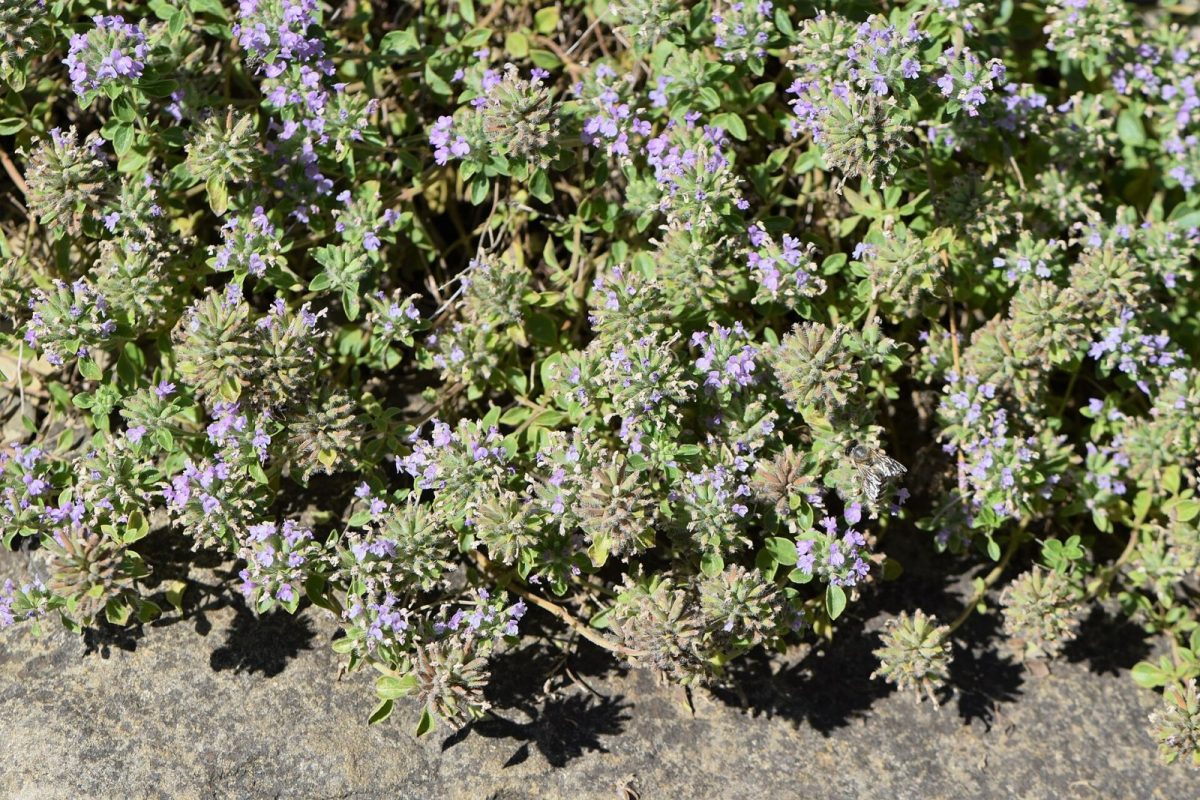
A shrub of the dry slopes
Lagochilus inebrians is a member of the Lamiaceae family, the same botanical group as common mint or Salvia divinorum, though its pharmacological profile bears no resemblance to the latter. It grows wild on the arid, sunny slopes of the steppes stretching from the Caucasus—Georgia, Armenia—to Uzbekistan, Turkmenistan, and parts of Afghanistan and Iran. The Lagochilus genus includes over thirty species, already described by classic ethnobotanists like Richard Evans Schultes.
It is a hardy, undemanding plant: it thrives in rocky, well-drained soils and tolerates both drought and some humidity, but it does not tolerate shade. Its roots anchor firmly into the stony ground, to the point that pulling it up by hand is practically impossible. It blooms between June and August with pink or white hermaphroditic flowers, which is when it was traditionally harvested.
A tradition of the steppes
Tajik, Tatar, Uzbek, and Turkmen peoples have for generations prepared decoctions using the toasted leaves, often combined with stems, flowers, and fruits. The taste is markedly bitter, so the custom was to sweeten the infusion with sugar or honey. The leaves were collected between late summer and autumn, and drying and storage intensified their fragrance.
For a long time, this plant was almost inaccessible to the Western reader, with barely any references in Spanish-language bibliography. Most of what is known comes from Soviet reports translated from Russian, in which scientists of the era described both its chemistry and clinical trials. It is worth keeping that origin in mind: these are valuable works, but they were conducted with the methodological criteria of their time and are difficult to verify today with independent studies.
Lagochilin and the plant’s chemistry
In 1945, phytochemistry succeeded in isolating a crystalline, non-alkaloid substance from the plant belonging to the diterpene group: lagochilin, a polyhydric alcohol. According to classic references (Rätsch), it accounts for an average of about 3% of the dry weight of the entire plant, although in dried leaves, the cited figures are much higher. The concentration is said to reach its peak during flowering and fruiting.
Here, one of the great unknowns of the subject arises: it has not been clearly demonstrated that lagochilin is responsible for the sedative effects attributed to the plant. The literature notes this with caution, and the fact that isolated lagochilin and scattered testimonies circulate does not equate to solid proof. It is a good example of how a compound can become “the active principle” through repetitive popularization before evidence confirms it.
Traditional uses and Soviet trials
Turkestan mint was even included in the Russian Pharmacopoeia, where it was credited with sedative, hemostatic (to stop bleeding), and hypotensive properties, in addition to dermatological uses. Tradition and reports also cite antispasmodic, antiallergic, and digestive applications.
Soviet trials, collected in sources such as those by Evans Schultes and Duke, describe experiences in centers like the Samarkand Medical Institute with patients suffering from nervous system disorders, neurotic or epileptic conditions, as well as bleeding problems. The results were reported as mostly favorable. Today, however, those percentages must be read with caution: there is a lack of clear control groups, blinding, and the validation standards we would demand of a current clinical trial. These are indications of historical interest, not definitive confirmations.
“Inebrians,” but more of a sedative
The epithet inebrians—”inebriating”—promises more than the plant seems to deliver. Both tradition and the available descriptions point to an effect primarily of relaxation and mild sedation, far from any psychedelic state or intense intoxication. It is, in essence, a bitter tranquilizing infusion, not a visionary substance.
Critical reading and harm reduction
Beyond ethnobotanical curiosity, it is advisable to properly contextualize this plant:
- Limited evidence. Almost everything published depends on old sources from a single geographic and political origin. There is no foundation of independent studies that other sedative plants possess.
- Hypotensive effects. It is credited with the ability to lower blood pressure. Anyone who already has low blood pressure, takes hypotensive or sedative medication, or suffers from cardiovascular pathologies would have plenty of reasons to stay away and, in any case, consult with a healthcare professional first.
- Unknown interactions. Combining sedative plants with alcohol, anxiolytics, or other central nervous system depressants is always a bad idea, and here the margin of information is especially scarce.
- Conservation of the species. In the wild, the plant is threatened in Central Asia, where its collection is restricted, although it does not appear on CITES convention lists. Any botanical interest should be directed exclusively to cultivated material, never to wild specimens.
Botanically, Turkestan mint is as legal as any other mint: it can be grown and marketed as a plant, and its use or sale for medicinal purposes would be subject to the corresponding regulations. That does not make it harmless or well-studied.
Conclusion: a rarity rather than a remedy
Turkestan mint is a fascinating piece of Central Asian ethnobotany: a plant of the steppes that Soviet science studied with interest and that tradition used as a sedative for centuries. But, with the information available, it remains more of a historical curiosity than a tranquilizer of proven efficacy. Like so many “mysterious” plants, its appeal is sustained as much by how little we know as by what is yet to be studied with rigor.


