

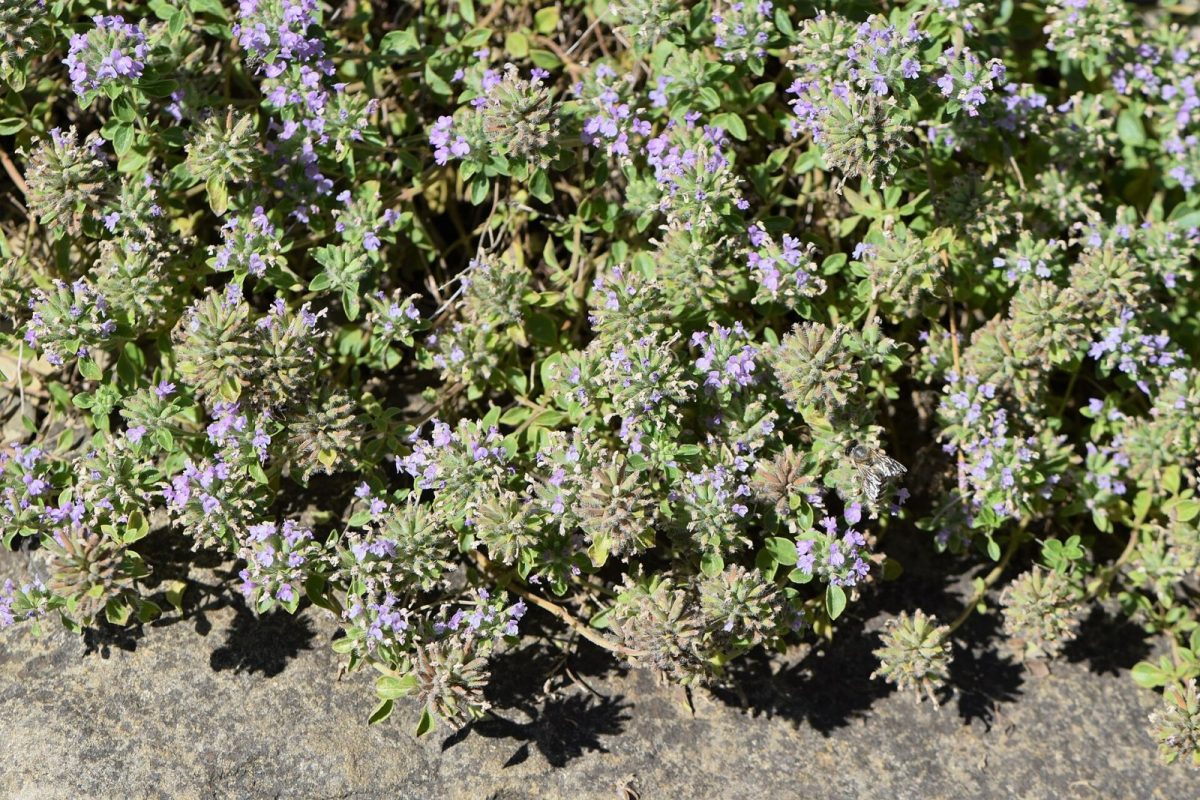
A Shrub of the Arid Slopes
Lagochilus inebrians is a member of the mint family (Lamiaceae), sharing botanical kinship with common culinary mints as well as Salvia divinorum, though its pharmacological profile bears no resemblance to the latter. It grows wild across the dry, sun-drenched slopes and steppes stretching from the Caucasus—Georgia and Armenia—through Uzbekistan, Turkmenistan, and parts of Afghanistan and Iran. The genus Lagochilus encompasses more than thirty species, documented by pioneering ethnobotanists such as Richard Evans Schultes.
The plant is hardy and remarkably resilient: it thrives in rocky, well-drained soils, tolerates drought alongside seasonal moisture, and cannot endure shade. Its deep root systems anchor so firmly into stony ground that pulling the plant up by hand is nearly impossible. It blooms between June and August with pale pink or white hermaphroditic flowers, which is the period when harvesters traditionally collected it.
Steppe Traditions
For generations, Tajik, Tatar, Uzbek, and Turkmen peoples brewed decoctions using the toasted leaves, frequently combined with stems, blossoms, and seed heads. Because the resulting infusion is intensely bitter, it was customary to sweeten it heavily with honey or sugar. The foliage was gathered from late summer into autumn, as drying and curing enhanced its aromatic qualities.
For decades, Turkestan mint remained virtually unknown to Western readers, absent from both European and American literature. Most available information comes from Soviet reports translated from Russian, in which period scientists outlined both its phytochemistry and clinical trials. This provenance warrants a critical eye: while these studies are historically valuable, they were conducted using methodological standards of their era and remain difficult to corroborate today through independent, modern trials.
Lagochilin and the Plant’s Chemistry
In 1945, phytochemical researchers isolated a crystalline, non-alkaloidal diterpene from the plant: lagochilin, a polyhydric alcohol. According to classical ethnobotanical references (such as Christian Rätsch), it accounts for roughly 3% of the whole plant’s dry weight on average, though dried leaves yield considerably higher concentrations. Lagochilin levels reportedly peak during flowering and fruiting.
Yet an important scientific question remains: there is no definitive proof that lagochilin is solely responsible for the sedative effects attributed to the plant. Scholarly literature approaches the claim cautiously, and isolated compounds paired with anecdotal accounts do not constitute robust clinical evidence. It serves as a textbook example of how a molecule can be labeled “the active ingredient” through scientific inertia long before pharmacological confirmation exists.
Traditional Uses and Soviet Clinical Trials
Turkestan mint eventually gained official recognition in the State Pharmacopoeia of the USSR, where it was credited with sedative, hemostatic (blood-clotting), and hypotensive properties, as well as dermatological applications. Historical accounts and ethnobotanical texts also cite antispasmodic, anti-allergic, and digestive remedies.
Soviet clinical evaluations, documented by researchers like Evans Schultes and James Duke, describe trials at institutions such as the Samarkand Medical Institute involving patients with nervous system disorders, neurotic symptoms, epilepsy, and acute bleeding. Investigators reported largely favorable outcomes. Today, however, these percentages must be approached with scientific skepticism: they lack clear control groups, modern blinding, and the rigorous validation standards required of contemporary clinical medicine. They represent fascinating historical clues rather than clinical proof.
“Inebrians,” but Predominantly Sedative
The botanical epithet inebrians—“intoxicating”—promises far more than the plant appears to deliver. Both folk traditions and pharmacological reports point toward mild relaxation and physical sedation, far removed from any psychedelic state or pronounced inebriation. In essence, it functions as a bitter, calming herbal tea rather than a visionary sacrament.
Critical Perspectives and Harm Reduction
Beyond ethnobotanical curiosity, several practical points should be kept in mind:
- Limited scientific validation. Nearly all published data derives from decades-old research from a single geopolitical source. It lacks the extensive, independent modern literature available for other herbal sedatives.
- Hypotensive action. The plant has been documented to lower blood pressure. Individuals with baseline hypotension, those taking antihypertensive or sedative medications, or anyone with cardiovascular disease should exercise extreme caution and consult a healthcare professional.
- Unknown drug interactions. Combining sedative herbs with alcohol, benzodiazepines, or other central nervous system depressants introduces unpredictable risks, particularly given the lack of contemporary pharmacological data.
- Species conservation. In its native habitat, wild populations are threatened across Central Asia, where commercial harvesting is strictly regulated, even though it does not appear on CITES appendices. Any botanical study or horticulture should rely strictly on cultivated material, never wild-harvested specimens.
Botanically speaking, Turkestan mint is generally unscheduled and legally treated like any other mint: it can be cultivated and traded as an ornamental or botanical specimen, though any medicinal marketing remains subject to regional drug regulations. Legal availability, however, does not make it thoroughly studied or risk-free.
Conclusion: A Curiosity Rather than a Remedy
Turkestan mint remains an intriguing chapter in Central Asian ethnobotany: a steppe shrub examined closely by Soviet science and used by regional cultures as a folk sedative for centuries. Yet based on the evidence at hand, it represents a historical curiosity rather than an established clinical tranquilizer. Like many obscure psychoactive botanicals, its reputation relies as much on what remains unstudied as on what is actually known.


