

A Ceremonial Drink Turned Global Product
In much of Oceania, kava occupies the same social space that wine or beer holds in Europe: it is shared at dusk, seals agreements, and accompanies ceremonies. The plant and the drink go by different names depending on the island—kava in Tonga and Wallis and Futuna, ‘ava in Hawaii, yaqona in Fiji—but the ritual is similar: the ground root is mixed with water, strained, and consumed slowly in a group setting.
Since the late 20th century, this traditional use has migrated to the “natural” supplement market, particularly in the United States, where root extract capsules marketed as tranquilizers and anxiety reducers have proliferated. It is important to keep this dual origin in mind: kava does not arrive in the West as a neutral ethnographic object, but rather within an industry that has incentives to exaggerate its virtues and minimize its risks.
What the Plant Is and Where It Comes From
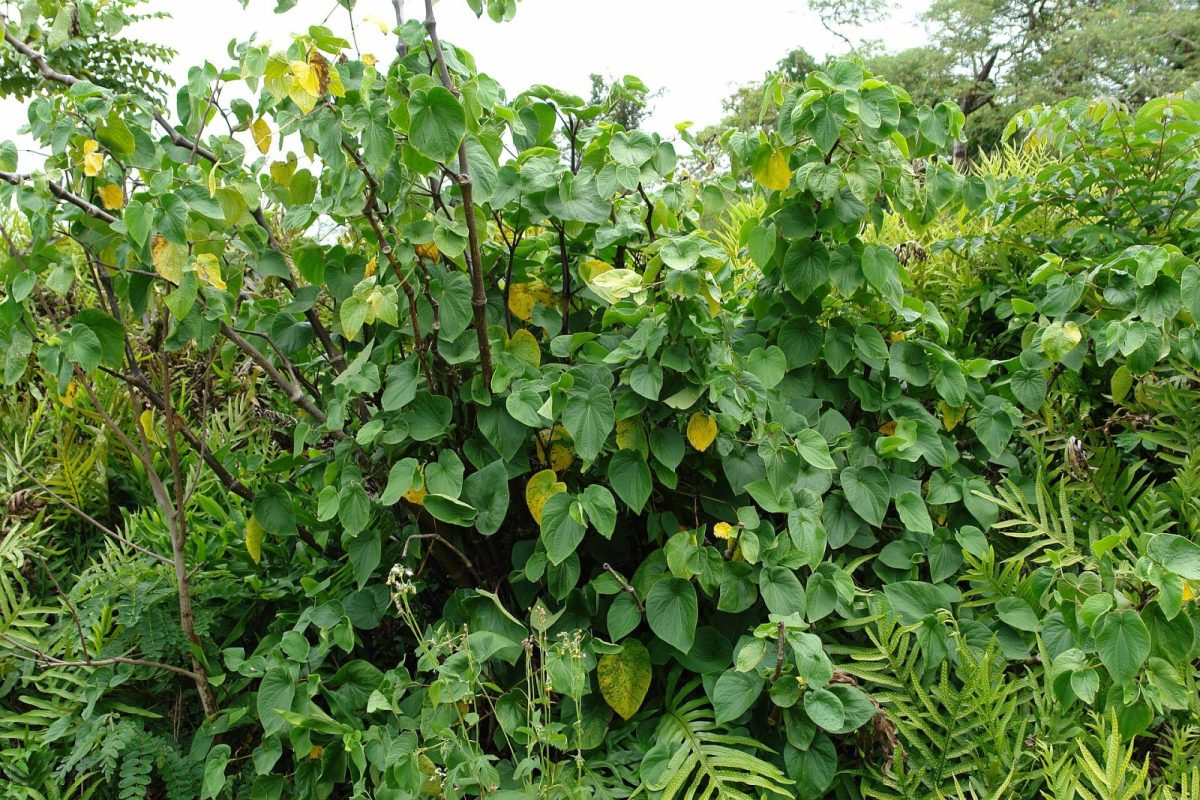
Kava is a shade-loving shrub that only thrives in humid equatorial or subtropical zones. Botanists consider it a cultivated form derived from a wild relative from the islands of Vanuatu, Piper wichmannii. It has been grown on almost all mountainous and volcanic islands in Polynesia and Melanesia—with notable exceptions like New Zealand, Easter Island, or flat coral atolls—and its ceremonial and social consumption dates back about 3,000 years.
It is a demanding plant: it prefers cool highlands, partial shade, protection from the wind, temperate temperatures, and high humidity. It is propagated by cuttings, and its roots take several years to accumulate active principles. In Vanuatu, the primary hub alongside Fiji, regulations only allow the sale of roots from plants of a certain age that have been sun-dried and are free of pesticides, precisely because quality and potency depend heavily on the variety and cultivation management.
Effects: Relaxation Without Hallucinations
In the late 18th century, pharmacologist Louis Lewin described the effect of kava as “a feeling of pleasant nonchalance, placidity, and peace,” characterized by fluid speech and sharpened senses, without the aggression or dullness associated with alcohol. In larger quantities, it produced muscle heaviness, an unsteady gait, and, eventually, deep sleep. This description remains reasonably faithful to the accounts of users and ethnographers.
The typical profile is that of a body relaxant and mild anxiolytic that, in moderate doses, encourages conversation and sociability, and in high doses, induces sedation and sleep. One point on which virtually all sources agree is that kava does not produce hallucinations. The historical confusion that presented it as a visionary substance stems from traditional mixtures with plants of the Datura genus, which are indeed hallucinogenic and, incidentally, much more dangerous.
Popular literature often repeats that kava “does not generate tolerance, hangovers, or withdrawal syndrome.” This is a claim that requires nuance: it stems primarily from ethnographic observation and authors like Lebot, Rätsch, or Escohotado, rather than a broad body of long-term clinical trials. There is serious evidence of its short-term anxiolytic efficacy—a classic German study (Volz and Kieser, 1997) compared it favorably to benzodiazepines for anxiety disorders—but “less addictive potential than a benzodiazepine” is not the same as “harmless.”
Kavalactones: Where the Activity Lies
Kava’s activity is concentrated in a group of resinous compounds called kavalactones (or kavapyrones). About fifteen have been described, but six account for almost all pharmacological activity: kavain, methysticin, desmethoxyyangonin, yangonin, dihydrokavain, and dihydromethysticin. Their proportions vary according to the plant variety and the part used: lateral roots are richer than the central root, and Vanuatu varieties are among the most concentrated.
An interesting detail for understanding why phytotherapy cannot always be reduced to a single molecule: isolated kavalactones do not replicate the effect of the full extract. The experience seems to depend on the combination and its kinetics. Kavain, which is rapidly absorbed, is associated with a more pronounced onset; dihydromethysticin, which is slower, dominates in varieties like tudei (“two days”), so named because its effects are prolonged. Pharmacologically, kavalactones are linked to the GABA system—the main “brake” of the central nervous system—which aligns with their sedative and muscle-relaxant profile.
Cultivation and Its Economic Context
Kava grows best on highland slopes with good drainage, deep soil rich in organic matter, and a slightly acidic pH. The roots are harvested after several years, and the shrub can live for decades. Beyond the agronomic data, there is an asymmetry here that deserves critical attention: cultivation is sustained by Pacific island economies, while a large part of the extract business has historically been concentrated in Western companies. The quality of the product that reaches the European consumer depends on that entire chain, including control over which part of the plant is processed.
The European Liver Controversy
In the early 2000s, several European health agencies ordered the precautionary withdrawal of kava products after reports of hepatotoxicity—including some severe cases—in Germany and Switzerland, mostly in people who were also consuming other substances or medications. This is the most serious episode in kava’s recent history and should not be dismissed as a simple bureaucratic maneuver.
The most cited hypothesis to explain the dissonance between those cases and centuries of apparently safe traditional use points to the raw material: the traditional drink is prepared with the root, while some commercial extracts may have incorporated leaves and stems, where an alkaloid absent in the root—pippermethysticin—has been identified and is suspected of causing liver toxicity. The role of solvents used in industrial extraction, which differ from the water used on the islands, has also been noted. Organizations like the WHO reviewed the matter and considered that traditionally prepared root presents a low risk, without fully closing the debate.
The reasonable conclusion is neither “kava is poison” nor “it was all a misunderstanding,” but rather that the method of preparation, the part of the plant, and, above all, the combination with other substances matter. Regulation has changed country by country over the last two decades, so it is advisable to check the current legal status of kava before taking anything for granted.
Critical Reading and Harm Reduction
This article is educational and does not constitute medical advice or a consumption guide. Even so, there are points that any honest reading of kava should include:
- “Natural” does not mean “harmless.” Kava acts on the central nervous system and can potentiate other depressants. Mixing it with alcohol, benzodiazepines, opioids, or other sedatives is precisely the type of combination associated with the most serious problems.
- Liver and interactions. Given the history of European cases, kava is especially inadvisable when combined with alcohol, hepatotoxic medications, or in people with pre-existing liver issues. It interacts with numerous drugs through hepatic metabolism.
- Sedation and driving. Although island tradition associates it with preserved reflexes, in high amounts, kava causes drowsiness. Driving or operating machinery under its influence is a bad idea.
- Chronic use. Intense and prolonged consumption has been linked to a characteristic dermopathy (dry, scaly skin), loss of appetite and weight, and alterations that usually reverse upon stopping or reducing consumption. It is not the image of a substance “without trade-offs.”
- Sensitive populations. Pregnancy, breastfeeding, minors, and people with liver pathology or those taking psychotropic drugs are clearly outside the scope of any prudent use.
Kava is a good example of a psychoactive substance that Western culture tends to read in extremes—herbal miracle or toxic threat—when the reality is more nuanced: a plant with a long history of social use, real and well-defined effects, and risks that depend heavily on how, how much, and, above all, with what it is consumed.