

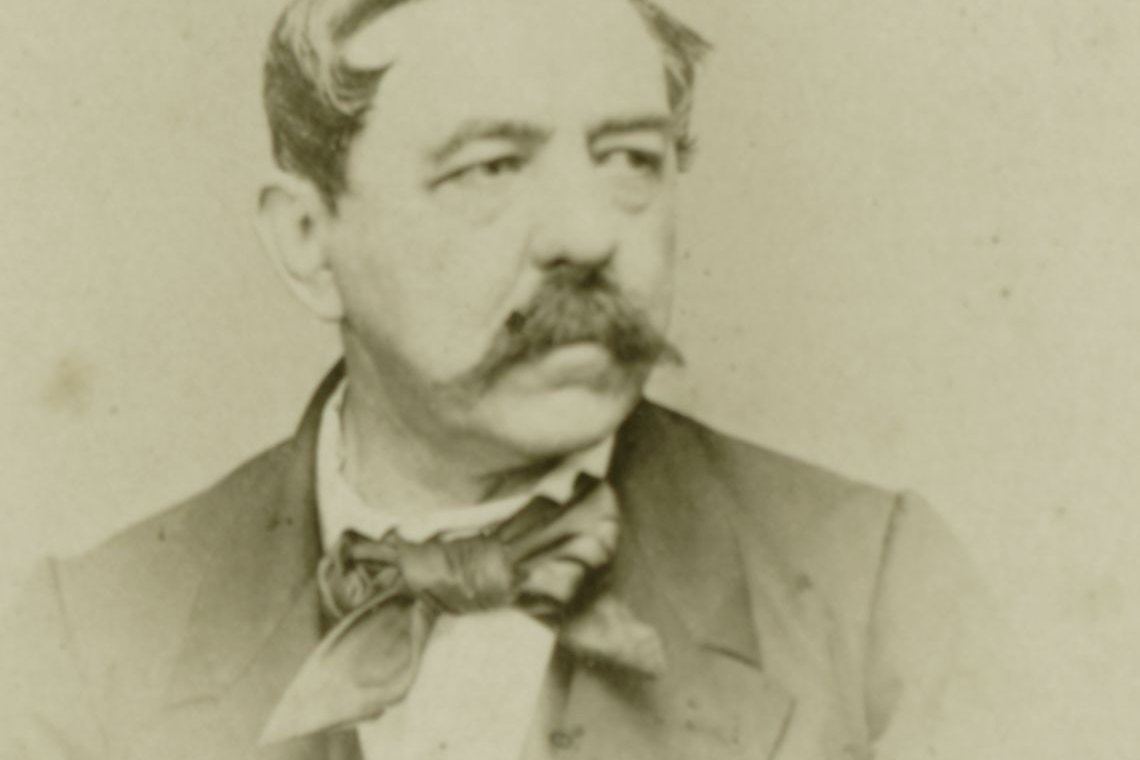
The Man Behind the World’s First Drug Catalog
In previous installments of this series, we made the case for why Ernst von Bibra deserves a prominent place among the early pioneers of modern psychoactive substance research. Now it is time to turn our focus to the man himself: a provincial aristocrat who, in the middle of the nineteenth century, chose to examine through the lens of a chemist what virtually everyone else dismissed as either mere vice or exotic curiosity. His biography explains much of his work, as having substantial personal wealth made possible a life largely free from institutional constraints.
An Aristocratic Franconian Lineage in Decline
Bibra was born on June 9, 1806, at Schwebheim Castle in Bavaria. He hailed from a distinguished Franconian lineage, the Bibra family, whose name still survives across several German towns, as well as a river and a lake. Among his ancestors was Lorenz von Bibra (1459–1519), Prince-Bishop of Würzburg and an advisor to Holy Roman Emperor Maximilian I. Yet one should take such pedigree with a grain of salt: while the surname carried genuine prestige, the family—like so many noble houses—was undergoing a gradual economic decline. Many of its members would eventually emigrate to the United States or Australia toward the end of that century.
His father, Ferdinand Johann Wenzel von Bibra, had fought in the American Revolutionary War under the French general Rochambeau. He married his niece, Lucretia Wilhelmine Caroline von Bibra, and Ernst was their only child. Ferdinand died when Ernst was barely a year old. Responsibility for his upbringing fell to Baron Christoph Franz von Hutten, who raised him in his Würzburg residence, which housed a remarkable private museum. That early exposure to art and collecting would shape Bibra’s character for the rest of his life.
From Law to the Laboratory
At age eighteen, following an uncle’s death, Ernst inherited the municipality of Schwebheim; he also received a share of the castle and the surrounding estate of Willershausen, which he later sold. It is worth remembering that Germany did not yet exist as a unified nation-state—that would only come in 1871—and the region remained a patchwork of principalities and duchies with near-feudal governance. The revenues generated by these properties afforded Bibra something very few researchers of his era enjoyed: total independence to study, write, collect specimens, and travel without answering to anyone.
He graduated at nineteen from the Neuberg boarding school and enrolled at the University of Würzburg to study law, chemistry, and medicine. His interest in law did not last; he soon turned all his attention to the two scientific disciplines. Contemporary accounts portray him as attractive, charismatic, and gifted with notable artistic talent, carrying an unmistakably Romantic aura typical of his era. He is said to have fought in forty-nine honor duels and lived to the age of seventy-two, suggesting he was anything but a clumsy swordsman.
In 1836, he married Josephine Pickel, who came from a middle-class family in Würzburg. A marriage between a nobleman and a commoner was heavily frowned upon at the time, and the decision says a great deal about his unconventional temperament. They had four children, one of whom died in infancy. With a family established, he set up his own chemistry laboratory inside Schwebheim Castle. His first published book focused on medical chemistry—an analysis of pus and other pathological secretions—which was followed, true to his eclectic range of interests, by a five-volume art history documenting the artistic monuments of Germany.
South America, Accolades, and the Groundbreaking Book
In 1846, Bibra relocated to Nuremberg. A year later, alongside Lorenz Geist, he published a landmark study on the occupational illnesses suffered by workers exposed to phosphorus fumes—a pressing public health hazard in the emerging match-making industry—which earned him the Montyon Prize from the French Academy of Sciences. In 1849, he embarked on an extensive journey across South America, walking in the footsteps of the great traveling naturalists of his century. That expedition yielded two major works: Reise in Süd-Amerika (Travels in South America, 1854) and, most notably, Die narkotischen Genussmittel (1855), frequently translated into English as Plant Intoxicants or Narcotic Stimulants.
It is this latter volume that makes Bibra essential reading today. In it, he brought together and compared a vast array of psychoactive substances used across different cultures—coffee, tea, tobacco, opium, hashish, coca, betel nut, and others—seeking to describe their physiological effects and chemical composition from an objective naturalist perspective rather than through moralizing judgment. It is neither a consumption manual nor an ideological defense: it is an inquisitive inventory, occasionally naive by modern standards, yet pioneering in its conviction that these substances could be examined as a coherent human phenomenon worthy of rigorous scientific scrutiny.
The journey also expanded his private museum so substantially that he had to purchase a larger home in 1851. In 1852, he co-founded the Germanisches Nationalmuseum, donating part of his collection and opening his private holdings to anyone who wished to visit, provided they did not disrupt his research; even monarchs like Maximilian II of Bavaria and Frederick William of Prussia came to view it. Honors quickly accumulated: the German National Academy of Sciences Leopoldina inducted him in 1844 under the cognomen “Paracelsus III”; Frederick William of Prussia decorated him for his contributions to the arts and sciences; and Tsar Alexander II presented him with a diamond ring in recognition of his treatise on cereal grains and bread. He was elected to the academies of sciences in Munich and Vienna and served until his death as an editor of the journal Gaea, Natur und Leben. In his later years, he turned his creative energies to fiction, achieving notable popular success as a novelist. He died on June 5, 1878, in Nuremberg, just days shy of his seventy-second birthday.
A Critical Reading
Looking back at Bibra requires two points of caution. The first is to avoid uncritical retrospective enthusiasm: his work remains a historic milestone, but his chemistry and pharmacology are inevitably outdated, and several of his assertions regarding the effects of certain substances mirror the cultural assumptions of his time rather than empirically verified facts. The very challenge of translating his original German title—oscillating between “pleasure drugs” and “narcotic stimulants”—highlights how imprecise scientific vocabulary around psychoactives was back then.
The second point is historical context. A nineteenth-century nobleman’s ability to travel across South America, collect botanical specimens, and publish freely on coca depended entirely on colonial structures and access that bear no resemblance to today’s legal and social landscape. Reassessing these pioneers helps us trace the origins of research into altered states of consciousness, not romanticize drug use or draw contemporary guidelines from texts published over a century and a half ago. As always at Psiconáutica, the focus here is educational and historical; any medical or pharmacological information should always be sought from modern, peer-reviewed sources.
(To be continued)