
A Tree with Two Names and a Long Tradition
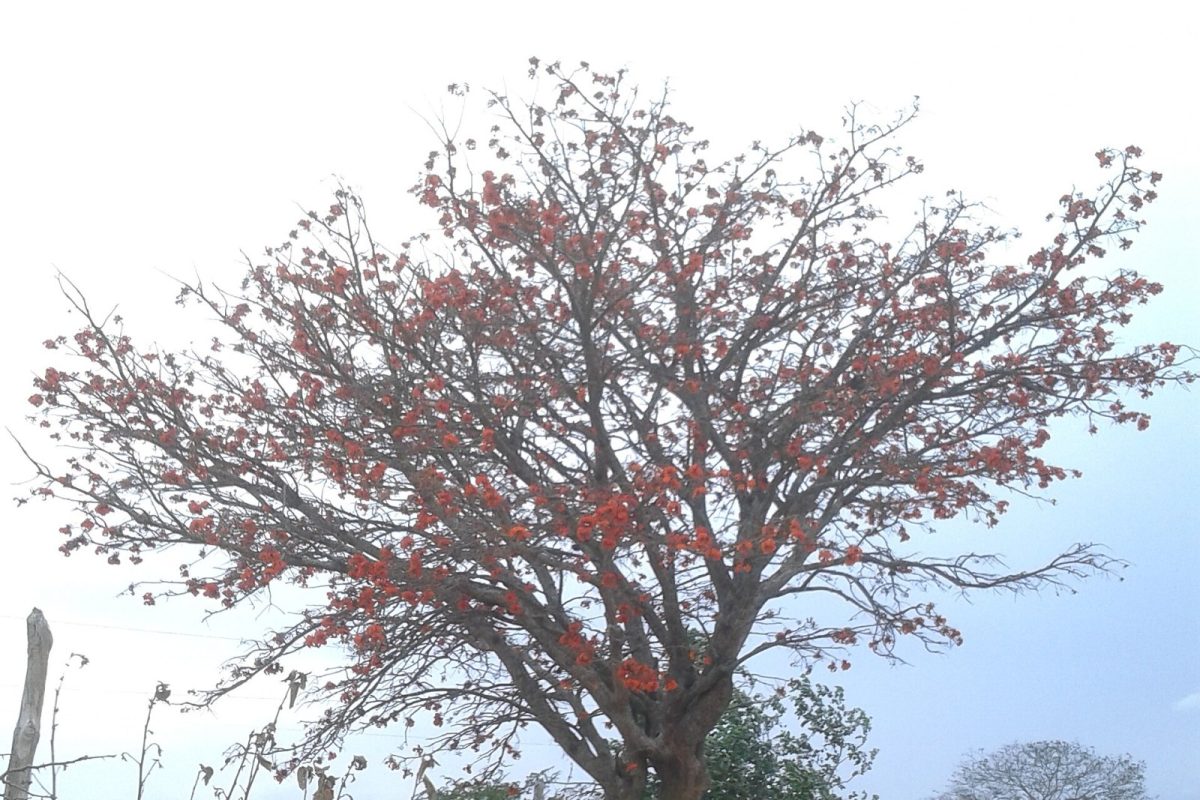
Amazonian peoples have used the tree they call mulungu for centuries. Western botany described it in 1829, and it still exists today under two nearly interchangeable scientific names: Erythrina mulungu and Erythrina verna. It is a medium-sized tree, reaching ten to fourteen meters (33 to 46 feet), also known as the “coral flower” due to the orange hue of its inflorescences. It grows naturally in Brazil, Peru, and tropical areas of Colombia, Bolivia, and northern Argentina.
The Erythrina genus includes more than a hundred species spread across tropical and subtropical regions of both hemispheres. Some are nearly identical in their uses and effects: Erythrina crista-galli, the national flower of Argentina, is used in much the same way in the Southern Cone. Others, such as Erythrina glauca and E. poeppigiana, are cited as ayahuasca additives in the works of Jonathan Ott. This botanical familiarity explains why much of the data on mulungu overlaps with that of its relatives, a fact worth keeping in mind when reading the literature.
Traditional Uses: Mulungu in Ethnomedicine
In Brazilian folk medicine, mulungu functions primarily as a nervous system calmer: it is used to relieve anxiety, insomnia, nervous coughs, and agitation, and to promote restful sleep. The bark is the most commonly used part. Ethnobotanist Christian Rätsch, in his Encyclopedia of Psychoactive Plants, documents its historical use as a mild narcotic and mentions—with notable brevity—that it “contains a narcotic with opiate effects,” a phrase that has gained popularity but should be taken with a grain of salt (we will return to this).
Beyond its sedative role, North and South American herbalism has attributed a wide variety of uses to it, including asthma, bronchitis, liver problems, intermittent fevers, and epilepsy, among others. Some naturopathic therapists have recommended it as a mild hypnotic-sedative for insomnia and to regulate sleep, and it has even been credited with effects on heart palpitations and blood pressure. It is a broad and heterogeneous catalog, typical of plants with a long tradition of use, where the boundary between clinical observation and cultural custom is rarely clear.
Composition: Alkaloids, Flavonoids, and GABA
The phytochemistry of mulungu was studied in some detail starting in the 1990s. Flavonoids, triterpenes, and about twenty isoquinoline alkaloids—such as erysodine, cristamidine, or erycristagallin—have been identified in its bark and roots, in addition to amino acids and GABA (gamma-aminobutyric acid), the brain’s primary inhibitory neurotransmitter, which may partially explain the plant’s calming profile.
This is where one of the most repeated myths appears: that “two of its alkaloids are identical to two opium alkaloids.” This claim circulates without solid backing and should be read with skepticism. Opium alkaloids (morphine, codeine) act on opioid receptors; those of mulungu target GABAergic and cholinergic systems. Calling it an “opiate” is, at best, a journalistic license, and at worst, a pharmacological confusion.
What the Research Actually Says
Scientific interest is concentrated on three fronts:
- Anxiolytic and sedative effect. Several studies in rodents (Onusic, 2002–2003; Vasconcelos, 2003–2004; Ribeiro, 2006) described responses comparable to those of diazepam in anxiety models. These are consistent results, but they are preclinical: measured in animals, not in humans.
- Anti-nicotinic action. Erysodine acted as a competitive antagonist of nicotinic acetylcholine receptors (Decker, 1995; Mansbach, 2000), which has fueled the idea of it being a potential aid for smoking cessation. The hypothesis is interesting; the evidence in humans is nonexistent.
- Possible hepatoprotective effect. This has been mentioned based on studies with rats, but the foundation is fragile and does not allow for clinical conclusions.
The pattern repeats: suggestive findings in the laboratory, but no robust clinical trials to confirm efficacy and safety in people. This does not invalidate the plant, but it does require lowering expectations.
Mulungu as a Kava-Kava “Substitute”: Caution with the Narrative
When kava-kava (Piper methysticum) came under suspicion in Europe due to alleged liver effects, part of the ethnobotanical market began presenting mulungu as its natural replacement: similar calming effects and, on top of that, supposedly liver-protective. It is an attractive commercial argument, but one should be wary of automatic substitutions. Just because two plants “relax” does not make them equivalent in composition or risk profile, and the lack of pharmacovigilance regarding mulungu simply means we know less about its potential problems, not that it doesn’t have any.
Critical Reading and Harm Reduction
Some keys to putting the above into perspective:
- Evidence is primarily animal-based. Comparisons with diazepam come from rat and mouse models; extrapolating these to the human experience is a leap that science has not yet made.
- “Opiate” is a misleading label. Nothing indicates a real opioid action; the mechanism points to GABA and nicotinic receptors.
- Sedation and hypotension. In traditional medicine, it has been used to lower blood pressure, and animal studies describe hypotensive and central nervous system depressant effects. Anyone taking blood pressure medication, who has low blood pressure, or who is combining depressants should exercise extreme caution; the combination of sedatives is never trivial.
- Interactions and pregnancy. There is no reliable safety data for humans, pregnancy, or breastfeeding, nor on interactions with medications. The absence of information is not equivalent to safety.
- Source bias. A good portion of the information on mulungu comes from commercial catalogs of smart shops and ethnobotanical stores, not independent reviews. It is worth reading with that lens.
Educational content written from a harm reduction perspective and with respect for individual freedom. It is not a substitute for advice from a healthcare professional and is not intended to encourage or condemn any drug use. It does not describe preparations, dosages, or consumption patterns: any decision regarding plants with activity on the nervous system should be made with medical information and an awareness of how much is still unknown.