

A Social Utopia Built Around a Sacred Plant
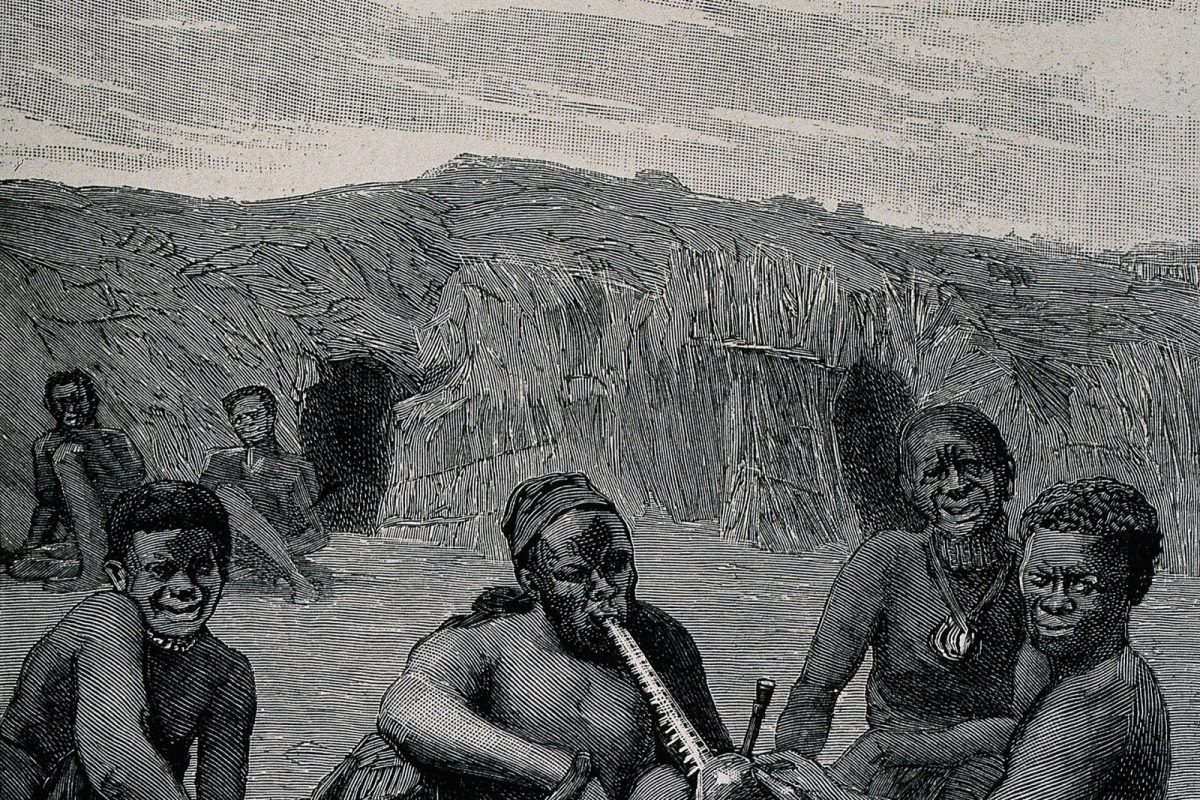
Few chapters in ethnobotany and drug history are as extraordinary as the saga of the Bena-Riamba. Around 1850, in the Lukubu territory of what is today the Democratic Republic of the Congo, a psychoactive botanical transitioned from casual customary use into the organizing axis of an entire civilization: inspiring a novel religion, moral code, and judicial apparatus. This was neither discrete nor occasional consumption. Cannabis was smoked through massive gourds and pipes reaching up to a meter in length, from which owners never parted—carrying them on voyages, hunts, and negotiations.
What originated as intimate circles of smokers bonded by kinship eventually crystallized into an egalitarian communal religion. This historical episode must be examined critically for what it is—a narrative reconstructed primarily from nineteenth-century European colonial accounts and later ethnographic monographs—rather than an impartial chronicle. Below, we examine the complexities and contradictions behind the legend.
How Cannabis Reached the Congo Basin
The precise historical introduction of cannabis into central Africa remains an active archaeological debate. Since smoking was not indigenous to the region, the botanical clearly arrived from external trade routes. Two historical hypotheses predominate. The first credits cultural transmission through nomadic hunter-gatherer interactions with Khoi-Khoi peoples. The second points to Arab-Swahili commercial caravans and slave routes penetrating inland from the East African coast toward Lake Victoria and the Congo river basin.
Most plausibly, cannabis diffused gradually across ethnic networks during hunting expeditions and barter networks, carrying seeds from village to village. The plant flourished under equatorial conditions: abundant equatorial sunshine and fertile tropical soils fostered rapid naturalization.
Kalamba-Mukenge and the Birth of a New Creed
Toward the middle of the nineteenth century, Chief Kalamba-Mukenge of the Baluba (Bashilange) sought to unify fractious rival clans and resist expanding European colonial pressures. According to ethnographic chronicles, he chose an unconventional strategy: establishing a unifying spiritual ethos centered on harmony, inter-tribal peace, and mutual cooperation.
Kalamba and his sister, Sangula Meta, presided over solemn ceremonies in which cannabis—known locally as riamba, meaning “hemp”—served as the central spiritual sacrament. Chroniclers record that the rulers ordered ancestral war fetishes and animist idols burned, replacing traditional rituals with communal consumption of the sacred herb. The old war deities fell, giving birth to the Bena-Riamba: the “Sons of Hemp.”
Their ideology was characterized by communal solidarity and agrarian cooperation. Traveling members carried long smoking pipes rather than spears. A recurring image in historical travelogues describes nocturnal village silence punctuated only by the rhythmic coughing of assembled smokers.
A Moral Code Founded on the Sacred Leaf
The emerging movement aimed to abolish inter-tribal bloodshed. Cannabis was revered as a divine token of peace, brotherhood, magical protection, and communal harmony. The social transformations were profound, according to preserved historical logs:
- Carrying weapons within village boundaries was strictly prohibited.
- The traditional practice of consuming enemy war captives was completely abandoned.
- Fermented palm wine, previously the principal intoxicating beverage, was banned.
- The universal greeting between citizens became “Moio,” signifying “life” and “health.”
Spiritual ceremonies took place after sundown in a central communal clearing termed the riota. Male participants assembled in a wide circle, unclad with shaved heads, sharing ceremonial pipes. They believed the sacrament facilitated spiritual reincarnation and attributed universal protective power to the plant against physical illness and misfortune.
It is vital, however, to acknowledge the dark underside of this communal society: domestic labor was profoundly patriarchal and unequal. While men engaged in spiritual rituals and political council, women bore the crushing burdens of agricultural fieldwork, child-rearing, and household drudgery. The celebrated “brotherhood” of riamba was strictly a male fraternity.
The Account of European Explorers
Much of the preserved historical documentation stems from German explorer Hermann von Wissmann, who documented the society in his 1891 volume My Second Journey Through Equatorial Africa. The primary community was the Bashilange, who referred to cannabis as riamba. Wissmann observed that around 1850, clans locked in chronic inter-tribal warfare began establishing peaceful pacts, cultivating cooperative trade, and codifying laws as the veneration of the plant deepened.
Wissmann encountered extensive agricultural plantations dedicated to hemp surrounding the settlements. Because the Bashilange believed in reincarnation, the arrival of white-skinned European travelers was interpreted as the return of ancestral spirits whose pigmentation had been bleached in purifying ancestral waters. Wissmann was hailed as the reincarnation of a revered deceased monarch, Kassongo, and presented with royal honors.
When the Plant Decreed Justice
Perhaps the most remarkable institutional innovation of the Bashilange was judicial. Capital punishment was abolished, replaced with trials based on cannabis consumption. Individuals accused of theft, treason, or adultery were compelled to smoke potent riamba until they confessed or collapsed unconscious, with required dosages determined by social status.
This judicial ordeal was far from gentle. Once an offender lost consciousness from toxic smoke inhalation, they might be stripped, subjected to burning pepper rubbed into their eyes, and have their nasal septum pierced with red thread as an indelible public brand of guilt. Romantic modern interpretations of cannabis as an inherently gentle peacemaker must be tempered: the system remained coercive and physically severe.
Structural Fractures and Discontent
The radical egalitarianism of the new laws ignited deep internal unrest. Traditional tribal aristocrats watched their hereditary privileges disintegrate: luxury cotton textiles, once an exclusive marker of elite nobility, became universal garments under brotherly sumptuary rules. More critically, vassal clans ceased paying tribute once military conquest and coercive subjugation were forbidden.
Disaffected warriors and conservative elders grew resentful, arguing they had fought to conquer tribute-paying subjects, not to embrace former enemies as equals. Secret conspiracies began brewing among traditionalist factions.
The Collapse of the Sons of Hemp
Historian Ernest Abel dates the decisive crisis to roughly 1876, when an armed uprising erupted against King Kalamba. Traditionalist plotters accused the monarch and his siblings of practicing sorcery against a tribal elder. To prove their innocence, the royal family was subjected to the smoking trial until they collapsed; while incapacitated on the ground, conspirators attacked them with blades. Only the swift armed intervention of loyalist guards prevented an assassination.
Although the coup failed and its ringleaders went unpunished, the authority of the movement was broken. Conservative factions mobilized to suppress the open cultivation of riamba. The utopian experiment had reached its end.
Nevertheless, cultural remnants endured. The Bashilange retained a lasting preference for diplomacy over open warfare, and smoking pipes remained an essential ritual for ratifying commercial covenants and regional peace treaties for decades afterward. This proto-hippie social experiment left a permanent mark on central African history.
Critical Appraisal
This history is fascinating, yet demands historiographical skepticism. Nearly all surviving records originate from European colonial officers and subsequent ethnographic observers whose perspectives were colored by nineteenth-century racial paternalism. Colonial labels like “savage,” “barbaric,” or “miraculous conversion” reflect the mindset of imperial observers as much as indigenous reality.
Furthermore, one must avoid the romantic 1960s countercultural trope depicting the Bena-Riamba as an unblemished psychedelic utopia. Historical reality involved coerced labor for women, painful physical punishments, and ongoing social friction. Attributing sweeping geopolitical transformations solely to a botanical molecule oversimplifies a complex reality driven by dynastic politics, economic shifts, and regional security pressures.
Finally, an important harm-reduction note for contemporary readers: historical ritual practices bear little resemblance to modern consumer drug habits. Cannabis carries genuine health risks—affecting executive memory, cardiovascular health, and in predisposed individuals, potentially triggering psychiatric distress. Furthermore, legal regulations vary worldwide. Documenting historical movements is an academic exploration, never an endorsement or medical recommendation.
Sources cited by the original work (without links): H. von Wissmann, narratives of his second journey through Equatorial Africa (1891); Ernest Abel, author of a history of cannabis published in 1980; and ethnographic studies by K. Zetterström on the Bena-Riamba, alongside educational works by R. Robinson, I. Marín Gutiérrez, and J. L. Martín.