

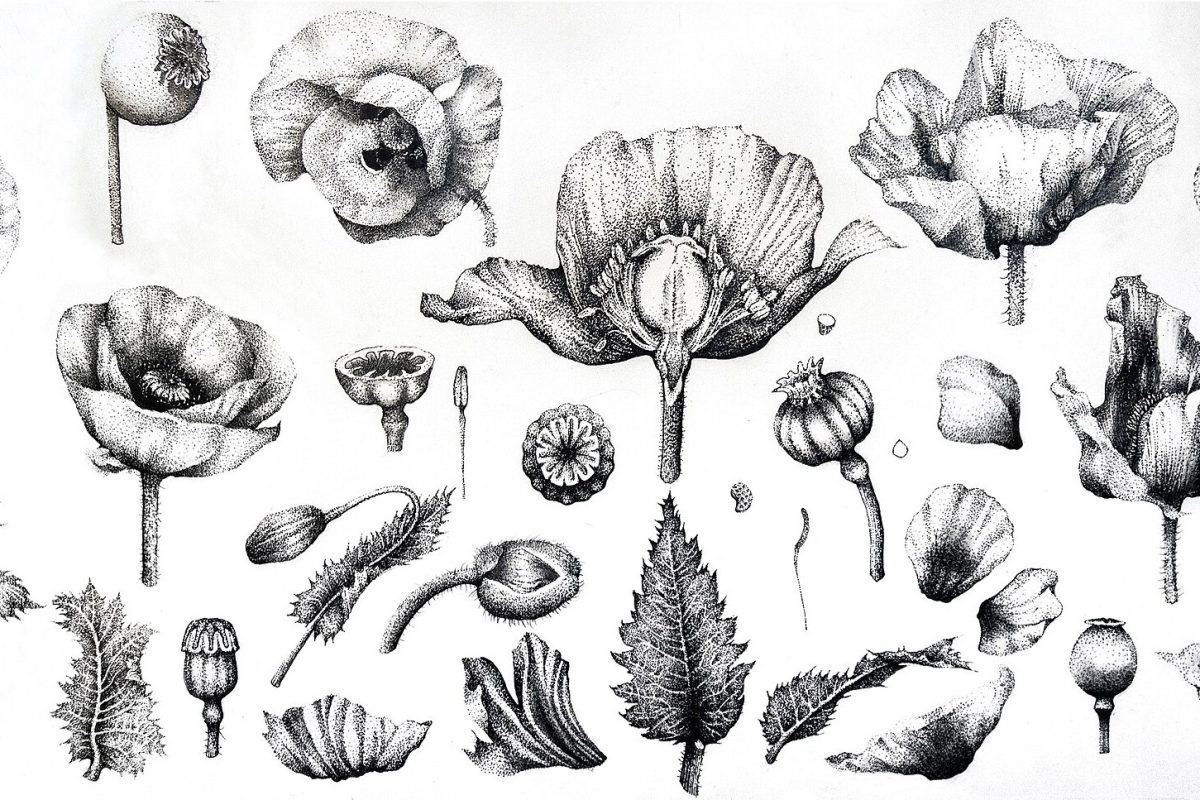
A flower with too much history
Few plants have shaped human history as much as the opium poppy (Papaver somniferum). From its capsule flows a latex that pharmacology transformed into morphine and codeine, and drug trafficking into heroin; from its petals, however, popular culture derived gentle remedies for insomnia and nervousness. This dual nature—medicine and dependency, comfort and ruin—runs through its entire biography and explains why the poppy appears just as frequently in ancient Mediterranean frescoes as it does in 21st-century public health records.
Literary, medical, and religious references to the Papaveraceae are countless, both in the East and the West. Opium has been an offering and an analgesic, a symbol of sleep and death, and the subject of laws, wars, and literature. It is worth remembering this symbolic density before reducing the plant to a simple “narcotic”: its history is also the history of how societies have managed pain, pleasure, and fear.
Botany and distribution
The Papaveraceae are distributed throughout the temperate and cold zones of both hemispheres. Their great adaptability has produced an enormous variety of local expressions, with differences in color, size, and, above all, alkaloid profiles. The plant grows as a shrub with characteristic glaucous green leaves, and in spring, it blooms with violet, white, pink, or crimson inflorescences. The fruit is a crowned capsule that holds hundreds of tiny seeds.
The fame of Papaver somniferum cultivation for opium has been associated for decades with Afghanistan and certain regions of Southeast Asia, in plantations linked to international drug trafficking circuits. But there are also legal and strictly controlled crops intended for the pharmaceutical industry: in the south of the Iberian Peninsula, for example, a white-flowered variety is grown to obtain morphine and codeine. In northern India and Pakistan, opium has historically had medical and ritual uses, and in Turkey, Morocco, or Russia, it is not uncommon to see flowering fields in the spring.
Argemone, the American cousin
A separate case is Argemone, the so-called prickly poppy, an American member of the Papaveraceae that extends from Mexico and the Antilles to northern Argentina and Chile. It contains various psychoactive alkaloids, but not morphine, and appears in traditional medicine and some shamanic contexts. Its chemistry, distinct from that of the opium poppy, reminds us that “Papaveraceae” does not automatically equal “opium”: within the same family, plants with very different risks and effects coexist.
Poppies, sleep, and popular culture
Alongside the opium poppy live more humble poppies, such as Papaver rhoeas, the common poppy that stains meadows and roadsides red throughout the Mediterranean. In the popular culture of Southern Europe, its petals have traditionally been associated with mild infusions for nervousness and insomnia. Its alkaloid profile is different from that of opium and is attributed a much milder effect, which explains why it occupies a domestic, almost harmless place in the collective imagination.
In northern Morocco, another tradition persists: harshasha, a poppy preparation closely linked to local culture and the markets of the Rif. We mention it as an ethnographic fact, not as a guide: these customs are part of the cultural heritage of each region, and understanding them is more interesting than imitating them blindly.
Critical reading and harm reduction
The cultural appeal of opium should not hide the essential: opiates are substances with a very high addictive potential. Consuming poppy latex or traditional preparations can generate tolerance and physical dependency in short periods, and opiate overdose—due to respiratory depression—is one of the leading causes of drug-related death worldwide. The difference between a “pleasant” dose and a dangerous one is narrow and unpredictable when the raw material is plant-based and its concentration is unknown.
For this reason, this text does not include quantities, recipes, or instructions for cultivation, preparation, or consumption: disseminating the history of a plant is not the same as teaching how to use it. If someone is dealing with opiate use—prescribed or otherwise—the keys to harm reduction include never mixing with alcohol or other depressants (benzodiazepines, gabapentinoids), not consuming alone, knowing the existence and use of naloxone as an antidote for overdose, and seeking medical support without fear of stigma. In the face of any sign of dependency, it is prudent to consult with health or addiction services.
For those who wish to delve into the historical and cultural context, classic works on the subject remain essential reading, from Thomas De Quincey’s Confessions of an English Opium-Eater to the essays of Antonio Escohotado or the ethnobotanical works of Schultes and Hofmann. It is best to read them with a critical spirit: many mix the rigor, myth, and enthusiasm typical of their time.