

Seeing that many people confuse the effects of these substances, I decided to create this guide to differentiate between them, as it is dangerous to consume one substance while believing it is another.
First of all, you must consider that most people selling substances clandestinely (unfortunately the only way) often have no idea what they are selling, so it is generally not worth asking.
One factor to consider, and which I will not go into detail about for obvious reasons, is the price: LSD costs between 3 and 10 times more than 25i-NBOMe. Just keep that in mind and you will save yourself many disappointments.
How to know if it is one or the other before taking it
OK, we have our blotter. How do we know if it is one or the other before taking it? Without beating around the bush or using hard-to-find Ehrlich tests: LSD reacts to black light, 25i-NBOMe does not.
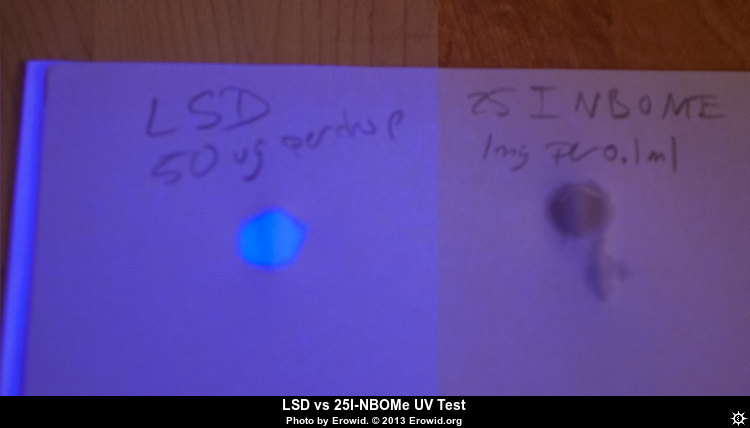
Anyone can do this test at home: if the blotter glows, it is LSD; if it does not, it is 25i-NBOMe. You can get a black light at any stationery store—ask for a counterfeit bill detector, and you have your acid tester.
How to differentiate the effects of LSD and 25i-NBOMe?
I will divide this section into two parts: subjective characteristics and objective characteristics. Subjective characteristics are those that depend on the individual; objective characteristics are those that, in most cases, do not depend on the perception or personality of each person.
Objective characteristics
LSD
- Affects various receptors (dopamine, adrenaline, serotonin, among others)
- Active orally and sublingually
- Active dose: 25 µg; low: 40~80 µg; medium: 80~125 µg; high: 125+ µg; LD50: 200~1000 µg per kilo
- Duration: 6~14 h
- Colorless, odorless, and tasteless
- Open and closed-eye visuals (generally starting at medium doses or higher)
- Increased creativity and associative thinking
- Sensation that the environment is “breathing” at your own rhythm
- Physical and/or mental stimulation
- Greater appreciation of music
- Sensitization of the senses
- Synesthesia
- Hyperthermia
- Anxiety
- Pupil dilation
- Slowing of time perception
- Insomnia
- Paranoia
- Dystonia (tension)
25i-NBOMe
- Potent full agonist of the 5-HT2A receptor.
- Inactive if consumed orally.
- Active dose: 50~250 µg; low: 200~600 µg; medium: 500~800 µg; high: 700~1500 µg; LD50: unknown
- Duration: 5~10 h
- Open and closed-eye visuals
- Increased creativity and associative thinking
- Pupil dilation
- Unusual body sensations
- Slowing of time perception
- Bruxism
- Confusion / difficulty concentrating
- Difficulty speaking
- Vasoconstriction
- Tremors
- Insomnia
- Paranoia
- Dystonia (tension) more pronounced than that caused by LSD
- Recursive thinking
Subjective characteristics
LSD
- Mood changes
- Euphoria
- Spiritual experiences
- Increased heart rate
- Seizures
25i-NBOMe
- Mood changes
- Euphoria
- Physical and/or mental stimulation
- Changes in music perception
- Spiritual experiences
- Empathy / distrust
- Increased heart rate
- Clonus
- Nausea
- Seizures
Source


