

In brief
- A team at the University of California, Santa Cruz reports in Nature Neuroscience that, in the mouse cortex, psilocybin promotes the formation and maturation of synapses on layer 5 pyramidal neurons, as well as the elimination of existing ones.
- According to the abstract, 5-HT2A receptors on those neurons are necessary and sufficient for this remodeling, but not for the head-twitch response, the behavior used in rodents as a proxy for hallucinogenic effects.
- This is basic research in animals and does not show that a drug without a “trip” would work as a treatment in people. This article is based on the published abstract and the preprint version of the work.
One of the questions now occupying psychedelic pharmacology is whether these drugs’ effects on brain plasticity can be separated from the subjective experience they produce. A mouse study published online on October 15 in Nature Neuroscience adds a piece to that debate. According to its authors, the receptor that underlies psilocybin-induced synaptic changes sits on a specific type of cortical neuron, and it is not the one that accounts for the behavior used as a marker of hallucinogenic effects.
What was studied
The paper is authored by Jacob J. Baker, Emily Kogan, Shaorong Ma, Ju Lu and Yi Zuo of the Department of Molecular, Cell and Developmental Biology at the University of California, Santa Cruz; Ju Lu is also listed at Lehigh University. The research, funded by the U.S. National Institutes of Health, focuses on layer 5 pyramidal neurons. These cortical cells express the serotonin 5-HT2A receptor, the main target of psilocybin and other classic psychedelics.
The preprint version of the work, posted to bioRxiv in April without peer review, describes the methods. The team used two-photon microscopy in living animals to track dendritic spines on these neurons, the small protrusions where synapses form. The mice had some neurons labeled with a fluorescent protein and received an injection of psilocybin; most experiments used 1 mg/kg. To isolate the receptor’s role, the researchers used genetically modified mice in which 5-HT2A was deleted only in those neurons or, conversely, restored only in them in animals that lacked it in the rest of the brain.
What they found
According to the published abstract, psilocybin promoted the formation and maturation of new synapses and accelerated the elimination of pre-existing ones. In other words, it did not simply add connections but reorganized the whole set. The selective manipulation indicated that 5-HT2A signaling in these neurons was necessary and sufficient for that remodeling. It was not required, however, for the head-twitch response, a behavior used in rodents as a proxy for hallucinogenic activity.
In the preprint, the share of new spines still present after 21 days rose from 29.3% in control mice to 51.0% in treated mice. Animals lacking the receptor in those neurons still showed the head-twitch response, while those that kept it only in those neurons did not. These figures come from the earlier manuscript and may have changed in the peer-reviewed version, whose full text we have not been able to access.
What this means
The finding fits the hypothesis that plasticity and perceptual effects depend, at least in part, on different circuits, an idea driving the development of psychedelic-derived compounds without hallucinogenic effects. Still, it is important not to read more into the study than it measures. The head-twitch response is an indirect marker, because a mouse cannot report what it perceives. Having more dendritic spines does not in itself amount to a clinical benefit, and the preprint did not include mood-related behavioral tests.
Nor does the study settle whether the subjective experience matters in people, a question that only human trials can answer. We previously covered another mouse study in which psilocybin’s effect persisted under light anesthesia. For general background on the substance, see our guide to psilocybin and magic mushrooms.
Sources
- Baker JJ, Kogan E, Ma S, Lu J, Zuo Y. 5-HT2A receptors in layer 5 pyramidal neurons mediate the neuroplastic but not the hallucinogenic effects of psilocybin. Nature Neuroscience, published online October 15, 2026 (DOI 10.1038/s41593-026-02490-y; PMID 42881224). The full text of the published version was not consulted.
- Bibliographic record and abstract on Europe PMC, accessed October 20, 2026. The full text of the published version was not consulted.
- Baker JJ, Kogan E, Lu J, Zuo Y. Dissociating the Hallucinogenic and Neuroplastic Effects of Psilocybin. bioRxiv, April 9, 2026. Non-peer-reviewed preprint, consulted for the methods.
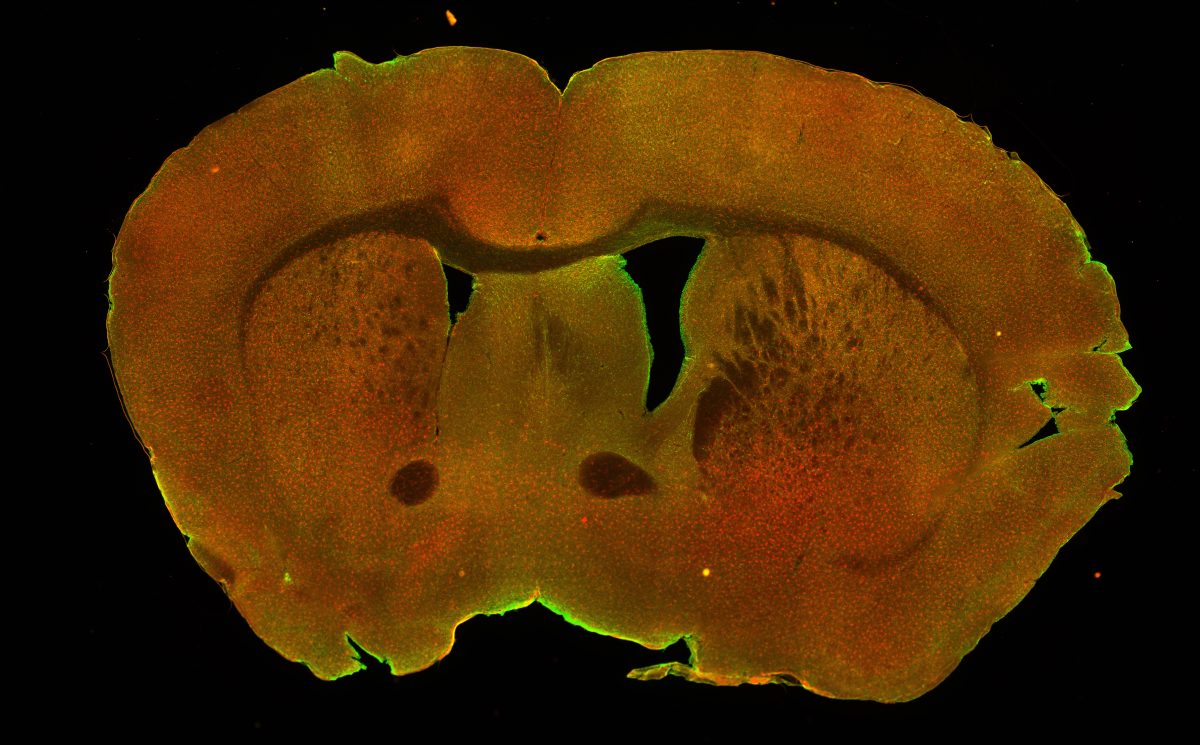
Coronal section of a mouse brain stained by immunofluorescence (neurons and microglia, according to the file description); illustrative image not taken from the study. Photo: Syed07 / Wikimedia Commons (CC BY 4.0).
Educational content written from a harm reduction perspective and with respect for individual freedom. It is not a substitute for advice from a healthcare professional and is not intended to encourage or condemn any drug use.