

Psiconáutica Editorial Team · November 25, 2026
At a glance
- On November 14, 2026, Drug Testing and Analysis published online a ring study in which five Swiss drug checking services quantified LSD in the same samples.
- According to the abstract, the relative standard deviation between laboratories was 8% to 16.5%, and higher for the liquid sample. Mean results were between 5.3% and 13.0% below the reference value.
- The study measures how consistent these laboratories are with prepared samples. It does not say how much LSD is in blotters in circulation, or why users expect higher amounts.
When a drug checking service reports how much LSD is on a blotter, the person who submitted it needs to know whether that number can be trusted. A group of researchers has tested that reliability in the most direct way: sending the same samples to several laboratories and comparing what each one measures.
Why it was needed
According to the abstract, drug checking services across Europe find that users generally expect considerably more LSD than laboratories measure. That gap raises the question of whether the services’ own methods are the problem. The study was designed to answer that question. It was led by Manuela Carla Monti of the Institute of Forensic Medicine at the University of Basel, with authors from the University of Lausanne and the European TEDI network. It was funded by a grant from the EMCDDA, the EU drugs agency now known as the EUDA.
What was done
Five Swiss drug checking laboratories took part. Each used its usual technique and its own extraction procedure. The techniques were liquid chromatography with diode-array detection (HPLC-DAD), gas chromatography with mass spectrometry (GC-MS) and liquid chromatography with tandem mass spectrometry (HPLC-MS/MS). All received three sample types: two blotters impregnated with LSD and one solution of LSD in methanol. So that differences between reference standards would not distort the comparison, results were corrected for standard purity, measured by quantitative nuclear magnetic resonance (qNMR).
What was found
The relative standard deviation shows how widely the laboratories’ results spread around their average: 10% means they typically differ from it by about a tenth. In this study it ranged from 8% to 16.5%. Mean accuracy was between −5.3% and −13.0%; the negative sign means that, on average, slightly less than the reference value was measured. The liquid sample was the most variable, and the largest deviations came from mass spectrometry-based methods. The authors conclude that variability was low and that the result supports the reliability of LSD quantification across the participating laboratories. It also provides a basis for future proficiency testing, meaning regular quality checks.
What the percentage does not mean
These figures are not a universal error margin: they refer to five laboratories and three prepared samples. Nor do they describe the content of blotters in circulation. To explain the distance between what people expect and what is measured, the authors discuss several possible factors: LSD’s limited stability, inconsistent clandestine blotter production, and expectations shaped by marketing or anecdotes. These are hypotheses the study raises, not causes it demonstrates.
What it means
For people who use a drug checking service, the study offers a benchmark: among these laboratories, LSD measurement was reasonably consistent, with somewhat more spread for liquids. A result describes the sample submitted, not necessarily an entire batch. For services, this kind of comparison is a quality tool worth repeating. For more context, see our guide to LSD and ergot and our story on 1D-LSD and 1T-LSD, another case where only chemical analysis settles the question.
Sources
- Monti MC, Gianola E, Koning RPJ, Ventura M, Oomen PE. “Quantitative Analysis of Lysergic Acid Diethylamide: A Ring Study Among Five Swiss Drug Checking Services.” Drug Testing and Analysis, published online November 14, 2026. doi:10.1002/dta.70190. Only the abstract was read, via the Europe PMC record.
Image
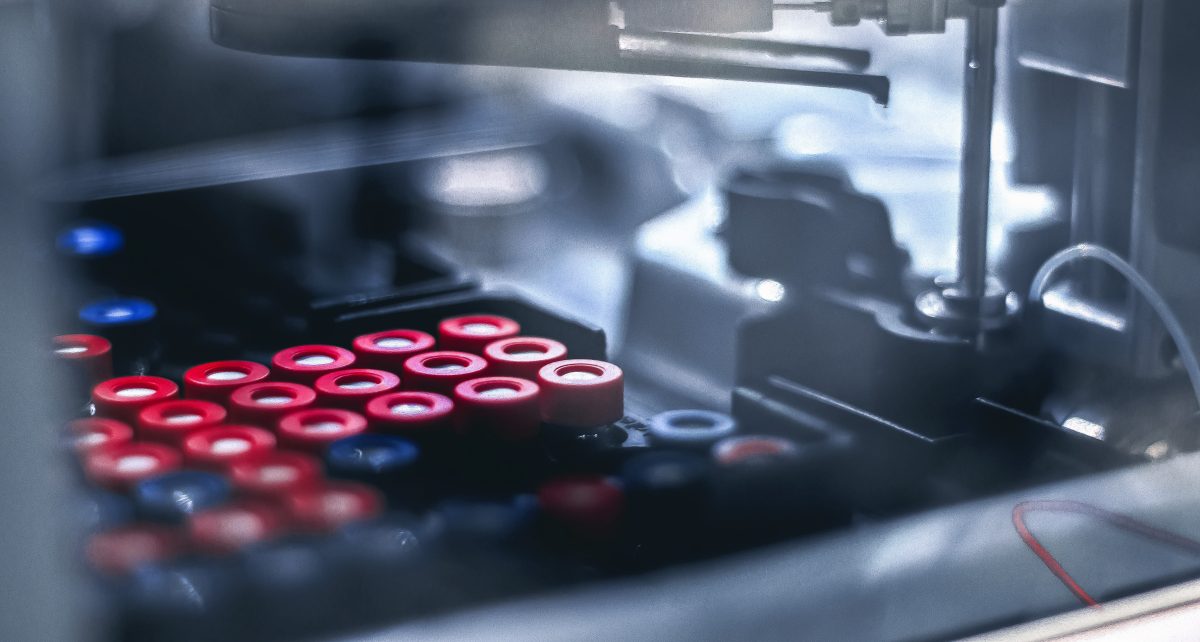
Illustrative image: an autosampler on a liquid chromatography (HPLC) instrument. It is not equipment from any of the study’s laboratories. Photo: Martin Schaier, Wikimedia Commons, licensed under CC BY 4.0.
Educational content produced from a harm-reduction perspective and with respect for individual freedom. It does not replace information from a healthcare professional and does not aim to encourage or condemn any use.