
Psiconáutica Editorial Team · November 25, 2026
At a glance
- A University of Florida team reports in Current Biology a mushroom, Galerina indica, whose tissues contained both psilocybin and amatoxins, toxins that damage the liver.
- The mushroom stained blue when handled, a trait seen in some psilocybin mushrooms. That color said nothing about the amatoxins.
- A visible sign can suggest what is worth measuring, but it does not replace expert identification or chemical analysis. If poisoning is suspected, seek urgent help without waiting for symptoms to worsen.
Among people who talk about mushrooms, an informal rule circulates: if it bruises blue when touched, “it’s a magic one.” The case of Galerina indica invites a more useful question: what can a visible sign really tell us, and what can it not? The answer has three steps: observing, measuring and assessing risk. Each one answers a different question.
Step one: an observation that suggests a hypothesis
Andrew Kunik, an undergraduate in Matthew E. Smith’s lab, found the mushroom while documenting fungi at the University of Florida’s Ordway-Swisher Biological Station (UF/IFAS), according to the university’s November 11 news release. It belongs to the genus Galerina, which includes species with potentially deadly amatoxins. This one also stained blue when handled, something seen in some psilocybin mushrooms. Smith explains that these mushrooms look like many other small brown species and are hard to tell apart even for trained experts.
An observation like this makes it possible to form a hypothesis: “perhaps this mushroom makes psilocybin.” But it says nothing about what cannot be seen. A trait linked to one compound tells you nothing about whether other compounds are present.
Step two: measuring
The paper, by Kunik, Christopher, Lemmond, Dentinger, Slot, Garrett and Smith and published online on November 11, 2026, tested that hypothesis in the laboratory. According to its abstract, mass spectrometry, a technique that identifies molecules by their mass, detected psilocybin and amatoxins in the mushroom’s tissue. Genomic analysis also found the genes needed to make both. The authors note that the two families of compounds had never before been shown to occur in the same species. Their phylogenetic analyses suggest that the ability to make psilocybin arrived through horizontal gene transfer, meaning from another organism, after the amatoxin pathway was already in place.
The measurement confirmed what the blue staining hinted at and revealed exactly what that color could not show: a potentially deadly toxin in the same mushroom.
Step three: assessing risk
Knowing what a mushroom contains is not the same as knowing how risky it is to eat. The abstract reports no quantities, doses or clinical cases linked to G. indica, so this study cannot estimate how often the species might cause poisonings. Other evidence is needed to understand what is at stake with amatoxins.
A report from the US CDC (MMWR, June 2, 2017) described 14 Amanita phalloides poisonings in Northern California in December 2016. The patients, aged 18 months to 93 years, had eaten wild mushrooms. Three needed a liver transplant. No deaths were reported and all recovered, although an 18-month-old girl was left with permanent neurological impairment. Four of the patients believed they had eaten psychedelic mushrooms picked in the wild. The report explains that amatoxins halt protein synthesis in liver cells. The first symptoms are digestive and delayed, and can resemble gastroenteritis before progressing to severe liver injury. It is a case series, not an incidence estimate, and it concerns a different species: these are not cases from the Florida study.
A sign that is not enough
Blue staining is not enough to say, without analysis, that a mushroom contains psilocybin, let alone that it is safe. The Florida case shows that a mushroom can show this trait and contain amatoxins at the same time. Spain’s food safety agency, AESAN, puts it plainly for any foraging: no popular belief “is reliable for telling a toxic mushroom from an edible one.”
What it means
For harm reduction, the lesson is not to learn a new sign but to distrust any visual shortcut. Identifying species requires experts, and chemical content can only be known through analysis. AESAN advises going with experts or getting advice before eating wild mushrooms. If someone feels unwell afterwards, it advises calling or going to emergency services as soon as possible. In Spain and across the EU, the emergency number is 112. As the CDC report shows, early symptoms can seem mild, so it is best not to wait for them to get worse. For more context, see our guides to psilocybin and magic mushrooms and to harm reduction.
One biological question remains open, which the University of Florida flags for future experiments: what role each compound plays for the mushroom itself.
Story spotted through coverage by Tina Hesman Saey in Science News. The details were checked against the paper’s abstract and the University of Florida release.
Sources
- Kunik AR, Christopher MW, Lemmond B, Dentinger BTM, Slot JC, Garrett TJ, Smith ME. “The ‘dark magic mushroom’ co-produces amatoxins and psilocybin.” Current Biology, published online November 11, 2026. doi:10.1016/j.cub.2026.10.041. Only the abstract was read, via the Europe PMC record.
- University of Florida (UF/IFAS). UF students discover the “dark magic mushroom”, November 11, 2026.
- Vo KT, et al. Amanita phalloides Mushroom Poisonings — Northern California, December 2016. MMWR 66(21):549–553, June 2, 2017.
- AESAN (Spanish Agency for Food Safety and Nutrition). Consejos para la recolección y el autoconsumo de setas silvestres (in Spanish).
Image
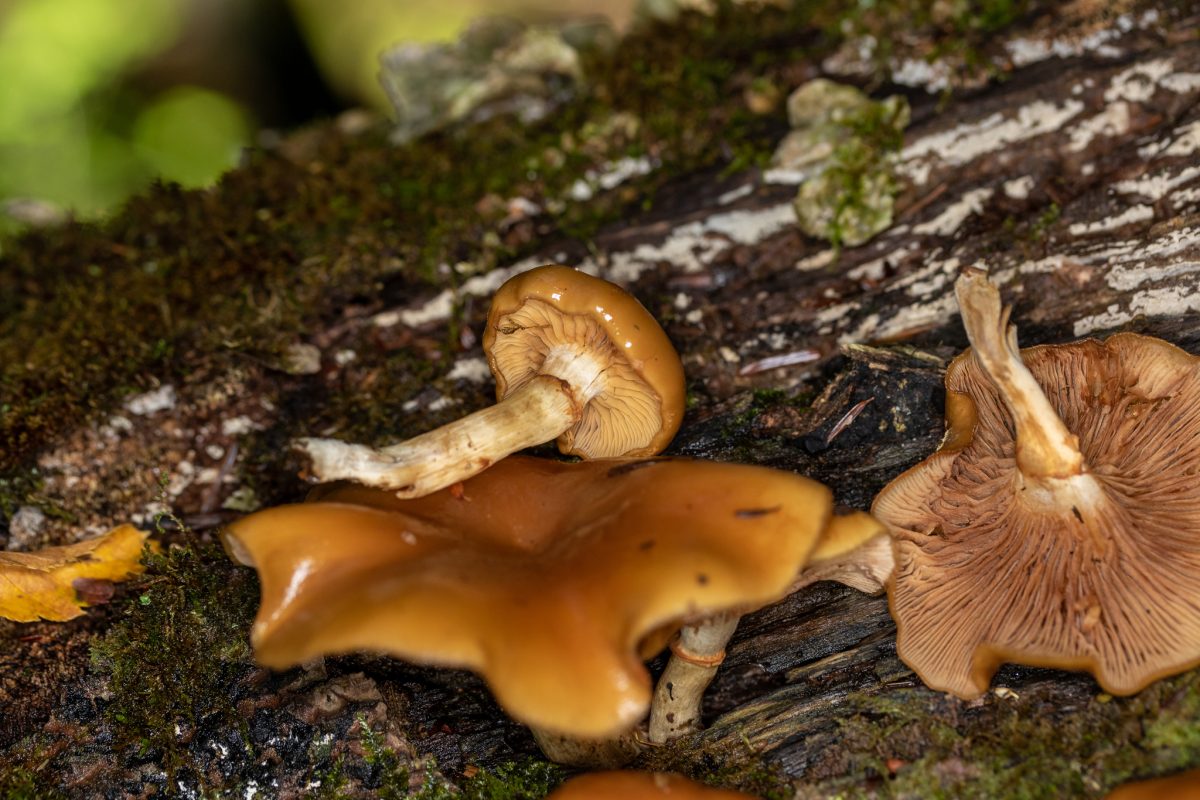
Illustrative image: Galerina marginata mushrooms, another species in the same genus. It is not G. indica, it is not from the study and it should not be used to identify mushrooms. Photo: Richard Jacob (via iNaturalist), Wikimedia Commons, licensed under CC BY 4.0.
Educational content produced from a harm-reduction perspective and with respect for individual freedom. It does not replace information from a healthcare professional and does not aim to encourage or condemn any use.