

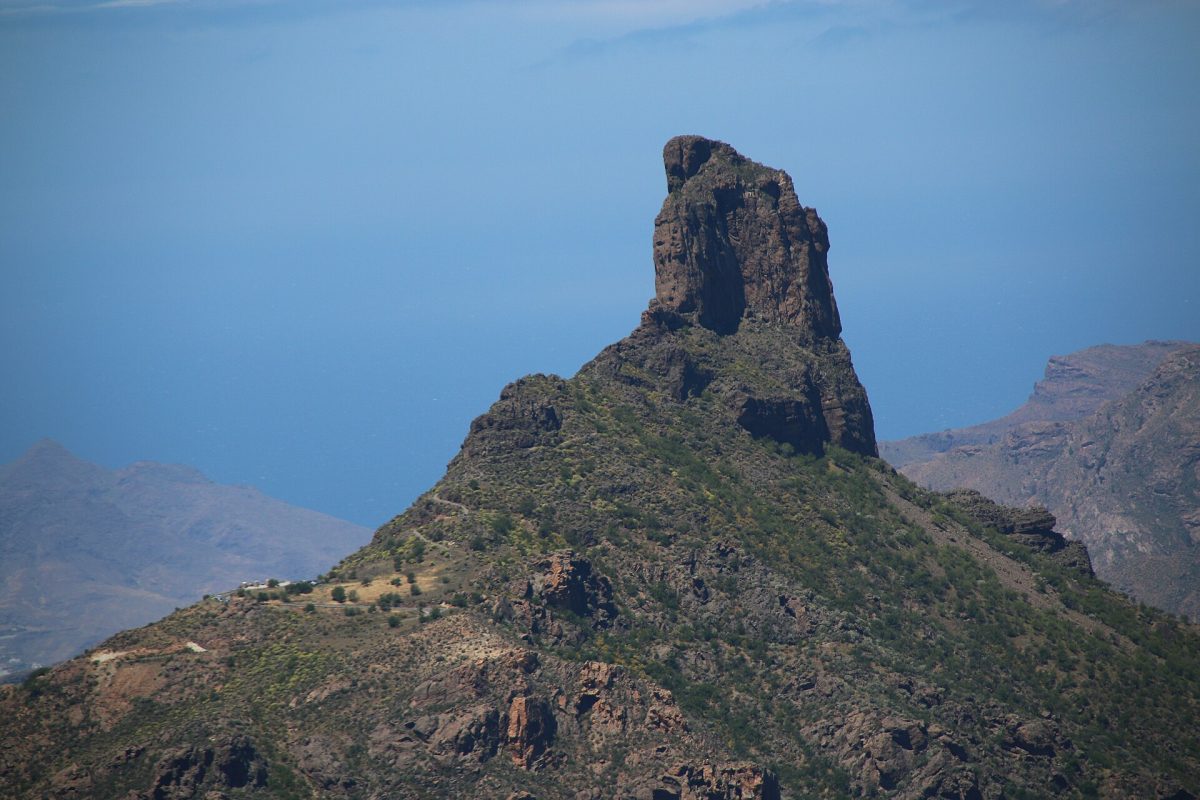
Almost all traditional cultures have developed ways to briefly step out of ordinary consciousness to consult the invisible, and the Canary Islands prior to the conquest were no exception. What is unusual is that while visionary plants appear in the Americas or Bronze Age Menorca, sources from the archipelago speak of trances, seers, and columns of smoke, but never mention any specific substance. This article reviews what we know, what has been assumed, and what recent research has added.
In brief
- Chroniclers from the 16th and 17th centuries describe ritual trances, seer priests, and smoke offerings among the ancient Canarians, but none mention psychoactive plants.
- The most prudent explanation is that the trance was achieved through non-chemical techniques: rhythm, chanting, fasting, sleep deprivation, and shared ritual, perhaps involving mild smoke.
- Archaeology has confirmed sanctuaries and fire altars, such as those at Garajonay (7th to 12th centuries) or the almogarenes of Risco Caído and Bentayga, a World Heritage site since 2019.
- Genetics place the origin of these populations in North Africa around the 3rd century. Analyses like those performed on hair from Menorca could, one day, resolve the mystery of these substances.
The starting problem: sources written by the victors
Almost everything we know about the religious life of the ancient Canarians comes to us through people who did not share it. The chroniclers who described it (the Portuguese Gaspar Frutuoso, the Franciscan Juan de Abreu Galindo, and the Gran Canarian physician Tomás Marín de Cubas) wrote between the late 16th and late 17th centuries, when the conquest had already dismantled much of that world. They often collected second- or third-hand oral traditions and filtered them through Christian categories: “pagan sacrifice,” “cloister,” “consecrated virgins.”
It is important to keep this in mind from the start. That these texts do not mention mushrooms, cacti, or visionary brews does not prove they did not exist; a 16th-century friar might not have seen them, understood them, or preferred not to write about them. However, this does not authorize us to imagine an entheogenic shamanism where there is not a single shred of evidence. The honest position is to acknowledge the void. For now, there is no evidence of ritual use of psychoactive substances in the Canary Islands, and the simplest explanation is that the trance was sought through other paths.
To frame the debate, it is worth remembering what anthropology has documented for decades: in many non-literate societies, plants that alter consciousness occupy a central place in healing, identity, and decision-making. Josep M.ª Fericgla explains this in detail in The Central Weight of Entheogens in Cultural Dynamics. The question regarding the Canaries is whether the archipelago fits that pattern or is one of the cases where ecstasy was sought almost exclusively through the body and ritual.
The Bimbache king’s daughter: a trance recounted in the 16th century
The most striking testimony is found in Saudades da Terra, the work Gaspar Frutuoso finished around 1590. He recounts the arrival in El Hierro of Juan Machín, a Basque sailor whose men heard voices in a plain and encountered the entire population gathered for a public sacrifice. It was presided over by the island’s king, who, according to the account, often resorted to these ceremonies so that the divinity would reveal the fate of his people. In the middle of the rite was his daughter, described as “suspended and stunned”: absorbed, absent, as if transported out of herself.
The description has all the hallmarks of an oracular trance: a collective ceremony, a person acting as a medium, and a consultation about the future. Frutuoso does not mention any drink or smoke; only the scene and the astonishment of the newcomers.
This must be read with caution. Frutuoso was writing more than a century after the events he narrates, and several historians have debated to what extent the Machín tradition is an embellished local legend. Even so, the detail of the trance fits with what other sources say about island religiosity, and it does not seem like a gratuitous literary device.
Faycanes, harimaguadas, and other specialists of the sacred
If there were trances, there were those who knew how to provoke and direct them. The chronicles of Gran Canaria speak of a figure called a faycán, who held both religious and political authority, and of men who lived in seclusion, dressed in skins, kept the memory of lineages, and were reputed to divine the future. Marín de Cubas compares them to cloistered religious figures: a type of ascetic who guarded knowledge and the relationship with the invisible.
Alongside them were the harimaguadas, young women dedicated to the cult who lived secluded in communal caves and participated in offerings and purification rites. Some authors have argued that the name comes from a Berber term that could be translated as “herbalist seers,” which would make them diviners with knowledge of plants. It is an attractive hypothesis, but it is a minority view and is debated; other specialists even doubt that the word has a Berber root and believe the institution was exclusive to Gran Canaria. At most, it suggests that plants were part of ritual knowledge, without that implying chemical visions.
What is clear is that the cult was organized, with defined roles: male priests, consecrated women, and a community that attended pilgrimages and offerings according to the calendar. That structure is what allows for the support of trance practices that are repeated and transmitted from one generation to the next.
Smoke, fire, and omen: ecstasy without plants
If there was no known entheogen, how was the trance achieved? The sources hint at several elements that, together, can significantly alter consciousness:
- The smoke of the offerings. In Gran Canaria and the eastern islands, grains, fruits, and fats were burned, and “omens were taken” by observing whether the column of smoke rose straight or twisted. Breathing the smoke of a ritual bonfire for a long time, especially if aromatic plants were added, can produce dizziness and a slight disorientation that, in a context of fervor, pushes one toward a trance.
- Rhythm. Repetitive chanting, clapping, and circle dancing are classic trance inducers everywhere, without the need for any substance.
- Fasting and vigil. Consultation ceremonies were usually long and often nocturnal. Hunger, lack of sleep, and physical exhaustion reduce conscious control and facilitate dissociative states.
- The location. Isolated peaks, vertigo, wind, open sky: the Canary sanctuaries are almost always in places that are overwhelming in themselves.
None of this is exotic. It is the repertoire of ecstasy techniques that ethnography has documented on every continent, and in many cases, it is enough for someone, like the young woman from El Hierro, to be “out of herself” during the ceremony. Comparison with other traditions also helps to nuance this: in India, for example, the use of bhang is surrounded by a ritual that fixes its meaning and limits, as Alain Daniélou explains in The Hallucinogenic Divinities. In the Canary Islands, what was ritualized was fire and smoke, not a plant.
Almogarenes and Sacred Mountains: What Archaeology Confirms
Historical chronicles have proven most reliable when describing sacred sites. The ancient Canary Islanders did not construct monumental temples. Instead, they utilized mountains, rock formations, caves, and cliffs, referring to these cult spaces as almogarén—a term Abreu Galindo translates as “holy house.” According to this chronicler, these enclosures in Gran Canaria were sprinkled daily with goat’s milk, and specific herds were set aside to ensure the supply of offerings never ran dry.
The people of Gran Canaria also held two major mountains sacred: Tirma, in the northwest, and Umiaya (or Humiaya), in the Tirajana region. Swearing by these peaks was the most solemn oath possible, and people would travel there in procession during times of need. Marín de Cubas describes an altar in Humiaya made of large stones with three braziers where all manner of fruits—but never meat—were burned to read omens in the smoke. Similar practices were recorded in Lanzarote and Fuerteventura, where a portion of the harvest was burned to divine the success of future endeavors.
Archaeology has since given substance to these descriptions. In 2019, UNESCO designated the Risco Caído and the Sacred Mountains of Gran Canaria Cultural Landscape, located in the island’s mountainous center, a World Heritage site. The complex includes dwellings, granaries, and cisterns carved into the rock, ritual caves, and two almogarenes—Risco Caído and Roque Bentayga—where ceremonies linked to the seasons and perhaps the worship of celestial bodies and Mother Earth were likely held. The astronomical interpretation of Risco Caído, however, has its critics: some mathematicians and geographers argue that the notion of an “observatory” has little foundation and relies primarily on the work of its discoverer.
On La Gomera, the team led by Juan Francisco Navarro Mederos (University of La Laguna) excavated the Alto de Garajonay, at an elevation of about 1,487 meters (4,878 feet), uncovering a double enclosure with sacrificial altars: dry-stone structures with small receptacles where offerings were burned. The study of animal remains, published in 2015, reveals a highly regulated practice repeated between the 7th and 12th centuries CE: only domestic animals were sacrificed, and only specific body parts were used. Other researchers have linked these burnings to the agricultural calendar and the rising of the Pleiades, which signaled the rainy season. Ultimately, fire served to sanctify the relationship between the community, the land, and the sky.
Following the conquest, many of these sites were not forgotten; they persisted in toponymy and popular memory, and much of their devotion was transferred to hermitages, pilgrimages, and rain-seeking processions that had been Christianized.
What We Know Today and What Remains Missing
Since the first versions of this debate were written, science has provided two significant pieces of evidence. The first is genetic. A study published in 2023 in Nature Communications, analyzing the genomes of 40 individuals from the seven islands, confirms that the ancient Canary Islanders arrived from North Africa, carrying a genetic component present in the Neolithic populations of Morocco, and colonized the archipelago around the 3rd century. They subsequently lived in relative isolation, with little contact between islands and clear differences between the eastern and western groups. This isolation helps explain why each island developed its own ritual repertoire and why it is unwise to simply transpose what is known about the continental Amazigh world onto the Canary Islands.
The second piece comes from another archipelago. In 2023, the team led by prehistorian Elisa Guerra Doce published an analysis in Scientific Reports of hair strands from the Es Càrritx funerary cave in Menorca, dating to around 800 BCE. They discovered atropine and scopolamine—alkaloids from nightshades like mandrake, henbane, or jimsonweed—as well as ephedrine, likely from ephedra. The authors suggest these were used in shamanic-style rituals. It is proof that when the right remains are preserved, chemistry can answer questions that texts leave open.
The Canary Islands possess material in their mummies and funerary remains that could one day be subjected to such analysis. Until that happens, the most solid conclusion remains the same, albeit better supported: the ancient Canary Islanders practiced ritual trances for divinatory purposes, organized by specialists and linked to fire, smoke, and sacred mountains, and we have no evidence that they resorted to visionary plants. Perhaps they did not need them. Or perhaps we simply have not yet learned how to look for them.
If you are interested in how other ancient religions managed ecstatic experience, and what is true or exaggerated regarding their alleged use of substances, you can continue with Mystery Cults of Rome: Attis, Isis, and Mithras.
References
- Serrano JG, Fregel R et al. The genomic history of the indigenous people of the Canary Islands. Nature Communications (RIULL repository, University of La Laguna), 2023.
- Alberto Barroso V, Navarro Mederos JF, Castellano Alonso P. Animales y ritual. Los registros fáunicos de las aras de sacrificio del Alto de Garajonay (La Gomera, Islas Canarias). Zephyrus, 76, 2015.
- National Geographic. On the study by Guerra Doce et al. regarding alkaloid consumption in Es Càrritx (Menorca). National Geographic, 2023.
- Permanent Delegation of Spain to UNESCO. Risco Caído and the Sacred Mountains of Gran Canaria Cultural Landscape, World Heritage. Ministry of Foreign Affairs, 2019.
- Risco Caído (includes criticisms of its astronomical interpretation). Wikipedia, accessed in 2026.
- EFE / Canarias Ahora. The ancestors of the Gomeros sacrificed animals in Garajonay to pray to the stars. elDiario.es, 2016.
This article updates and rewrites a text by Raúl del Pino originally published in Cannabis Magazine.
Educational content written from a harm reduction perspective and with respect for individual freedom. It is not a substitute for advice from a healthcare professional and is not intended to encourage or condemn any drug use.