

A Religion Bereft of Solace
Between the 1st and 3rd centuries, the Roman Empire weathered far more than a sequence of political upheavals: it suffered an existential crisis. Generational civil wars over the imperial purple shattered the conviction that the gods guarded the commonwealth. If the gods protected Rome, why was Rome devouring itself? Adding to this widespread popular doubt was an intellectual critique: Greek philosophers filled aristocratic salons, openly questioning the very existence of those traditional deities.
The state cult endured, yet it demanded civic allegiance rather than inner conviction. Honoring the emperor bound a citizen to the state, but it offered no comfort in loneliness and said nothing about death. Into that vacuum flowed religions originating in Egypt and Asia Minor, promising precisely what was missing: an intimate bond with the divine and an afterlife that did not end in the cold earth of the tomb.
Why Emperors Tolerated (and Sometimes Embraced) Them
Far from suppressing these mystery cults, several emperors actively promoted them out of calculated political pragmatism. Commodus underwent initiation into the mysteries of both Isis and Mithras; Caracalla championed the solar cult of Sol Invictus; and Constantine—the very ruler who would grant official recognition to Christianity—openly aligned himself with that unconquered Sun before his decisive religious pivot. This apparent contradiction carried its own internal logic: a faith offering personal solace could either reinforce imperial stability or dissolve it, depending on how it was channeled.
The outcome was thoroughly double-edged. By shifting spiritual devotion toward an individual savior god, these mysteries subtly eroded the civic bond tying subjects to the emperor. Salvation no longer ran through the institutions of Rome. Moreover, almost everything we know about these practices reaches us late and through fragmented accounts: secrecy was an indispensable element of the rite, and the surviving sources are largely posthumous, fragmentary, or authored by hostile critics. Much of what is stated with absolute certainty is, in truth, scholarly reconstruction.
The Shared Archetype: Dying to Be Reborn
Under varying names, the mystery traditions adhered to a shared grammar. Following an intensive preparatory phase of purification—marked by fasts, sexual abstinence, and ritual washings—the initiate stepped into a sacred drama reenacting the deity’s mythic cycle: death and resurrection. This was no mere theatrical performance; the initiate was expected to feel the overwhelming presence of the god, culminating in a state of deification—an intimate communion experienced as an irreversible inner metamorphosis.
Motivations varied considerably. Some initiates sought genuine moral elevation, while others chased visceral emotional catharsis through frenzied rituals that left a deep psychological mark but fostered little lasting community. Yet nearly all converged on the central promise: triumph over fate and mortality, and eternal life beyond death. Therein lay their decisive advantage over the rigid civic rites of the Roman state.
Attis and Cybele: Phrygian Ecstasy
The earliest secret rites to infiltrate Rome were those devoted to the Phrygian Great Mother Cybele and her consort Attis. Disdained by patrician elites yet embraced by the working classes, these rites featured radical acts—such as ritual self-castration by ecstatic priests—while ordinary followers engaged in flagellation, hypnotic music, ecstatic dancing, and tattooing to induce deep trance states. Attis operated as an expiatory figure carrying the accumulated suffering of the mortal realm. Prior to the climactic rites, candidates shared a communal meal of bread and wine preceded by rigorous fasting.
This phase is of particular interest to the history of consciousness-altering substances, though it demands careful scrutiny. After prolonged sensory deprivation and fasting, an evening feast accompanied by unwatered wine can easily provoke altered states; inferring the deliberate use of “hallucinogens” from this alone requires a significant leap. Scholar Antonio Escohotado, in his General History of Drugs, proposed that visionary botanical preparations may have circulated during the primary mysteries, but this remains a hypothesis rather than an established archaeological fact. Given the nature of the rite—far closer to Dionysian frenzy than to Eleusinian contemplation—any pharmacological agent would have served possession trance rather than quiet vision. It is a plausible interpretation, not a settled historical certainty.
Isis and Osiris: Darkness, Light, and Silence
Isis represents the quintessential Egyptian archetype of the mother goddess. Sister and consort to Osiris, she reassembles the dismembered body of her husband following his murder by Set, and through her grief achieves his resurrection in harmony with the cyclical renewal of vegetation. Her parallels with the Greek pantheon are unmistakable: Isis mirrors Demeter, while Osiris reflects Dionysus. Her devotees formed organized sodalities, the collegia Isidis, incorporating male priests and priestesses alongside custodians of sacred relics concealed within ritual baskets, as famously chronicled by Apuleius.
Apuleius provides our most evocative firsthand testimony, detailing dawn sacrifices, the reading of hieroglyphic scrolls, purification baths, and ten days of strict abstinence from meat and wine. When approaching the supreme moment of initiation, however, he deliberately draws the veil: “I would tell you if it were lawful to speak; you would know, reader, if it were lawful to hear.” Yet he reveals the experiential architecture, echoing Eleusis: first the descent into terrifying darkness, followed by blinding light and revelation. “I approached the frontiers of death,” he writes, “I set foot on the threshold of Persephone… at midnight I beheld the sun blazing in all its glory.”
Did botanical substances catalyze these visions? In his treatise on the Egyptian mysteries, the Neoplatonist Iamblichus distinguishes between delirious trances that unhinge the mind and higher states that elevate the soul, recounting raptures in which the initiate experienced direct vision of the gods face to face. Some modern commentators detect hints of sacred pharmacology in these passages, while others interpret them as metaphors for intense devotional ecstasy. Historical rigor demands that we do not put words into ancient texts: ecstatic vocabulary alone does not confirm the presence of a chemical pharmakon.
Mithras: The Soldier’s Deity
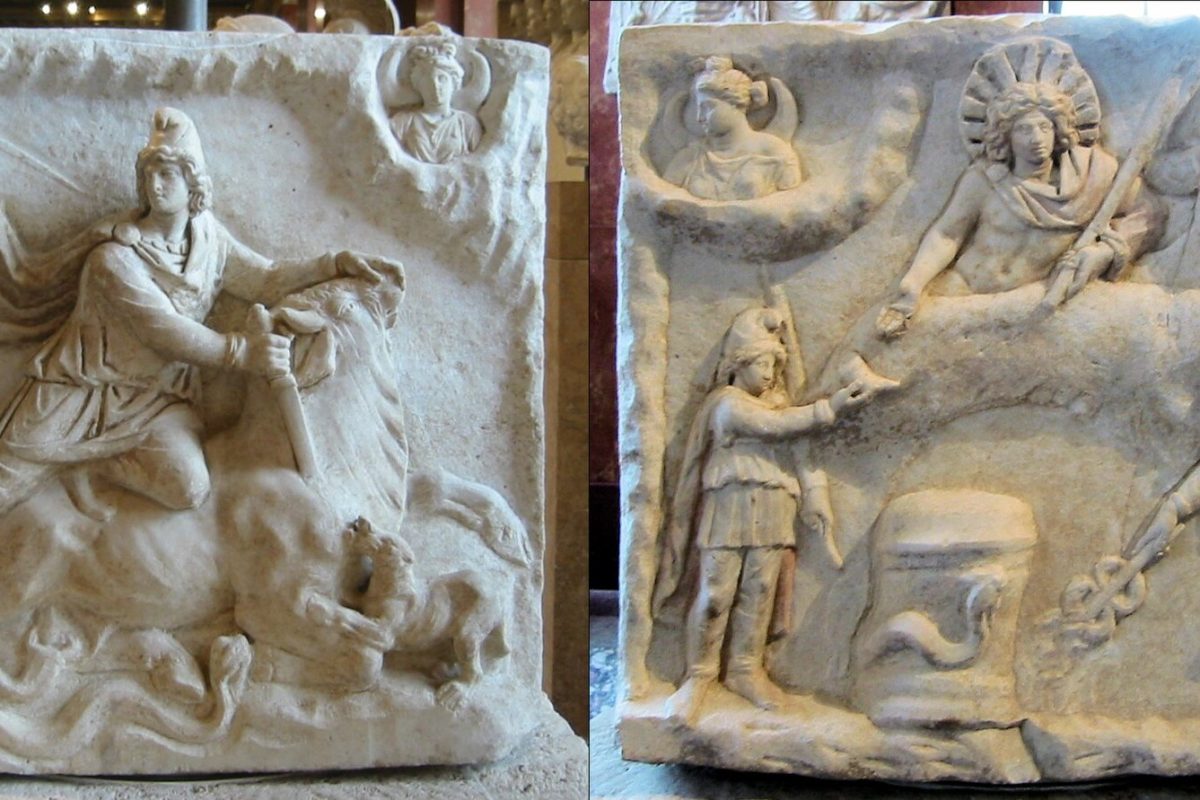
Among the cults of Hellenistic origin, none achieved greater renown than that of Mithras, an Iranian deity intimately bound to bull symbolism. Initiation required baptism in the blood of a freshly sacrificed bull, alongside a sacred meal structured around an “offering of bread.” Serving as the quintessential religion of Roman legionaries, Mithraism spread swiftly along the empire’s frontiers during the 1st and 2nd centuries. Introduced according to tradition by Cilician pirates, Mithras soon merged with solar iconography: Deus Sol Invictus Mithras.
During their sacramental feasts, initiates consumed bread and wine symbolizing the flesh and blood of the primordial sacrificed bull, while the officiating priest offered the benediction: “You have saved mankind through the shedding of eternal blood.” This communion sealed a mystical union with the deity along with the pledge of immortality. Small congregations gathered in subterranean sanctuaries (mithraea), many of which survive today precisely because early churches were erected atop their foundations—the basilicas of San Clemente and Santa Prisca in Rome being well-documented examples.
Mirrors of Christianity: Who Borrowed from Whom?
Early Church Fathers grew profoundly uneasy when confronted by pagan rites that mirrored their own sacraments. Tertullian resolved the dilemma by accusing the devil of “diabolically mimicking the divine sacraments”: baptism, remission of sins, the bread offering, and the motif of resurrection. Attributing the similarities to demonic imitation served a clear polemical purpose: denying any reciprocal cultural influence. Modern comparative historiography has often reversed this narrative, emphasizing that nascent Christianity evolved within the very same cultural milieu and naturally shared symbolic forms with its contemporaries.
The points of contact are undeniable: honoring the solar god’s birth on December 25th, the sacred observance of Sunday—the Solis Dies—and shared visions of eschatology, universal judgment, and bodily resurrection. Historians have likewise noted that early Roman bishops adopted titles resonant with Mithraic priesthoods. Nevertheless, one must distinguish between genuine shared lineage, indirect diffusion, and modern mythmaking. While several parallels are historically grounded, others have been exaggerated in popular culture into dubious historical tropes. A ritual resemblance does not automatically prove direct genealogical descent.
Critical Perspectives
Three caveats are essential when evaluating this chapter of religious history without succumbing to easy sensationalism. First: secrecy was foundational to these traditions, meaning almost all surviving evidence comes from late, indirect, or openly hostile accounts; much of our current understanding is informed historical reconstruction rather than direct testimony. Second: the presence of psychoactive substances in these rites is plausible in specific contexts, but it remains unproven across the board. The language of ecstatic vision—perceiving supernatural radiance, crossing metaphysical thresholds, seeing the gods—can arise from extended fasting, sensory deprivation, rhythmic music, group suggestion, or a pharmacological pharmakon; ancient sources rarely allow us to isolate these variables with certainty. Projecting entheogenic plants onto every ancient visionary experience is just as historically careless as dismissing the possibility out of hand.
Third: parallels with Christianity tempt observers into overly tidy narratives of direct plagiarism. Contemporary religions sharing a geographic space inevitably draw upon a common symbolic vocabulary without necessarily copying one another; convergence is not proof of causal derivation. Viewed through this lens, the rise of the Roman mysteries reveals less about esoteric conspiracies and far more about an enduring human impulse: when established civic institutions fail to give meaning to life and death, people will always seek transcendence elsewhere.
Authors such as Escohotado, Iamblichus, and Apuleius are cited here to illuminate the historiographical debate rather than to provide definitive proof. Those wishing to explore further should weigh popular accounts against peer-reviewed scholarship in the history of religions, where these assertions are evaluated with necessary nuance.


