

A substance as domestic as bread
It is hard to imagine from today’s perspective, but for centuries, poppy juice occupied a place in Roman households similar to salt or oil. It was bought in shops, kept at home, and administered without moral alarm. The category of the “addict” did not exist, nor was there a crusade against drugs: opium was, quite simply, medicine. Reconstructing that normalcy helps us understand to what extent a culture’s relationship with substances depends less on chemistry and more on the legal, medical, and symbolic framework surrounding it.
An empire with very few drug laws
Roman law barely legislated what we would call psychoactive substances today. The Lex Cornelia, in effect from the Republic until the imperial decline, was for centuries almost the only general precept touching on the matter, and it was created more to prosecute poisoning than to regulate consumption. Specific interventions were just that—specific: an edict attributed to Alexander Severus that, following some intoxications, banned the use of jimsonweed (a datura) and powdered cantharides in certain brothels; or the famous palace episodes of mushroom poisoning—tradition accuses Agrippina of dispatching Emperor Claudius by mixing Amanita phalloides with the edible Amanita caesarea. Beyond these cases, the two plants that anchor the Roman culture of mood are the vine and the poppy.
Galen: the poison that also heals
Claudius Galen (129–199 AD) practiced under Marcus Aurelius, Commodus, and Septimius Severus, and was likely the most influential physician of Antiquity. His system—which organized substances by qualities and intensities—defined medicine well into the Middle Ages. He was born in Pergamon, a city associated with poppy cultivation and a temple of Asclepius where incubatio was practiced, a sleep therapy intended to heal the patient while they slept; excavations of the site revealed surgical instruments and rooms that evoked the dwelling of Hypnos, the god of sleep.
For Galen, poppy juice embodied a paradox: it was both remedy and poison, something that “heals because it almost kills.” He classified it as “cold in the fourth degree,” the same level as hemlock, even above mandrake. No other drug matched its analgesic and soporific potency, and for that very reason, he considered it essential for pain. Against those who labeled it useless or harmful to the eyes, he defended its use in eye drops. He also left us evidence that cannabis was offered at gatherings of the Roman elite—a custom he attributed to Athenian or Celtic influence—with the warning that excess was harmful.
Opium in the imaginary: sleep, oblivion, and myth
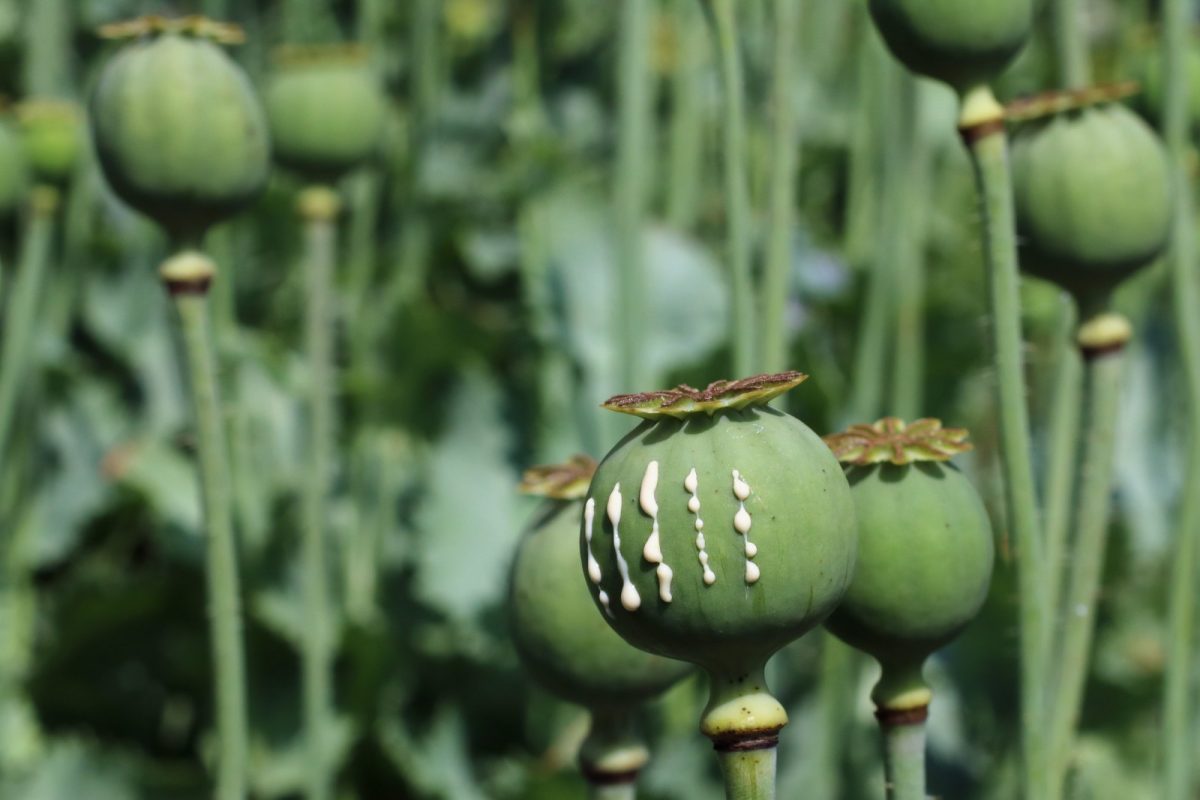
The poppy was woven into the culture long before the pharmacopeias. Tradition associated it with Demeter’s consolation for the loss of Persephone, and the goddess—Ceres in her Latin version—is depicted with poppy capsules in her hand. Pliny the Elder stated without hesitation that “the poppy has always enjoyed favor among the Romans,” and poets turned it into a symbol of the restorative sleep that banishes the anxieties of wakefulness. Virgil spoke of capsules “impregnated by the sleep of oblivion,” and Somnus was usually depicted as a bearded old man pouring the juice onto the sleeper’s eyelids from a horn; the image became so common that the vessel ended up being known as the “opium horn.”
Theriacs and the emperors
The theriac was a complex preparation—sometimes with more than seventy ingredients of plant, mineral, and animal origin—that mostly included opium. It originated around the 3rd century BC as an antidote against poisons and bites, and over time it was considered a universal remedy. A good portion of the imperial leadership consumed it generously. Augustus’s physician, Philon, devised a theriac with white pepper, spikenard, opium, and honey for the emperor’s daily use. Tiberius retired to Capri without giving up his opium. Nero’s physician, Andromachus of Crete, formulated the antidotus tranquillans, with 30% opium; chronicles recount that Nero would take large quantities daily. Trajan and Antoninus Pius had their own formulas, and the milestone of this tradition was the theriaca magna or Galenic theriac, a favorite recipe of Arab and European pharmacopeia until the 16th century, with an opium proportion close to 40%. The Antonine dynasty—Hadrian, Trajan, Marcus Aurelius, and Antoninus Pius—was, apparently, the most devoted to its use. Marcus Aurelius himself, by Galen’s prescription, ate a portion of opium diluted in wine for breakfast for over twenty years.
These figures should be read with caution. The doses and quantities recorded by ancient sources and their modern commentators are often approximate, rhetorical, or difficult to verify; they serve to illustrate a culture of consumption, not as clinical data. And, although the word does not appear in the texts, what they describe is sustained exposure to opioids with real risks: acute intoxication, dependence, and death by overdose, something the tradition itself hints at by attributing the end of some emperors to an excess of theriac.
Dioscorides, Pliny, and the dispute over opium
The first great systematic inventory of therapeutic botany is credited to Pedanius Dioscorides (40–90 AD), a Greek military surgeon in the service of Rome, whose De Materia Medica gathered hundreds of plants, minerals, and animal substances and was the most influential pharmacological treatise of Antiquity. Regarding opium, he wrote that it “totally removes pain, mitigates cough […] apply with water on the forehead and temples of those who cannot sleep,” but warned: “taking it in large quantity offends, because it causes lethargy and dispatches.” Pliny the Elder, in his Natural History, collected testimonies of deaths caused by opium—including that of one who used it deliberately to die—and recorded an open controversy among physicians: Diagoras and Erasistratus condemned it as a deadly drug, while others defended it. That discussion is revealing: the classic debate did not revolve around addiction, but around toxicity.
Market, fraud, and monitored prices
Roman opium was a market product, with disparate qualities and diverse origins. Alongside poppies from private gardens, there was a trade in Egyptian—called “Thebaic”—and Mesopotamian opium, exported from Alexandria, which botanical experts denounced as a source of adulteration. Dioscorides and Pliny dedicated entire pages to teaching the buyer to distinguish pure opium from the falsified version by its smell, the way it burned, or its behavior in water, a sign of how common fraud was.
The most striking feature is the state control of the price. Demand far exceeded supply, and yet the emperors did not allow speculation with this merchandise, probably due to a mix of humanitarian reasons—preventing price hikes from denying access to a good considered a basic necessity—and economic policy, such as containing the flight of currency to Asia Minor. Sources speak of hundreds of shops dedicated to its sale and significant batches stored in imperial pantries. Diocletian’s Edict on Maximum Prices (301 AD) even set a rate for opium, and it is significant that this price was lower than that of hashish: in legal Rome, the exact opposite happened compared to many contemporary illegal markets, where opium multiplies the value of cannabis many times over. Antonio Escohotado popularized this comparative reading in his General History of Drugs, which remains the most cited educational reference on the subject.
Critical reading
This journey invites several cautions. First, regarding the sources: a good part of what we “know” about Roman opium comes from ancient authors and later syntheses that mix fact, anecdote, and legend; figures such as tons stored, tax percentages, or imperial doses should be taken as indications, not as reliable accounting.
Second, regarding the silence on addiction: that classical physicians did not describe withdrawal syndrome does not mean that dependence did not exist, but that they lacked the conceptual framework to name it. Idealizing that consumption “without problems” would be as big a mistake as demonizing it. Opium is an opioid with addictive potential and lethal risk due to respiratory depression; what changed between Rome and today is not the molecule, but the legal, health, and cultural context.
Third, regarding the easy moral. The Roman case is useful for thinking critically about how a society manages substances—regulation, access, price, discourse—without falling into the nostalgia of a tolerant past or moral panic. That is the interesting conversation, and the one that best fits with a harm reduction perspective.