

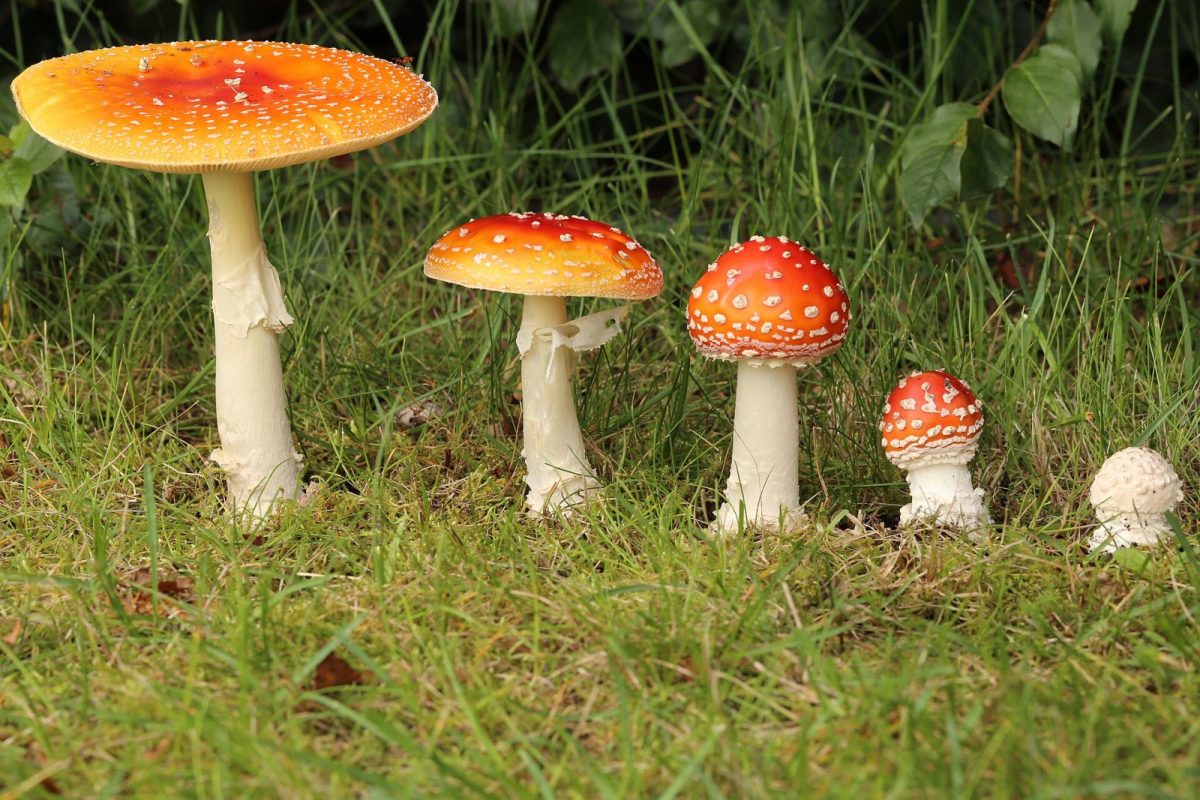
The Mushroom of All Mythologies
Few mushrooms have left as deep a mark on culture as Amanita muscaria. Various authors consider it the oldest visionary agent on record, with some placing its use among Siberian peoples six to eight thousand years ago. One frequently cited clue is linguistic: in several Siberian languages, the same root serves to name the mushroom and to mean “intoxication.” Panx has been proposed as one of the oldest words to designate it (Ott).
The trail extends to southern Europe. In Catalan, there is the expression estar tocat del bolet—”touched by the mushroom”—which anthropologist Josep M.ª Fericgla linked to this tradition. Fericgla also documented traces of recreational fly agaric use in Catalan Pyrenean towns like Berga and Ripoll. As early as the late 1970s, a psychedelic magazine of the era claimed to know elderly Pyrenean shepherds who would sniff dried, powdered fly agaric. It is best to take these testimonies for what they are: ethnography and oral history, not controlled studies.
An Unpredictable Spectrum of Effects
If anything distinguishes Amanita muscaria, it is the enormous variability of its effects. Descriptions collected in literature range from euphoria, disinhibition, and increased muscle tone—a desire to move, talk, or run—to the exact opposite: deep calm that can lead to a heavy sleep, sometimes described as a comatose but non-toxic state. Perceptual distortions (objects appearing larger or smaller than they are) and, less frequently, mystical experiences have also been reported.
The problem is that this spectrum does not correspond to a fixed dose or a stable pattern. Two specimens of identical appearance can have vastly different potencies, and the same amount can leave one person talkative and another unconscious for hours. It is precisely this unpredictability—not its toxicity—that makes this mushroom a poor candidate for any recreational use.
The Classic Error: Counting Caps
Much of the Amanita’s bad reputation stems from a method of “dosing” repeated in widely cited books: measuring by the number of caps. This is a criterion with no basis. The concentration of active principles varies enormously from one specimen to another and cannot be deduced from size or external appearance. Relying on a figure like “one large cap or two small ones” is equivalent to playing Russian roulette with your own consciousness.
Sources agree on another point that should be underscored as a warning, not a recipe: effects can take between one and three hours to appear. This delay has led more than one person to “redose,” believing nothing was happening, with dangerous results. We do not provide usage guidelines here; we only point out why the combination of a slow onset and unpredictable potency is especially treacherous.
The Legend of Muscarine and Real Chemistry
For a century, it was believed that the active principle of Amanita muscaria was muscarine, a compound that produces salivation, tearing, sweating, and digestive distress. This idea has proven incorrect for two reasons. First, modern analyses show that the European Amanita contains only traces of muscarine, below 0.0003% (Rätsch). Second, muscarine does not cross the blood-brain barrier, so it does not explain any mental effects.
Psychoactivity comes from another pathway. Analyses by Eugster (1969) on fresh material identified ibotenic acid at around 0.03% on average. As the mushroom dries, that acid transforms into muscimol, which is significantly more active at the central level. This is why traditions that used it employed the dried mushroom rather than the fresh one: drying is not a storage detail, but a chemical transformation. Important: understanding the chemistry does not make it safe. The margin between a mild effect and intoxication remains narrow and difficult to control outside a laboratory.
A Deadly Mushroom? What the Numbers Say
The “dark legend” presents Amanita muscaria as a lethal poison. However, authors who have carefully reviewed the subject document only one case of death attributed to an overdose of the mushroom (Ott; Rätsch). Estimates cited in the literature calculate that a lethal dose would require ingesting absurd quantities of the mushroom—on the order of several kilograms (several pounds)—which is practically impossible to consume.
None of this makes it harmless. That it rarely kills does not mean it is benign: falls due to loss of balance, episodes of agitation, vomiting, spasms, and prolonged states of unconsciousness are real risks, especially without a safe environment and sober company. Mycophobia exaggerates the danger of death; psychonautic enthusiasm sometimes minimizes the rest.
Rural Myths That Need Debunking
Beliefs presented as traditional knowledge circulate around the Amanita that do not withstand minimal scrutiny. That high-altitude mushrooms are “more potent” than those at low altitudes; that only those growing under birch trees are worth it; that the young specimen stimulates while the old one “makes you see”… These are claims repeated from book to book without verification, and experience documented in areas like the Pyrenees contradicts them time and again. The underlying lesson is methodological: folklore disguised as data abounds regarding psychoactive plants and fungi, and it should be read with skepticism.
From Wine Substitute to Christmas Decoration
The historical journey of the Amanita includes a curious chapter. In late 19th-century Italy, when phylloxera devastated European vineyards, physician Battista Grassi explored the dried mushroom as a “wine substitute” and tested preparations that, in very low amounts, produced according to his notes a light intoxication, without a hangover and without tolerance. Grassi’s accounts, later collected by Samorini, include euphoric scenes of his volunteers; they also include experiments performed on very young people that are ethically unacceptable today and should be read with that critical distance.
Legally, Amanita muscaria does not appear as an illicit substance in international conventions. In Spain, its commercialization for therapeutic purposes is restricted to homeopathic pharmacies (which offer the “Agaricus muscarius” tincture), while as a decorative object, it is perfectly common: in countries like Germany, it is, in fact, a standard Christmas ornament.
Critical Reading
Much of what has been written about Amanita muscaria mixes three registers that should not be confused: historical ethnography (Ott, Fericgla, Samorini), serious chemical analyses (Eugster, collected by Rätsch), and first-person accounts from self-experimenters. The first documents cultural uses; the second explains the pharmacology; the third is anecdotal testimony, valuable as culture but not as clinical evidence.
From a harm reduction perspective, three ideas summarize the situation. One: this mushroom is chemically unpredictable, and that unpredictability is its main danger. Two: its reputation for lethality is highly exaggerated, but its adverse effects (deep sedation, lack of coordination, agitation, digestive distress) are frequent and real. Three: there is no “reliable” way to dose it based on the specimen’s appearance, so any estimate based on size or number of caps is simply wrong. This article is not a usage guide: it is an invitation to understand a fascinating mushroom with a cool head.


