

From Literature to the Visual Image
In previous installments of this series, we approached psychedelic consciousness through the written word, where authors’ intentions were almost always explicit. We encountered figures such as Carlos Castaneda, with his apprenticeship chronicles alongside an alleged Yaqui sorcerer in the Mexican desert, and Lewis Carroll, whose Alice plunges into an illogical, parallel realm. Literature provided a hospitable canvas for narrating excursions into the mind’s least charted territories.
The visual arts demand something fundamentally different: they do not narrate the voyage; they display it. For this reason, visual art represents fertile—and slippery—ground for tracking that current of thought seeking knowledge, identity, or meaning by bypassing habitual perceptual filters. It is worth clearing up a common misconception at the outset: psychedelia and entheogens are routinely packaged together in popular culture, yet they are not synonymous. Many argue that the psychedelic impulse can manifest entirely without chemical substances. Dalí’s own career places this exact premise on the table.
“The First LSD Painter Without LSD”
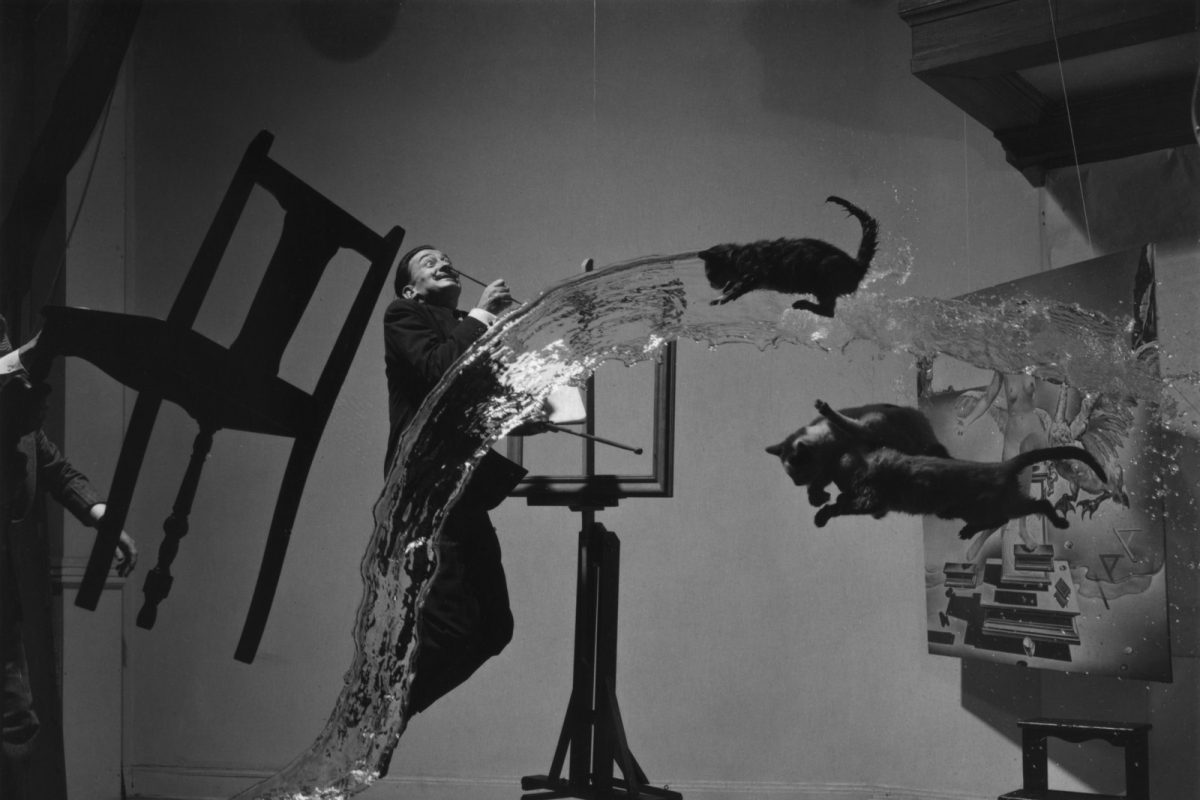
Dalí consistently denied ever taking drugs. Nonetheless, Timothy Leary and the San Francisco counterculture dubbed him the first LSD painter without LSD. The moniker is revealing: although the painter promptly distanced himself from American psychonauts, his canvases betrayed an ambition that mirrored theirs—to create and articulate vision through states of consciousness distinct from the ordinary.
Dalí was one of the most prominent faces of Surrealism. André Breton set the movement’s trajectory in his Surrealist Manifesto (1924), defining it as an attempt to “express the real process of thought, in the absence of all control exercised by reason, outside of aesthetic or moral preoccupations.” Dalí’s work does not strictly conform to mid-century psychedelic poster art, yet both share a defining impulse: evading the censuring filter of logic. Dalí himself formulated this in Conquest of the Irrational: the fact that he did not understand the meaning of his paintings while creating them did not mean they were devoid of meaning, but rather that their significance was “so profound, complex, coherent, and involuntary” that it eluded conventional rational analysis.
The Imprint of Freud and Dream Symbolism
The intellectual engine behind this entire movement was the unconscious. The Surrealists championed psychic automatism—thought flowing without rational mediation—as the primary gateway to the deepest recesses of the psyche. This synergy with contemporary psychoanalysis was no accident: by 1922, Dalí was devouring the writings of Sigmund Freud, who had become the movement’s intellectual idol. Reading The Interpretation of Dreams (1900) marked a definitive turning point, inspiring artists to compose directly from raw oneiric material.
Yet here lies a striking paradox. If dreams are spontaneous manifestations of the unconscious, relying on conscious memory to depict them inevitably rationalizes them, filtering them through the very analytical structure Surrealism sought to abolish. Surrealism constructed its philosophical program upon the dismantling of logic, yet remained in large measure ensnared within it.
In Dalí’s case, Freud’s influence crystallized into an idiosyncratic lexicon of personal symbols rooted in childhood trauma: the death of an older brother also named Salvador—whose ghost haunted Dalí with persistent identity confusion—the loss of his mother, estrangement from his father, and acute sexual anxieties. Ants, grasshoppers, eggs, drawers, and soft watches served as a structured vocabulary: ants signified decay and mortality; eggs symbolized love and the maternal womb; grasshoppers represented visceral dread. In The Great Masturbator (1929), this symbolic universe appeared fully realized, featuring a distorted self-portrait intertwined with motifs of longing, guilt, and his partnership with Gala. Dalí never hesitated to lay bare his deepest neuroses; in that respect, he remained radically faithful to Surrealism’s initial mandate.
The Paranoiac-Critical Method
What distinguished Dalí from his peers was a singular claim: having invented a systematic technique to liberate creative expression from conscious control. He titled it the paranoiac-critical method, characterizing it as a “spontaneous method of irrational knowledge” grounded in the critical interpretation of delirious associations. In practice, he claimed to access subconscious images that superimposed themselves upon physical reality.
His double images represent the clearest manifestation of this approach: Mae West’s Face which May be Used as a Surrealist Apartment (1934–35), where a parlor with fireplace, sofa, and pictures simultaneously outlines the actress’s face; Ballerina in a Death’s Head (1939); and his conceptual storyboards for Destino (1947), the animated collaboration with Walt Disney. This technique diverged from orthodox passive automatism, providing Dalí with an intellectual defense against charges that he had lapsed into conventional representation—an accusation he leveled against Breton and his circle. Fittingly, upon being expelled from the Surrealist group, Dalí famously retorted: “You cannot expel me, for I am Surrealism.”
These declarations warrant careful scrutiny. Dalí claimed to inhabit this method perpetually, existing in an unbroken state of involuntary image interpretation. This narrative sounds, at best, like carefully staged mythology. It provokes the same reasonable skepticism warranted by any grand claims about non-ordinary consciousness: what was it in concrete reality? An ecstatic trance, a self-induced hypnagogic state, or theatrical posturing? The artist himself never provided a definitive answer.
Eccentric, Showman, and Master Draftsman
Beyond his theoretical method, Dalí was above all a master of persona. He expanded his practice across jewelry design, cinema, advertising, and literature, displaying profound curiosity regarding nuclear physics, DNA, Einsteinian relativity, and Heisenberg’s uncertainty principle. He even composed a pseudo-scientific treatise on paranoia that he presented to Freud during their long-sought meeting; according to historical accounts, the founder of psychoanalysis did not bother to read it, leaving Dalí quietly crestfallen.
He was equally a controversial figure, routinely accused of turning art into commerce, blurring the boundary between masterpiece and consumer commodity, and prioritizing theatrical sensationalism—a commercialization that fueled his formal break with the Surrealists, punctuated by notorious publicity stunts such as delivering a lecture wearing a deep-sea diving suit. George Orwell captured this ambiguity concisely: one should be able to hold simultaneously that Dalí was both an exceptionally brilliant draftsman and an irritating human being, without one truth negating the other.
Critical Appraisal
The depiction of Dalí as an intrepid voyager of the unconscious is captivating, yet demands several critical qualifications. First, regarding epistemological foundations: the notion that Surrealism or psychedelic art reveals an objective “non-rational” truth is a cultural interpretation rather than an established fact. Dalinian motifs invite diverse psychological interpretations, and assigning them fixed meanings—like a dream dictionary—mirrors the rigid Freudian reductionism that modern psychology has largely superseded.
Second, regarding the paranoiac-critical method: it represents neither an empirically verifiable cognitive process nor a clinically recognized mental state, but rather a provocative branding device forged by the artist. Equating it uncritically with neurochemical states induced by entheogens or holotropic breathwork mistakes artistic metaphor for cognitive neuroscience. We must take care not to confuse evocative metaphors with empirical evidence.
Finally, a word on harm reduction: cultural romanticism surrounding non-ordinary states of consciousness must not be misconstrued as an encouragement for reckless experimentation. Entheogens are powerful psychoactive agents that entail genuine psychological, physical, and legal risks that no aesthetic lens can erase. Dalí’s legacy demonstrates above all that navigating the frontiers of human imagination can be explored—and vividly dramatized—through many creative pathways entirely independent of pharmacological substances.