
Beneath its yellow flowers, the Canary broom maintains an alliance with soil bacteria that helps explain its ecology, its presence in forest clearings, and its conservation value.
Second installment of the series “The Canary Broom: Science, History, and Myth.”
The most important part of the Canary broom is not always visible. Just a few centimeters below the surface, its roots can develop nodules where bacteria live, capable of transforming atmospheric nitrogen into forms the plant can utilize. The shrub provides carbon; the microorganisms provide access to an essential nutrient. It is an ancient, discreet, and costly chemical negotiation, yet it is decisive for understanding how a legume establishes itself on volcanic slopes, forest edges, and disturbed soils.
In brief
- The broom forms a symbiosis with rhizobia, including strains of Bradyrhizobium and Rhizobium.
- Conserving the species also implies conserving the microbial communities that sustain its nutrition.
- It is globally assessed as Least Concern, but remains a protected endemic species in the Canary Islands.
A Negotiation Underground
The air contains abundant nitrogen, but plants cannot directly utilize the N₂ molecule. Some bacteria, however, possess the necessary machinery. When a legume and a compatible strain recognize each other, the root forms a nodule: a specialized structure where the bacteria fix nitrogen and the plant controls oxygen, nutrients, and sugar supply.
The image of a plant that “manufactures fertilizer” is tempting, but it is an oversimplification. Fixation consumes energy and depends on phosphorus, moisture, temperature, acidity, and the availability of compatible strains. A root without the right partner does not gain the same benefit; an inefficient symbiosis can cost more carbon than it returns in nitrogen.
In the broom, this association connects visible botany with hidden biodiversity. A single specimen is not just stem, leaf, and flower: it is also a small underground ecosystem.
Not All Bacteria Serve Equally
In the late 1990s, researchers studied rhizobia isolated from various Canary Island leguminous shrubs. Some Bradyrhizobium strains showed a relatively broad capacity to nodulate different hosts. In contrast, a Rhizobium isolate, designated RES-1, proved much more selective and nodulated Teline canariensis.
The finding illustrates a mixed system. There can be generalist partners capable of establishing themselves with various legumes, and more specific relationships. That diversity offers resilience, but it also raises questions: Do the bacteria change between Gran Canaria and Tenerife? Are there local strains adapted to specific soils? Does a restoration project fail if the species is planted where its most effective symbionts are missing?
In 2005, Bradyrhizobium canariense was described—an acid-tolerant bacterium associated with endemic genistoid legumes. It is not exclusive to the broom, but its name serves as a reminder that the natural heritage of the Canary Islands includes microscopic organisms with their own evolutionary histories.
The Specialist of the Edges
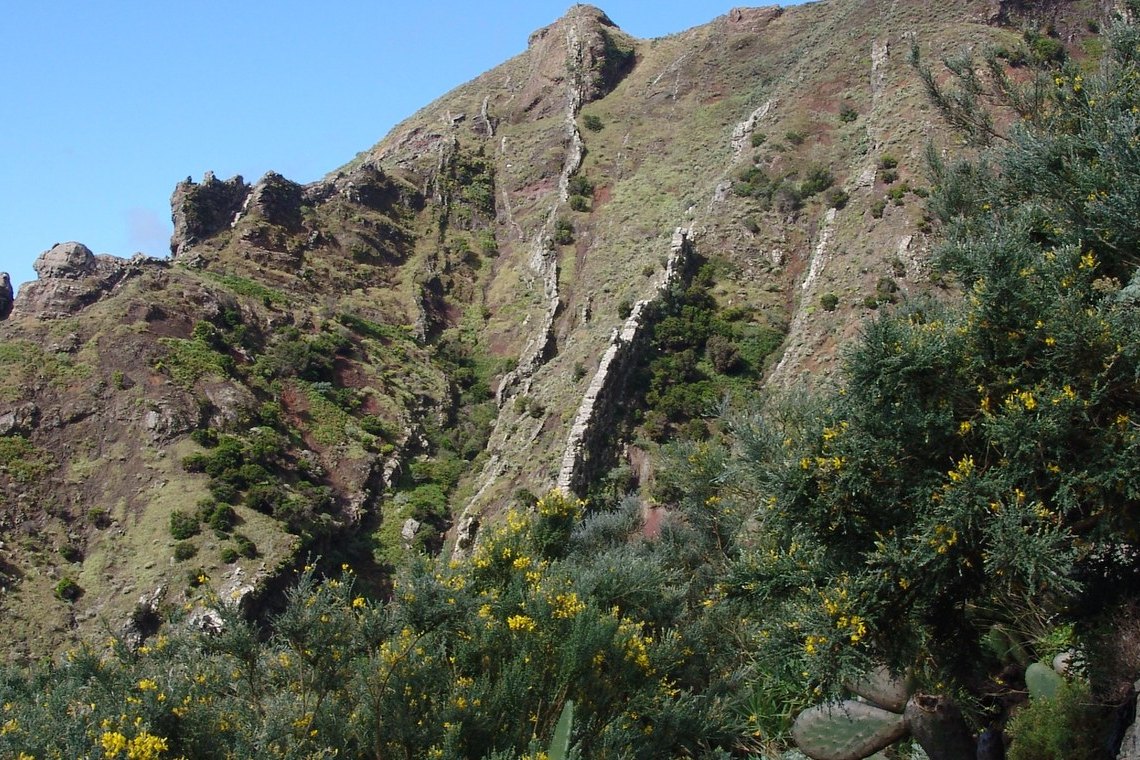
The broom frequently appears in rocky, sunny enclaves of the monteverde, along embankments, clearings, and trails. Additional light may favor its flowering and seedling establishment. The dry pods project seeds a short distance, and the hard seed coat characteristic of many fabaceae could allow some of them to remain in the soil until a disturbance opens up space.
However, several mechanisms remain unmeasured. The duration of the seed bank, the rate of self-pollination, the identity of its main pollinators, and the contribution of birds, rodents, or runoff to dispersal are not well understood. Nor are there long-term series on recruitment and mortality.
Its presence on a degraded edge can be interpreted in two erroneous ways. One is to assume that any disturbance benefits the plant. The other is to assume that a visible shrub is equivalent to a recovered ecosystem. Moderate opening can create opportunities; erosion, repeated fire, or soil loss can eliminate the conditions that make symbiosis and reproduction possible.
“Conserving a legume also means conserving the bacteria that make its nutrition possible.”
What It Contributes to the Monteverde
Nitrogen fixation can favor the accumulation of biomass and modify the immediate environment. Its branches provide structure; its flowers offer resources to insects; its leaf litter returns organic matter to the soil. In plant succession, a shrub of this type could facilitate the arrival of other species.

The keyword is “could.” The general function of legumes is well established, but the magnitude of the broom’s effect on the monteverde has not been quantified. How much nitrogen does it fix per season? Does it increase fertility under its canopy? Does it facilitate or compete with laurisilva seedlings? Which insects depend on its flowering? These are experimental questions, not minor details.
This caution does not reduce its value. On the contrary, it prevents turning a reasonable hypothesis into an ecological function proclaimed without measurements.
Least Concern Does Not Mean Expendable
The global assessment published in 2017 placed Genista canariensis in the IUCN Least Concern category. That label indicates that, with the available data, the species did not meet the threat thresholds. It does not mean that all its populations are stable or that the assessment is permanent.
The broom concentrates its entire natural global distribution on two islands. A fire, a construction project, a disease, or a sustained change in humidity and phenology can have different effects on each. For this reason, a monitoring program should separate Gran Canaria and Tenerife, recording size classes, flowering, fruiting, recruitment, mortality, herbivory, and genetic structure.
Furthermore, the Government of the Canary Islands considers it a protected species and includes it in Annex III of the 1991 Flora Order for both islands. The regime does not imply an absolute prohibition like that of stricter categories, but it does prevent the assumption that harvesting is free. Permission depends on the use, the land, the protected area, and the applicable regulations.
From the Mountain to the Corral: Forage Appeal and Its Limits
Canarian rural culture knew the broom as a forage resource and material for certain tools. Decades later, agronomic trials compared Teline canariensis with other endemic shrubs and with tagasaste. The results confirmed that it has productive interest, although tagasaste showed advantages in several parameters.
The problem is that a forage plant is not evaluated solely by protein. One must measure fiber, digestibility, minerals, tannins, alkaloids, palatability, and actual consumption. Studies detected seasonal variation and possible mineral imbalances in the set of species analyzed. The presence of quinolizidine alkaloids adds a layer of caution, especially for pregnant animals.
“Livestock eats it” may be an important ethnographic fact. It is not a toxicological threshold. Before recommending proportions in a diet, batch analysis, veterinary trials, and provenance control are necessary.
Conserving a Network, Not Just a Shrub
The Canary broom forces us to look at conservation at several scales. There is the visible plant, with its flowers and seeds. There is the genetic diversity that perhaps differentiates the two islands. There are the rhizobia, the pollinators, the herbivores, and the pathogens. There is the soil that allows them all to meet.
A restoration that only counts stems may miss half the story. Protecting the broom means maintaining the conditions that allow for the underground alliance, reproduction, and variation between populations. In the monteverde, even a shrub that thrives on the edges depends on a community that rarely appears in the photograph.
Sources
- Santamaría, M. et al. (1997). Characterization and differentiation of native rhizobia of Canarian legumes.
- Vinuesa, P. et al. (1998). Rhizobia of genistoid legumes of the Canary Islands.
- Vinuesa, P. et al. (2005). Bradyrhizobium canariense sp. nov.
- IUCN. Red List of Threatened Species — global assessment of Genista canariensis (2017).
- Government of the Canary Islands. 1991 Flora Order, Annex III.
- Chinea, E. et al. (2007). Forage evaluation of endemic leguminous shrubs.
Educational content written from a harm reduction perspective and with respect for individual freedom. It is not a substitute for advice from a healthcare professional and is not intended to encourage or condemn any drug use.