

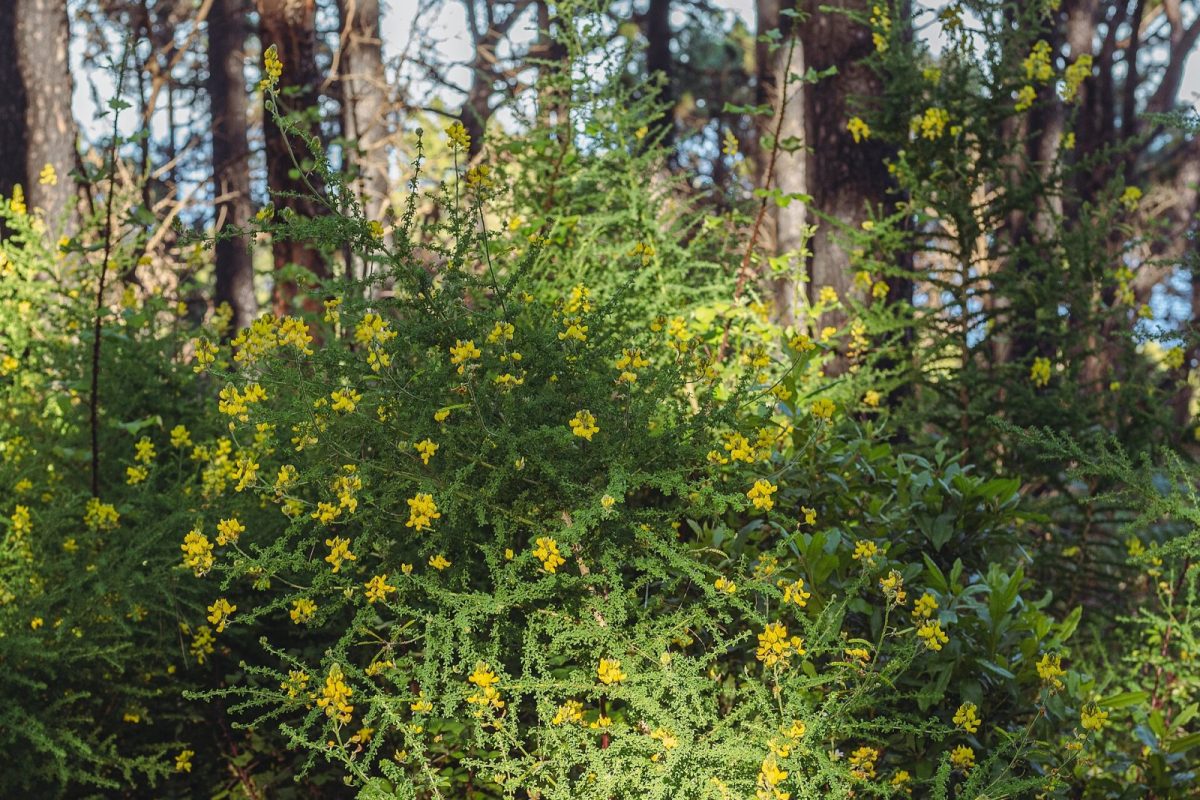
Cytisine, anagyrine, and N-methylcytisine account for the plant’s chemical interest, but also explain why folklore, pharmaceuticals, and home remedies are far from equivalent.
Part three of the series “Canary Broom: Science, History, and Myth”.
For years, one broom lent its chemistry to another. Manuals and popular science articles attributed to Canary broom a chemical profile dominated by sparteine and other compounds known primarily from Cytisus scoparius, Scotch broom. The confusion was understandable: similar common names, shifting botanical classifications, and literature that cited “broom” without specifying the species. When looking at studies that directly analyzed Genista canariensis, the story changes completely.
In brief
- A leaf sample analyzed in 1983 showed approximately 40% anagyrine, 39% cytisine, and 19% N-methylcytisine within the total detected alkaloids.
- These percentages describe a single sample and do not represent the percentage of leaf mass.
- Purified cytisine can serve as an approved medicine; the whole plant remains a variable and potentially toxic botanical mixture.
The Error of Borrowed Chemistry
Sparteine occupies an important place in the pharmacological history of Scotch broom. It was used as an antiarrhythmic and oxytocic agent, although its narrow therapeutic window and metabolic variability limited its clinical use. That pharmacological history was transposed far too easily onto Canary broom.
The problem is more than just nominal. Two related species can share families of metabolites while differing decisively in concentrations and relative proportions. A plant does not automatically inherit the chemical profile of another simply because they share the name “broom.” Establishing what a plant actually contains requires identified samples, rigorous analytical techniques, and, ideally, voucher specimens deposited in a herbarium.
The 1983 Chemical Snapshot
The comparative study by Michael Wink and colleagues, published in 1983, remains the most informative quantitative reference available for the species. In a leaf sample identified as Cytisus canariensis, the detected alkaloids were distributed approximately as follows: 40% anagyrine, 39% cytisine, 19% N-methylcytisine, and a small fraction of minor compounds.
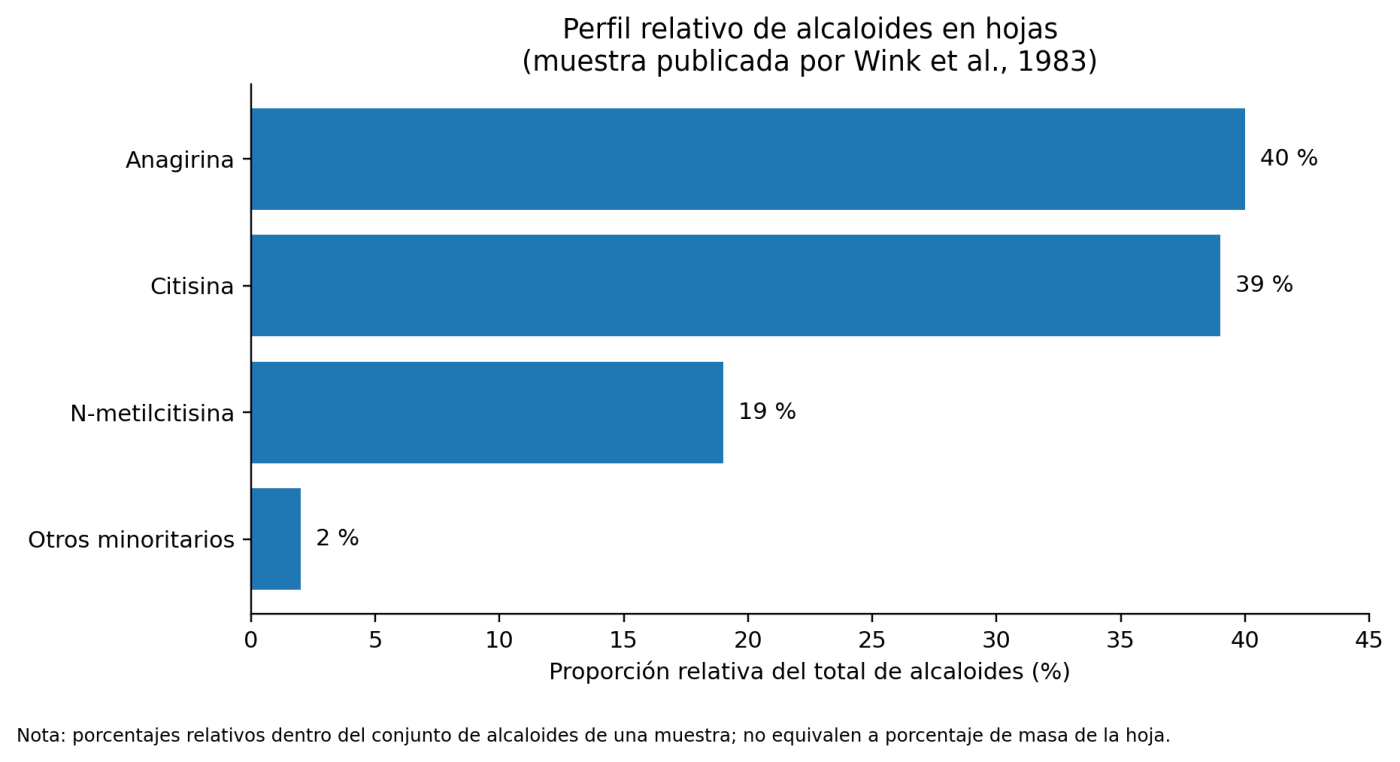
This finding requires two critical caveats. First, it is a relative proportion within the detected alkaloid fraction, not 40% of the total leaf mass. Second, it comes from a single sample. It cannot represent on its own every wild population on Gran Canaria and Tenerife, across all seasons and plant tissues.
The authors placed the total alkaloid content in a category of 100 to 400 micrograms per gram of fresh weight. That historical benchmark offers guidance, but does not replace modern chromatography using analytical standards, calibration curves, and validated detection limits. We still lack data on how alkaloid profiles vary across leaves, flowers, pods, seeds, bark, and roots.
Why Plants Produce Alkaloids
Quinolizidine alkaloids are derived from lysine and occur across numerous legumes. For the plant, they function primarily as chemical defenses. A herbivore biting a leaf may encounter bitterness, neurological disturbances, or sufficient gastrointestinal distress to discourage grazing. Defense efficacy depends on the herbivore, the tissue consumed, and the precise blend of compounds.
Their distribution within the plant is never uniform. Reproductive organs often receive greater chemical protection in many species, but Canary broom still lacks an organ-by-organ chemical profile. Concentrations can vary with plant age, genotype, season, herbivore damage, soil nutrients, and drought stress.
Cell culture work delivered another surprise. In cell suspension cultures, Wink and colleagues observed a profile dominated by lupanine, which made up nearly 95% of detected alkaloids. Intact leaves and undifferentiated cell cultures do not metabolize identically. Light exposure, developmental stage, vascular transport, and cellular compartmentalization all shape metabolic pathways. That is why lupanine from culture cannot be cited as the “primary alkaloid of the plant.”
“A medicinal molecule does not make the plant containing it a medicine.”
Cytisine: From Plant Toxin to Approved Medicine

Cytisine binds to nicotinic acetylcholine receptors. In purified, standardized formulations, it is approved in multiple countries as a smoking cessation aid. Clinical trials and systematic reviews demonstrate that it significantly increases abstinence rates compared to placebo or no intervention.
This pharmaceutical success illustrates an essential principle that is often misunderstood. A natural molecule can become an effective medicine when it is isolated, accurately dosed, clinically validated, and administered with clear contraindications. It does not prove that an infusion, crude extract, or smoked preparation of a plant containing that molecule is therapeutically equivalent.
The whole plant contains multiple alkaloids, unpredictable concentrations, raw plant material, and possible environmental contaminants. Route of exposure fundamentally changes absorption kinetics. Furthermore, the very same compound can transition from mild stimulant effects to severe neuromuscular blockade as dosage increases.
What Canarian Folk Medicine Records
The catalog of medicinal plants of the Canary flora by Pérez de Paz and Medina recorded traditional uses as an appetizer, topical wash, and diuretic associated with the flowering tops. This ethnobotanical record deserves preservation because it forms part of rural history and the cultural relationship between island communities and their flora.
However, an ethnobotanical record is not a clinical trial. Bitterness was commonly associated with appetite stimulation; topical application, with skin complaints; and European broom traditions, with fluid elimination. No clinical trials have evaluated Canary broom preparations to establish efficacy, safe dosing parameters, or superiority over standard medical treatments.
Claims regarding arrhythmias, hypotension, tumors, wound healing, or induction of labor are even more fragile. They generally derive from other species, historical sparteine literature, or historical sources where “broom” does not specify a taxon. Presenting them as confirmed properties of G. canariensis turns loose analogies into false certainties.
When Stimulation Becomes Intoxication
Nicotinic alkaloids can induce a biphasic clinical picture. Initial symptoms include nausea, vomiting, abdominal pain, salivation, sweating, headache, dizziness, tremor, agitation, and fluctuations in heart rate or blood pressure. With higher exposure, sustained receptor stimulation gives way to desensitization and blockade: muscle weakness, hypotension, cardiac arrhythmias, seizures, paralysis, and respiratory failure.
Anagyrine introduces veterinary and teratogenic concerns by analogy with toxic lupines, where it has been linked to skeletal deformities when maternal exposure occurs during specific gestational windows. No quantified threshold exists for Canary broom to evaluate this risk directly, but its presence warrants extreme caution.
Smoking does not “neutralize” plant toxins: it adds particulate matter, carbon monoxide, and combustion byproducts. Solvent extracts can unpredictably concentrate alkaloids. Topical application is likewise not inherently safe, especially on compromised skin or mucous membranes.
The Lesson of Its Chemistry
Canary broom is chemically fascinating precisely because much of its profile remains uncharacterized. We know it synthesizes anagyrine, cytisine, and N-methylcytisine; we know that plant tissue type and differentiation state reshape its profile; and we know these compounds exert pronounced neuroactive effects.
What remains unknown is equally critical: variation across islands, populations, organs, and seasons; non-alkaloid secondary metabolites; toxicokinetics; veterinary exposure; and clinical evaluations. The responsible conclusion is not that the plant lacks biological activity, but that biological activity, medical utility, and clinical safety are three entirely separate questions.
Safety notice. This article does not provide preparation, dosing, or consumption instructions. The species contains bioactive alkaloids and should not be used for self-medication.
References
- Wink, M.; Witte, L.; Hartmann, T.; Theuring, C.; Volz, V. (1983). Quinolizidine alkaloid accumulation in plants and cell cultures.
- Wink, M. (1984). Metabolism of quinolizidine alkaloids in legumes.
- Schep, L. J.; Slaughter, R. J.; Beasley, D. M. G. (2009). Nicotinic plant poisoning.
- Livingstone-Banks, J. et al. (2023). Cytisine for smoking cessation (Cochrane review).
- EFSA (2012). Scientific opinion on quinolizidine alkaloids in food and feed.
- Pérez de Paz, P. L.; Medina, I. (1988). Catalog of medicinal plants of the Canary flora.
Educational content written from a harm reduction perspective and with respect for individual freedom. It is not a substitute for advice from a healthcare professional and is not intended to encourage or condemn any drug use.


