

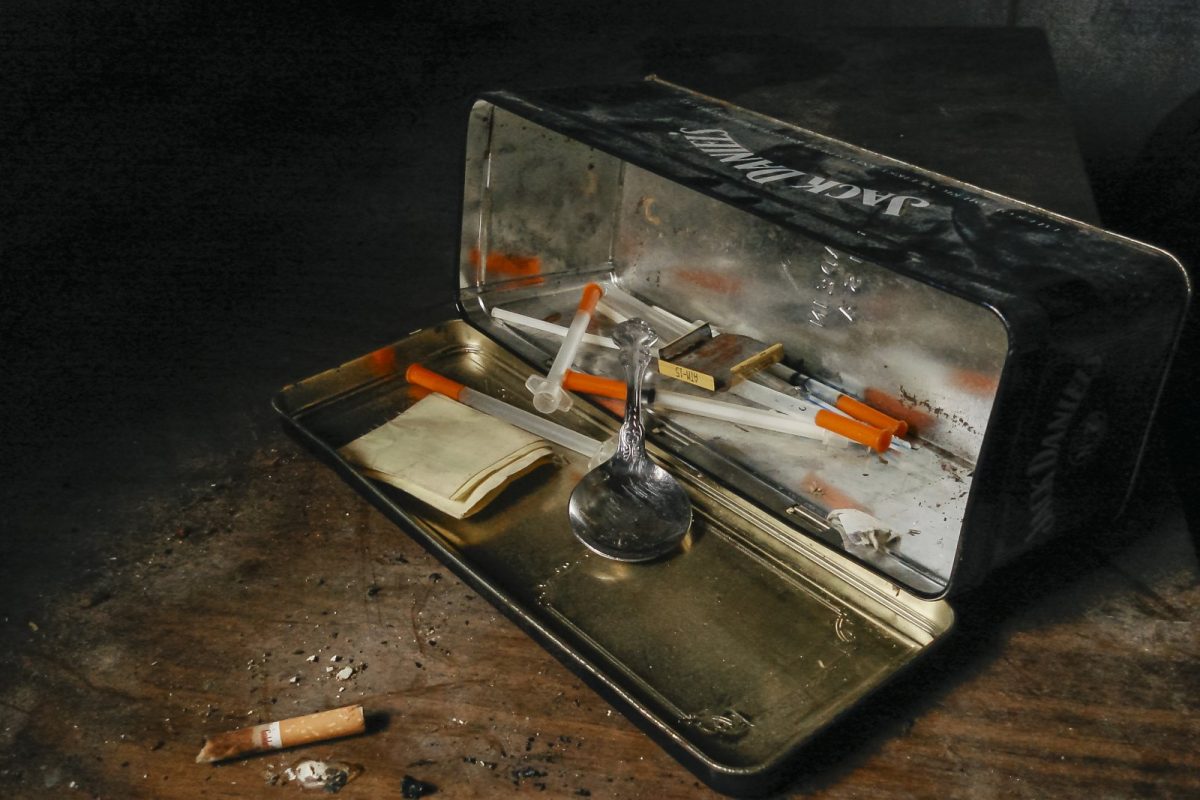
Two substances that rarely traveled alone
Those who have worked in harm reduction often repeat an uncomfortable idea for the popular imagination: in the most intensive consumption environments, heroin and cocaine rarely appeared separately. The British association Lifeline once described this coexistence with domestic metaphors—rice and curry, yin and yang—a graphic way of pointing out that wherever one was sold, the other was almost always available.
In street slang, this pair had its own names: duto for heroin, kisha for cocaine. Using them as a common thread allows us to tell a story that public opinion simplified for decades, reducing it to the figure of the “heroin addict” when the reality for many users was far more mixed. Madrid serves as a case study here: a city where the market, sales points, and consumption habits changed so much that it is hard to recognize in the 2000s what began in the 1970s.
The 1970s: From the initiated to the first boom
Recreational opioid use did not begin in that decade, but it was then that it took the form we recognize today. By 1973 and 1974, there was only a small circle of initiates in illicit heroin, largely upper-middle-class youth who supplied each other with material brought intermittently from places like Thailand or Amsterdam. There was no stable market yet, only a trickle of supply and a minimal clientele. In parallel, a broader social spectrum was already turning to pharmaceutical opioids for recreational purposes, and intravenous use was present from the beginning.
The situation accelerated at the end of the decade. Sources—both formal and testimonial—place the first major boom in consumption in 1978, which this time involved mainly working-class youth. From that moment on, one can speak of a full-fledged illicit market: fixed supply points, somewhat organized networks, and a more or less stable distribution. And, from then on, the heroin market was welded to the cocaine market.
It was a peculiar market due to its isolation: it operated on the margins of the rest of the illegal substance trade and sold, almost exclusively, those two. Petty dealing was spread throughout the city center, among the users themselves, while clans that would dedicate themselves to drug trafficking for decades began to settle on the periphery.
The nuance that the press of the time overlooked was made clear by a well-known anthropological testimony from those years, collected in the book La historia de Julián. Años de heroína y delincuencia (The Story of Julián: Years of Heroin and Crime). Its protagonist admitted that he considered himself “more of a cokehead than anything else” and that he only used heroin two or three times a day “to take the edge off.” The social label said one thing; the practice, another.
The 1980s and 1990s: The “hypermarkets” and the shift to smoking
By the end of the 1980s, street-level dealing in the center was losing ground to a more concentrated model: the so-called drug hypermarkets, settlements in peripheral neighborhoods that by the 1990s had come to corner most of the business. Names like Las Barranquillas or La Celsa became sadly familiar. In all of them, once again, heroin and cocaine were dispensed.
The most relevant change of those years was not the location, but the method. A good portion of users began abandoning heroin injection in favor of smoking it on aluminum foil. A note on harm reduction is appropriate here: the idea—widespread at the time—that smoking was “harmless” compared to injecting mixed a truth and an error. It is true that the smoked route reduces the risk of infections associated with injectable equipment (HIV, hepatitis, abscesses), a decisive factor in the midst of the AIDS crisis. But it does not make the substance safe: overdose, dependence, and respiratory damage remain. No change in the route of administration eliminates the risk; it only displaces some dangers and leaves others intact.
In the center, meanwhile, control of the dealing changed hands, and sales continued to take place right on the street. And at the end of the 1990s, a product appeared that would rearrange the board: cocaine base, known as crack.
The 2000s: The turn almost no one expected
The emergence of crack produced a curious effect. In some central enclaves, powdered cocaine—renamed “cruda” (raw) to distinguish it from the base—began to become scarce until it almost disappeared, a phenomenon that was also documented in consumption environments in the United Kingdom and the United States. In those areas, the smoked consumption of both cocaine base and heroin began to predominate.
In the large peripheral points, however, the usual assortment continued to be sold, now expanded with base and preparations that combined both substances. The presentations and forms of consumption changed, but the old alliance of duto and kisha remained intact. Until, well into the decade, that union began to crack in a way few anticipated: the moment the two substances stopped traveling together deserves its own story.
Critical reading
This history relies largely on accounts from protagonists and testimonial literature, not on homogeneous statistical series. This makes it valuable for capturing nuances that official figures erase—such as the dissonance between the “heroin addict” label and a consumption pattern that was actually two-headed—but it also requires taking dates and percentages with caution: memory reconstructs, simplifies, and sometimes dramatizes.
It is also advisable to resist two temptations. The first is to read these neighborhoods and plazas as a merely police-related problem: behind every settlement there was social exclusion, precarious housing, and drug policies that, by pushing consumption to the margins, multiplied the associated harms. The second is to idealize the past or the change in consumption routes: neither was smoked heroin harmless, nor did the disappearance of a substance from the market mean less suffering, only a different kind of suffering. Understanding this evolution serves, above all, to avoid the mistake of confusing the management of stigma with public health.


