

Why two people see the same world differently
Imagine a two- or three-year-old child sitting on a living room rug with two adults. Suddenly, one of those adults begins to levitate and spin around the room. The child would likely barely flinch, or show only mild surprise. The other adult, however, would move from disbelief to shock, and very possibly to fear, panic, or questioning their own mental health.
What separates one mind from the other? The answer lies in something so mundane we barely notice it: the concepts and categories we use to organize reality. The adult has learned solid rules about what “can” and “cannot” happen; the child has not.
The brain catalogs: concepts, categories, and illusions
The world presents features that we group into categories so we don’t have to memorize everything separately. Under the concept “fruit,” we fit bananas, strawberries, pears, or kiwis, and that label tells us what to expect: that it is edible, that it might need peeling, and that it doesn’t talk or move. This allows us to define a part of the world without examining it from scratch every time.
The problem arises when something doesn’t fit into any box. A whale is a mammal, but by shape and habitat, we associate it more quickly with a fish. That friction between what we perceive and the available category is exactly what optical illusions exploit: the brain tries to “catalog” what it sees immediately, even if it is sometimes wrong until it understands what it is looking at.
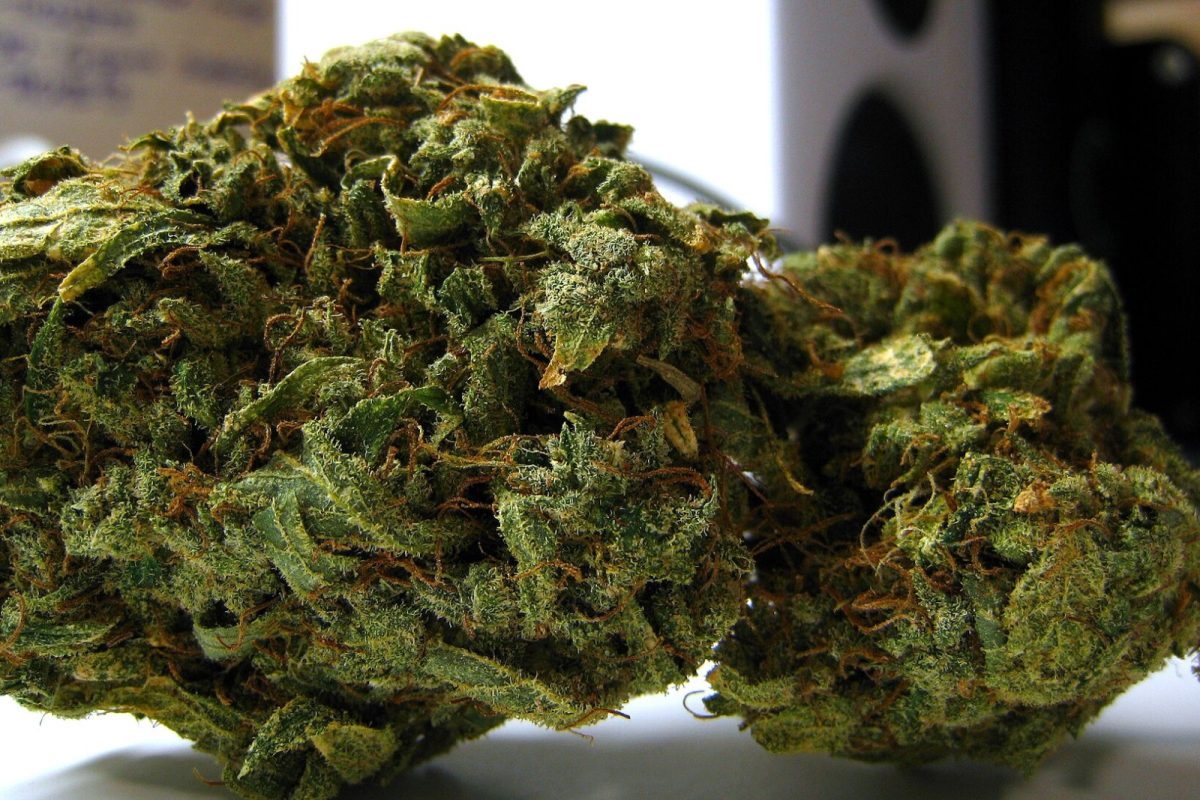
Here enters the protagonist: cannabis. Like other substances in the psychonaut’s pantry, it has been used for millennia to induce altered states of consciousness. In those states, the way the brain integrates information changes, so the outside world also seems to change, because the only world to which we have direct access is the internal one. The usual popular hypothesis is that cannabis loosens those conceptual barriers and lets information circulate and combine in different ways.
Convergent and divergent thinking
For a long time, being “intelligent” was associated almost exclusively with convergent thinking: starting from a set of data to find the only valid or conventionally accepted answer. It is effective, but it leaves the thinker trapped within the limits of the established.
Contemporary psychology gives increasing weight to divergent thinking: generating many different ideas or solutions from the same information, without closing oneself off to a single outcome. This is the terrain where creativity is usually situated.
The intuition of many users is that cannabis pushes toward this divergent mode. Consider the musical sensitivity some describe while high, or a musician who composes in that state: the result will be different from what would have emerged in sobriety. It is worth noting an important nuance: any notable alteration of the body and mind changes how we create. Going 48 hours without eating would also modify that music. Just because something is different does not automatically imply it is better or more original; that is a claim that must be measured, not taken for granted.
Dopamine, serotonin, and creativity: a hypothesis, not a certainty
Attempts have been made to anchor creativity in neurotransmitter levels, especially dopamine and serotonin. But what exists is a diffuse relationship, not a clean, causal one: the mind is too global a phenomenon to be reduced to the concentration of two molecules.
Hans Eysenck, back in the nineties, proposed linking dopamine and serotonin to creative thinking within his personality model. He described a dimension called psychoticism or “tough-mindedness” (not to be confused with psychopathy or a disorder), associated with highly competitive and achievement-oriented people. This intense motivation has been linked to high levels of dopamine, the neurotransmitter released when anticipating a reward, and some studies have connected it in turn to greater originality.
Serotonin enters this model as a regulator: when released in quantity, it tends to reduce dopaminergic activity. The interplay between the two is especially relevant in the mesolimbic and mesocortical pathways, where emotions, motivation, impulsivity, affect, empathy, and the combination of information are processed. The hypothesis is that certain imbalances in that equilibrium could favor more associative mental processes.
It is important to emphasize the “could.” These are useful explanatory frameworks for thinking, not proven laws. And none of this happens in a vacuum: learning, education, and cultural context weigh as much or more than any neurotransmitter when explaining why someone creates.
“Over-inclusion”: when filters are loosened
A classic concept for discussing creativity is over-inclusion, coined by Norman Cameron while studying thought in schizophrenia. It describes a reduction in mental inhibition that facilitates the production of new information and combinations—that is, mixing categories that we would normally keep separate.
The proposed logic is that cannabis, by altering that dopamine-serotonin balance, leads to handling information in a more global and open way, less tethered to the concrete concept. Hence the effects many people describe: relaxation, greater empathy, more tolerance for situations that previously caused tension, and that feeling of “connecting” disparate ideas that sometimes helps to look at a problem—a relationship issue, a stalled emotional situation—from another angle.
The fact that the origin of this concept lies in psychopathology should not be read as a validation: it is a reminder that loosening filters has two sides. The same openness that sometimes helps to associate can also disperse, saturate, or generate connections that seem revelatory but then hold no water.
Critical reading
It is best to take all of the above as a conceptual map, not a closed manual:
- Correlation is not causation. The relationships between neurotransmitters and creativity described by Eysenck and others are diffuse and debated. Reducing creativity to “more dopamine” is a simplification.
- “Different” does not equal “better.” Under the influence, one’s self-perception of their own output changes; what feels brilliant while high is not always so when reviewed while sober.
- Variable effects. Dose, strain, tolerance, expectations, and context greatly modulate the experience. What opens one person up may cause anxiety, blockage, or dullness in another.
- No consumption recipes. This text does not propose how, how much, or when to consume. If you decide to consume, the minimum framework is legality, being of legal age, not driving or operating machinery, avoiding mixtures, and paying attention to mental health history, where cannabis can act as a risk factor.
The relationship between cannabis and creativity is real as an object of interest and research, but it is far from a guaranteed shortcut. It serves more as an invitation to understand how our mind works—how we categorize, integrate, and sometimes overflow with information—than as a promise of inspiration on demand.