

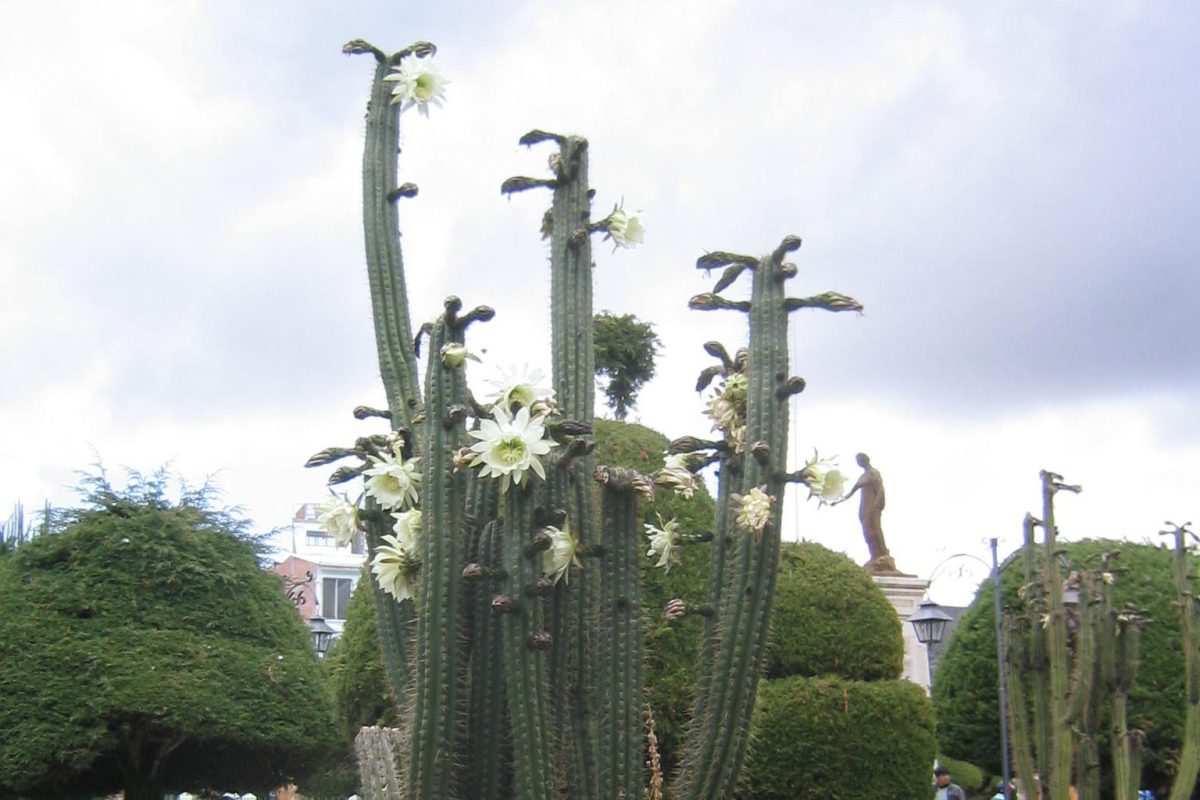
A Columnar Cactus and Many “Mescalines”
Under the common name San Pedro, several columnar cactus species of the genus Trichocereus (now reclassified by many botanists under Echinopsis) are grouped together. Native to the Andes, they have been used in traditional healing rituals in northern Peru for millennia. Their signature active compound is mescaline, the same phenethylamine alkaloid that made Mexican peyote famous.
An initial clarification is essential: “San Pedro” is neither a single plant nor a uniform chemical profile. It is a cultural umbrella term covering species, varieties, and ornamental cultivars that differ significantly from one another. This heterogeneity explains much of the confusion—and the risks—surrounding the cactus.
Reported Effects
Anthropologist Anthony Henman, one of the most prominent authors to popularize the subject in Spanish, describes the experience as a state of well-being, emotional openness, and “a great deal of love for everyone,” accompanied by a positive outlook on life. Henman goes so far as to claim he has never witnessed a “bad trip” with San Pedro and that, despite its intensity, he considers it “very safe.”
As an illustration of this emotional palette, an account often circulates about a European woman who, blocked from mourning a loved one’s death due to emotional numbness, turned to the cactus seeking catharsis; she described a protracted release of emotional tension that felt like finally moving through grief. These accounts are valuable as cultural and phenomenological testimonies, but they should not be read as clinical proof of therapeutic efficacy: context, expectations, and individual personality carry just as much weight as the molecule itself.
“Safe”? Nuance Is Needed
It is true that mescaline has a relatively wide margin of safety: animal studies report high median lethal doses, and there is no clear documentation of fatal overdoses directly caused by mescaline or San Pedro. However, “no documented overdose deaths” is not synonymous with “harmless.”
The positive affect described by enthusiasts coexists with common physical side effects (severe nausea and vomiting, tachycardia, elevated blood pressure, anxiety) and serious risks for individuals with cardiovascular conditions or a personal or family history of psychiatric disorders. Added to this are dangerous drug interactions, particularly with serotonergic pharmaceuticals or substances and monoamine oxidase inhibitors (MAOIs). Promoting an idea of “complete safety” is itself a risk factor when it encourages people to let their guard down.
The Real Issue: Unpredictable Potency
If there is one reality that should guide any honest appraisal of San Pedro, it is this: two nearly identical-looking specimens can have radically different mescaline concentrations. Published analyses, though scarce and incomplete, reveal massive variations.
Broken down by species, the figures reported in the literature (percentage of mescaline by dry weight) are approximate and widely divergent:
- Trichocereus pachanoi: from negligible amounts up to roughly 2% (Pardanani and McLaughlin, 1977).
- Trichocereus peruvianus: from virtually zero to nearly 0.8%, despite its reputation for high potency.
- Trichocereus puquiensis and cuzcoensis (=schoenii): low values, on the order of fractions of a percent, according to tests cited by Serrano (2008).
- Trichocereus bridgesii: traditionally used in Bolivia, but lacking reliable analytical data to substantiate specific percentages.
Henman argues that the distinction between species matters less than commonly assumed, claiming that growing conditions are decisive: grown in full sun and subjected to prolonged drought and stress, the cactus reportedly produces higher alkaloid levels. This hypothesis is intriguing and aligns with reports that abandoned, “wild” urban cacti can be surprisingly active, yet it remains unconfirmed by rigorous science, as available analyses rarely document plant age, the specific tissue tested, or prior growing conditions. One fact does appear solid: mescaline is remarkably stable and does not degrade over time—it has even been detected in thousand-year-old peyote found in archaeological burial sites (Ott, 2000).
The genus Trichocereus comprises more than 80 species. Of the roughly thirty tested that yielded positive results, only a handful contain substantial amounts, and many have never been analyzed at all. The rest is, largely, botanical folklore.
Regarding Homemade Preparations
Popular literature describes numerous methods to make the cactus palatable—boiling, reductions, culinary preparations—prompted by its intensely bitter taste and slimy texture. We do not detail these procedures or amounts here: that is not the goal of this article, and given the unpredictability of actual alkaloid concentrations, any “recipe” creates a false sense of control over an unknown quantity. From an educational perspective, the vital takeaway is recognizing the unresolved question behind any preparation: exactly how much mescaline the raw plant material actually contains.
A Critical Perspective
Much of the available information on San Pedro comes from popular and ethnobotanical publications (Henman, Ott, Rätsch, Berger, Gottlieb) and anecdotal accounts in countercultural magazines, rather than modern clinical studies. While these sources provide valuable historical and cultural context, they must be approached critically: they mix isolated lab data with subjective impressions, cite decades-old analyses repeatedly, and often convey an uncritical enthusiasm that minimizes real risks. Potency estimates should always be viewed as rough ranges, not reliable measurements for any specific plant.
Harm Reduction
Approaching this subject honestly requires acknowledging what remains unknown. The sheer unpredictability of alkaloid concentration makes it impossible to foresee the true intensity of an experience. Significant physical contraindications (cardiovascular issues) and psychological vulnerabilities (personal or family history of mental health conditions) apply, as do dangerous interactions with various medications and recreational substances. The legal status of mescaline and mescaline-containing cacti varies across jurisdictions and warrants careful research. Above all, in the event of acute distress—physical or psychological—the immediate priority is seeking prompt medical attention without withholding information from healthcare providers.