

A Culture of Tribes, Druids, and Forests
The Celts never formed a unified empire. They were a mosaic of Indo-European-speaking peoples organized into tribal confederations who, beginning roughly three millennia ago, expanded across much of Western Europe. By the 6th century BCE, they had already established a presence along the Atlantic coast of the Iberian Peninsula—Galicia and Portugal—later pushing into Navarre and Aragon, reaching their cultural zenith between the 4th and 3rd centuries BCE. Their society was structured around a tripartite hierarchy whose symbolic pinnacle was the druidic caste: priests, judges, healers, and custodians of a strictly oral tradition.
That lack of written records is essential to understanding the core dilemma: nearly everything we “know” about their relationship with psychoactive plants reaches us filtered through Greco-Roman authors—Diodorus, Posidonius, Pliny, and Strabo—who wrote about an alien culture, often with moralizing or propagandistic intent. Their accounts should be read as biased testimonies, not neutral ethnography.
The Amanita and the Forest as a Temple
Classical sources describe druidic rites held in forest clearings, featuring chanting, communion with the elements, and the ingestion of certain plants and fungi to “make contact” with other realms. Among these fungi, Amanita muscaria is frequently mentioned; it grows wild throughout the coniferous forests that once blanketed much of Celtic territory. The enduring consumption of mushrooms in regions with Celtic roots, such as Wales, is often cited as a distant echo of that ancient relationship, though this remains an evocative suggestion rather than definitive proof.
Here, a crucial caveat is in order: Amanita muscaria is a toxic mushroom, not a “recreational psychedelic.” Its active chemistry (ibotenic acid, muscimol) produces delirium, vomiting, and loss of motor coordination, and the margin between an active dose and severe poisoning is narrow and unpredictable. Ethnobotanical intrigue should never be mistaken for an invitation to experiment.
Nightshades and the God Belenus
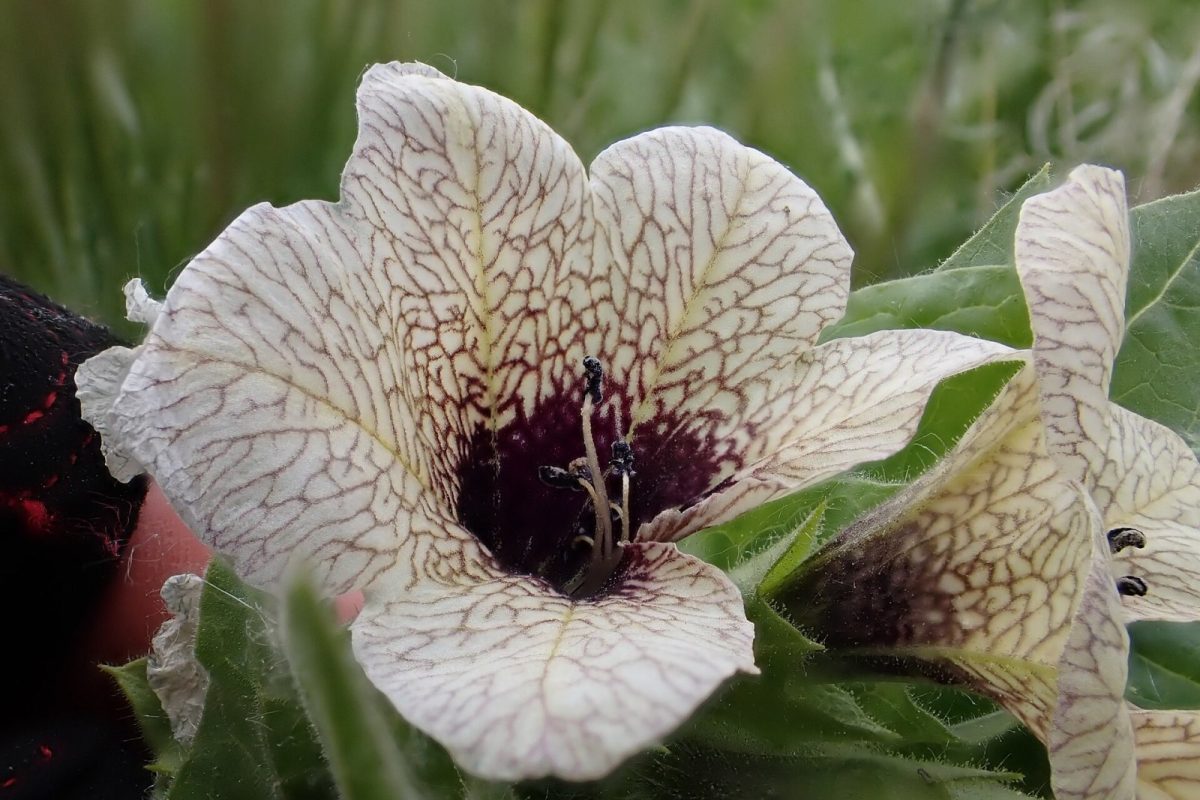
The Celtic connection to psychoactive nightshades—henbane, belladonna, mandrake, black nightshade, and datura—is among the best substantiated, as these plants appear repeatedly in association with European witchcraft. It is often noted that the Spanish name for henbane, “beleño,” may derive from the Gaulish god Belenus, a solar deity equated with Apollo to whom the plant was sacred; Pliny even went so far as to call it Apollonaris. In Asturias, a town named Beleño still exists today. The etymology is plausible but debated, and a linguistic hypothesis should not be mistaken for certainty.
What does align with the broader evidence is that Celtic Western Europe offered fertile ground for foraging and utilizing these plants. Their tropane alkaloids induce delirium, hallucinations, and sensations—levitation, flight, visions—that folklore later tied to witchcraft. They are also intensely toxic plants that can easily prove fatal, which explains why handling them was strictly reserved for specialists.
Hemp Entered Europe from the North
One of the most striking details is the Celtic role in spreading hemp. Neither the Greeks nor the Romans cultivated it systematically, largely because they could source it from the Celts, who as early as the 7th century BCE were trading through Massalia (modern Marseille), supplying the Mediterranean with rope, sailcloth, and tow. They utilized the plant for both its fiber and its flowering tops. Collections of Gallo-Roman pipes found in archaeological museums—Seville, Tarragona, Coulmier-le-Sec—have fueled speculation that they may have been used to smoke cannabis, given that tobacco did not reach Europe until the 15th century. This is a plausible conjecture, not a certainty: a pipe can hold many substances, and the archaeological record rarely preserves what was burned inside.
Opium Poppy, Yew, and Missing Alcohol
The Celts were also familiar with opium and rank among the earliest European cultures to cultivate the opium poppy: seeds have been recovered from Central European sites at Hallstatt (Austria) and La Tène (Switzerland). Far grimmer is the documented use of potions brewed from yew (Taxus baccata), an intensely poisonous tree, in episodes of collective suicide by tribes choosing death over surrender to the enemy.
Their relationship with alcohol was more nuanced. Plato grouped the Celts among peoples who “drink unwatered wine,” yet six centuries later Ammianus Marcellinus, writing from firsthand observation, noted that they did not cultivate vineyards and instead brewed “other drinks with similar properties.” In Hispania, beer was known as caelia or cerea; the Celtiberians produced mead from their abundant honey, while wine—costly and imported—was saved for grand feasts.
Cantabrians: Trance, Slaughter, and Resistance
The name of the Cantabrian Orgenomesci has been interpreted as a Celtic compound combining the roots for “drunkenness” (mesc-) and “slaying” (orgeno-): roughly, “those drunk on slaughter.” It likely designated an initiatory warrior fraternity whose purpose was to strike terror. The Irish epic “The Intoxication of the Ulstermen” echoes these ritual drinking bouts and midnight rides during Samhain. In the rugged mountains of Roman-era Cantabria, ancient sources also mention “guardians of the taboo,” women associated with potions, ointments, and poisons. Rome’s brutal suppression of their rebellion, led by General Agrippa around 19 BCE, left harrowing accounts—mothers killing their children, captives singing battle hymns while hanging on the cross—that brought Celtic independence on the Iberian Peninsula to an end.
The Druid as a Literate Shaman
The figure tying this entire pharmacopeia together is the druid: a shaman figure transformed into a hereditary elite within an oral yet highly sophisticated society. Classical accounts credit them with plant healings, the laying on of hands, and vocal chants ranging from gentle lullabies to fierce shouts intended to “cast out” the spirits of disease. It is very likely they commanded knowledge of nightshades and other potent preparations, reserving them for personal use or administering them in secret draughts. The Gauls even indulged a taste for the dried leaves of wild lettuce, which Dioscorides described as a “harsh drug.” Such purported feats—telepathy, divination, supernatural endurance—are best understood as cultural interpretations of altered states rather than literal facts.
Critical Reading
Much of the above draws on popular historical works in Spanish (including studies by Manuel Velasco on the Celts and Eduardo Peralta on the Cantabrians) along with classical chroniclers reinterpreted centuries later. This material is valuable but secondary, and it carries two distinct biases worth keeping in mind: the prejudice of Greco-Roman writers depicting an enemy, and modern ethnobotanical enthusiasm, which tends to see every mushroom or pipe as definitive proof of widespread “shamanism.” Where archaeology provides hard data—poppy seeds, pipes, hemp trade routes—the picture is grounded. Where only etymologies or folkloric parallels exist, honesty requires treating them as hypotheses. None of this serves as practical guidance: many of these plants and fungi are lethal poisons, and their significance is historical, not recreational.


