

A documentary born from an anthropological question
What role does an entheogen play within its ritual context, rather than outside of it? That was the starting question for fieldwork that began in early 2014 in the southern Ecuadorian Amazon. Authored by Mónica Hinojosa Becerra, Alexandra Raquel Abarca Aldean, and Isidro Marín Gutiérrez, the project used participant observation and visual anthropology to record the ayahuasca ritual—natem, in the Shuar language—in the community of Shaime.
The team, consisting of eight people including camera operators, a sound technician, and a director, lived with the community for two weeks. The result was an ethnographic-participatory documentary of about twenty minutes, filmed between July and August 2014 and presented on September 26 of that year at the Ibiza Ayahuasca Congress, organized by the ICEERS institute. The research was part of an agreement between the Technical University of Loja (UTPL) and the then-CONSEP, the Ecuadorian substance control agency.
Where it happens: Shaime, in the Upper Nangaritza
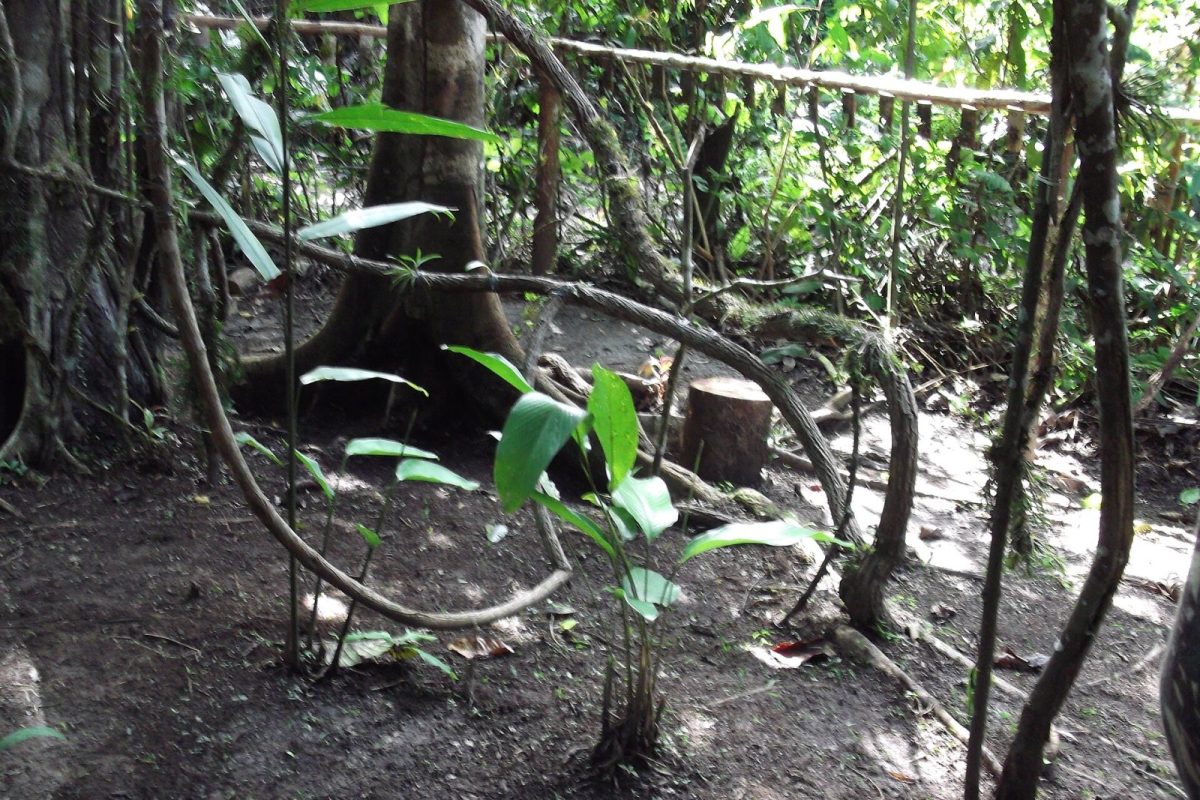
Shaime is a small town, populated mostly by Shuar and a minority of settlers, in the southeastern corner of Ecuador, near the border with Peru: Zamora-Chinchipe province, Zurmi parish, Nangaritza canton. The canton’s name comes from the Shuar Nankais, “valley or river of poisonous plants,” alluding to the river that crosses it. Getting there requires about six hours from Loja and, finally, fording the Nangaritza itself; on the day of filming, the rains had swollen it so much that the team had to disembark in a side creek.
The Upper Nangaritza is one of the areas with the highest biodiversity on the planet and, at the same time, one of the most fragile: roads, deforestation, colonization, and mining exploration put it under constant pressure. This is the backdrop for a process that the documentary portrays without idealization.
The Shuar people between tradition and modernity
The Shuar are an Amazonian people of about 80,000 individuals spread across Ecuador and Peru, in a territory that neither the Incas nor the Spanish managed to control. The word “Shuar” means “person” or “true people.” The historical stereotype that described them as irreducible “Jíbaros” clashes with the field experience: they are welcoming and generous with visitors.
The documentary does not hide the acculturation. In Shaime, people wear t-shirts, play indoor soccer, have electricity, shop at the store, speak Spanish, and pray in church. Family organization, hierarchies, and much of their way of life have changed. And yet, one thread persists: the consumption of natem. One of the study’s conclusions is precisely that—natem survives globalization and acculturation, no matter how intense they have been—though it should be taken as a case study hypothesis, not a general law.
Juan Chuinda, the shaman who sustains the practice
The protagonist is Juan Chuinda, one of the few shamans remaining in the area. He learned the craft starting in 2003 from a uwishin from Zamora, who passed on a way of understanding the inner world. The documentary is organized around his figure: the arrival in the community, his introduction, and an interview about how he conceives of ayahuasca, the gathering of ingredients, the preparation of the brew, the nocturnal ritual, and, finally, the farewell.
You can watch the full piece below:
What is natem from an ethnobotanical perspective?
“Ayahuasca” is a Quichua term: from aya (dead, spirit) and huasca (vine), “the vine that leads to the world of the dead”; also “vine of the souls.” Among the Shuar, it is called natem, a term that designates both the brew and one of its plants, the Banisteriopsis caapi vine.
Its pharmacological interest lies in a combination: the vine provides monoamine oxidase inhibitors (MAOIs)—the same family as the first antidepressants—and a second plant provides N,N-dimethyltryptamine (DMT), a psychedelic tryptamine naturally present in many plants. DMT is inactive orally because the body degrades it; its effects only manifest in the presence of an MAOI. That two different plants are combined specifically to bypass this barrier is one of the ethnobotanical findings that most intrigues science, and it is a source of controversy: there were attempts to patent varieties of the vine in the United States that were stopped by the opposition of indigenous communities.
Archaeological evidence in Ecuador suggests a long-standing use of these mixtures in the Amazon region. The “millennia” figures that circulate should be taken with caution: they depend on specific findings and their interpretation, and do not equate to a documented, uninterrupted continuity.
The ritual, without an instruction manual
We describe here what the documentary shows, not a user guide. Preparation is a manual and prolonged process carried out by the shaman: the vine is chopped and boiled for hours along with the plant that provides the DMT until a thick, dark, and very bitter liquid is obtained. The ritual takes place at night and in the dark, for about three hours, in a sound environment guided by Juan.
Ethnographic accounts agree that the beginning is physically harsh: nausea, vomiting, sometimes diarrhea—which in Shuar culture are interpreted as cleansing—tremors, slow pulse, and pupil dilation, hence the photophobia and the darkness. Once that threshold is crossed, visions appear: landscapes, animals, lights and geometric shapes, figures of living or dead people. The participants in the filming described the shaman as gigantic and luminous, in reds, greens, and blues; one compared it to the aesthetic of Tron (1982). The next day, according to the testimonies, the head “feels clear.”
These descriptions come from subjective experience and classical anthropological literature (Karsten, Fericgla, Larraya, Panera, Schultes), not from controlled measurements. It is best to read them as culturally shaped experiences, not as proof of “paranormal” phenomena—clairvoyance, vision of the future—that those old sources sometimes take for granted.
Critical reading and harm reduction
This piece is valuable as a portrait of a specific case at a specific moment, not as a manual or an endorsement of recreational or self-managed use. Some nuances that help read it well:
- Context, not formula. What gives meaning to natem among the Shuar is a ritual, communal framework and the figure of a specialist. Taken out of that, it ceases to be what the documentary describes.
- Real risks. The combination with MAOIs is not harmless: it interacts with numerous drugs (including several antidepressants) and certain foods, and is contraindicated in cardiovascular problems and some psychiatric disorders. The physical effects described—vomiting, pulse alterations—are not anecdotal.
- Tourism and cultural extractivism. The global rise of ayahuasca puts pressure on fragile communities and ecosystems like those of the Upper Nangaritza. Romanticizing the ritual without addressing that context reproduces the same logic that the documentary denounces.
- Sources of their time. The cited ethnographic bibliography is real and useful, but part of it is old and mixes observation with interpretations that are difficult to support today.
The work was conceived as a first contact, with the intention of continuing to investigate other communities and entheogenic rituals in Ecuador. As educational content, its best use is to understand a cultural practice in its place, not to replicate it.


