

A plant older than almost everything we remember
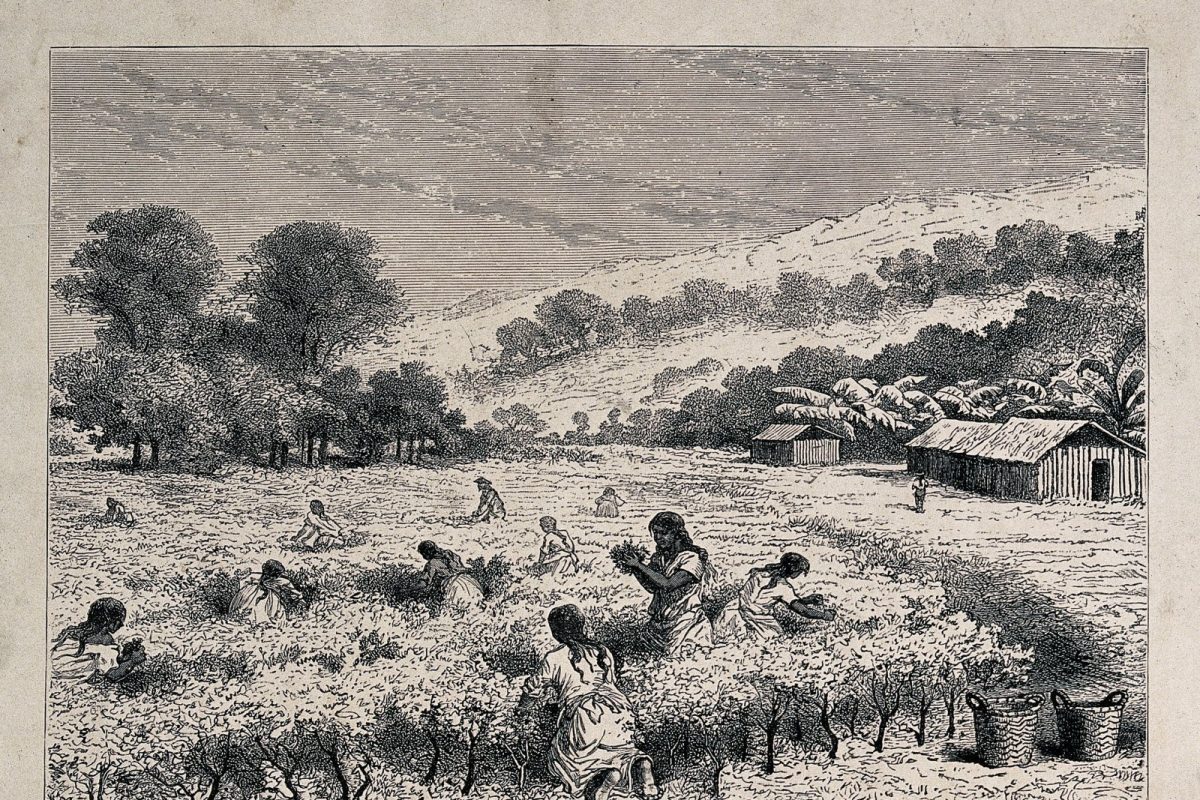
The coca shrub (Erythroxylum coca) grows on the warm, humid slopes of the Andes in what are now Colombia, Bolivia, and Peru. Its relationship with humans is so long that it is difficult to find a starting point: in northwestern Peru, archaeological remains have been found that place its use as far back as the sixth millennium BCE. We are not talking about a trend or a colonial vice, but a botanical companion that predates much of the region’s written history.
In those settlements, chewed leaves appear alongside calcium-rich stones. This combination is no coincidence: the lime obtained from them helped the leaf release its alkaloids during chewing. It is a revealing detail, as it shows practical knowledge refined over generations, transmitted without laboratories or manuals.
A privilege before a custom
Everything indicates that, in its origins, chewing coca was not available to just anyone. Findings suggest consumption was restricted to specific individuals, which aligns with what we know of the Inca Empire: the leaf was reserved for the nobility and the priesthood. The emperor himself could grant the right to consume it as a reward for services rendered. In this way, coca functioned less as a recreational stimulant and more as a marker of hierarchy and political favor.
That logic broke down with the conquest. After the fall of the Inca Empire in the 16th century, traditional restrictions crumbled and consumption spread to the working classes. The plant ceased to be a privilege and became a mass practice, set against a backdrop of violence and the dismantling of Andean structures.
Prohibiting, tolerating, and, above all, taxing
The Spanish attitude toward coca summarizes the contradictions of colonial power well. At first, they condemned it for religious reasons, viewing it as a pagan superstition that should be eradicated. But the calculus soon changed. The leaf proved to be a significant source of income: it was even used to pay taxes.
The second motive was more brutal. The colonizers observed that by chewing coca, indigenous workers could endure grueling shifts, including the extraction of gold and silver in mines. The plant they once wanted to prohibit became tolerated and encouraged because it sustained a system of exploitation. It is important not to romanticize this period: coca did not “improve” the lives of those who consumed it under colonial rule; rather, it helped extract their labor.
The long European disinterest
During the first two centuries of Spanish presence, coca remained, in European eyes, a South American oddity. The physician and botanist Nicolás Monardes described it in his Joyfull Newes Out of the New Found World (1574) and brought leaves to the Old Continent around 1580, but it barely sparked curiosity. A practical problem was influential: the leaves lose their properties over time, so what arrived in Europe was already a shadow of what was consumed in the Andes.
Neither the poem that the Englishman Abraham Cowley dedicated to the plant (“A Legend of Coca,” 1662) nor the mention in the Institutiones rei medicae (1708) by the Dutch physician Herman Boerhaave were enough to popularize it. And it is understandable: a slow, sustained stimulation that requires chewing for hours alongside an alkaline substance did not mesh well with the European mentality, which was more impatient and inclined to seek rapid, concentrated effects.
From leaf to alkaloid
European interest took off in the mid-19th century, when various naturalists traveled through South America and saw firsthand how the natives consumed the leaf and the physical endurance it seemed to provide. Observation was followed, almost inevitably, by the impulse to isolate its active principle. This was achieved for the first time in 1855 by the German chemist Friedrich Gaedcke (1828–1890), who named it erythroxyline in honor of the plant from which it originated.
This gesture, seemingly a mere laboratory milestone, marked a change of era. Separating the molecule from the leaf turned a cultural and ritual practice into a chemical substance that was manipulable, dosable, and, eventually, marketable on a large scale. Here, coca and cocaine cease to be synonyms and begin to tell different stories.
Critical reading
A good portion of the narratives regarding coca carry a double bias. On one hand, there is the temptation to exoticize it, as if the entire Andean culture revolved around it. On the other, there is the tendency to demonize it due to its kinship with cocaine. Neither reading does justice to a plant that, for millennia, has had diverse ritual, social, medical, and economic uses.
Three nuances should be kept in mind. First, the leaf and the alkaloid are not the same: traditional chewing releases the active principle slowly and in a diluted form, far from the effect of the isolated compound. Second, the history of coca is permeated by power dynamics—Inca privilege, colonial exploitation, fiscal business—that should not be erased under a sanitized narrative. And third, the leap from the 19th-century laboratory opened a subsequent chapter, that of the medicalization and prohibition of cocaine, whose health and social effects deserve to be analyzed with a cool head and a harm reduction approach, without nostalgia or alarmism.


