

A substance that was both god and problem
Few cultures have contemplated intoxication with as much ambivalence as the Greeks. Wine was not merely a beverage; it was a power that could elevate the spirit to sacred delirium or sink it into a state of stupor. This tension—between what liberated and what decomposed—permeates much of their poetry, theater, and philosophy.
It is no coincidence that the debate over regulating or tempering consumption appeared among the tragedians. Aeschylus and other authors, whose works have largely been lost, presented drunkenness as a model of stupor against which one should be protected. Yet, even as moderation was being debated, the orgiastic rites of Dionysus were an official cult in 5th-century BCE Athens, occupying several weeks of public festivals each year. The society that theorized about the dangers of inebriation simultaneously celebrated it as a state ritual.
Dionysus: The god who arrives from abroad
Dionysus—the Bacchus whom Rome would later assimilate, conflating him with the Italic Liber Pater—was the god of wine in the broadest sense: not just its toxic power, but its social footprint. He was considered a promoter of civilization, a legislator, a lover of peace, and a protector of agriculture and theater. Above all, however, he was a god of mystery rites, related to the mysteries of Demeter and Persephone at Eleusis and, according to many researchers, the result of a syncretism between a Greek nature deity and an older god from Thrace or Phrygia, such as Sabazios.
His atmosphere has its own markers: the bull, the serpent, ivy, and wine. Alongside the grapevine, the fig tree and ivy—his wild and sterile counterpart—were also sacred to him. Myth also presents him as a god “who comes”: rejected by princes who feared the disorder and madness associated with his cult, he wanders in a frenzy caused by Hera, is cured by Cybele in Phrygia, and travels across Asia—including a long expedition to India—teaching the cultivation of the vine before imposing his cult in Greece.
A small fable encapsulates his moral of consumption. It is said that Dionysus transplanted a fragile vine stem into the bone of a bird, then a lion, and finally an ass, before it bore fruit. Hence the states induced by wine: in the right measure, it makes the drinker as cheerful as a bird and as strong as a lion; in excess and by habit, it degrades them like an ass. The warning is contained within the myth itself.
How they drank: Water as the norm
Greek wine traveled far in ancient times. By the Mycenaean period (1600–1100 BCE), it was exported to Egypt, Syria, and Sicily, and by 1000 BCE, the Greeks called present-day Italy the “Land of Wines.” Homer, around the 8th century BCE, already mentions the aging of wine in wooden vessels.
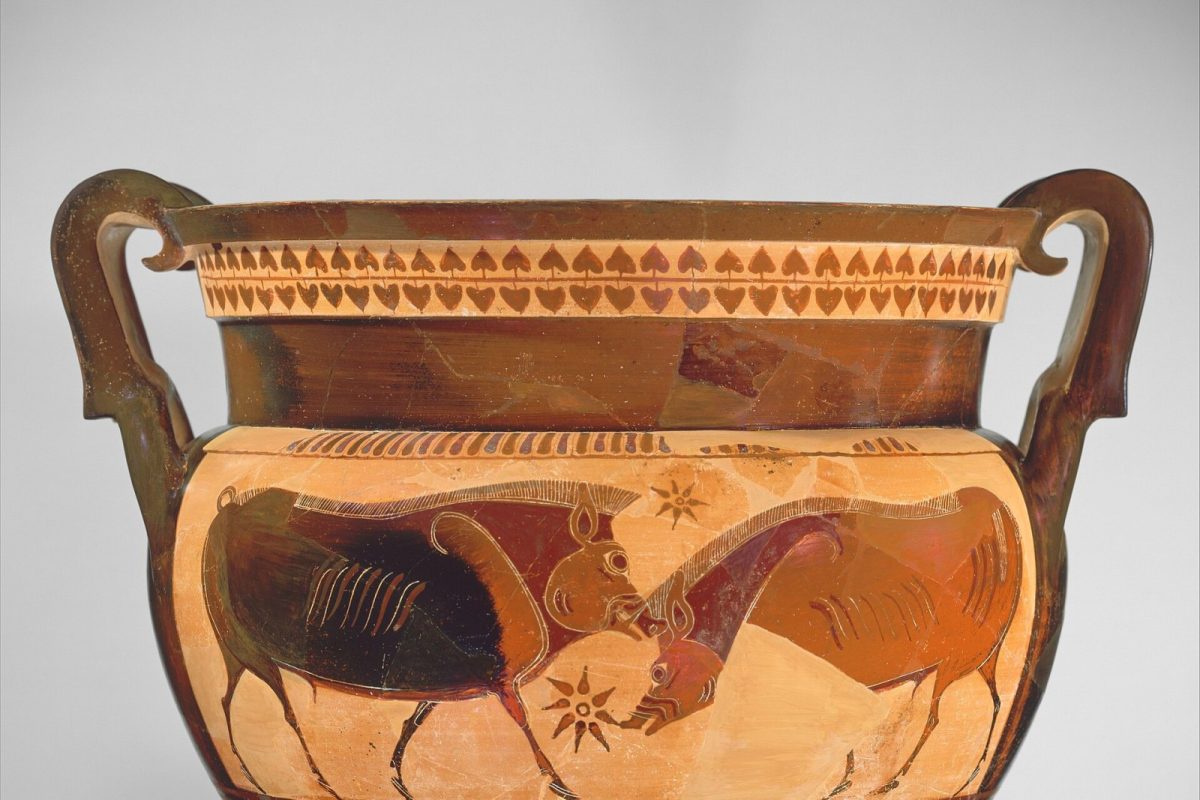
The cultural key, however, was not just drinking, but drinking wine mixed with water. Diluting wine was the social norm, and doing the opposite—drinking it pure—was considered barbaric and a precursor to uncontrolled intoxication. At banquets, a master of ceremonies regulated the proportions and set the limits. Historical sources describe wines so concentrated that they were diluted with many parts of water, to the point that the capacity of the kraters suggests this systematic dilution.
This fact raises an interesting question. Since the Greeks did not distill and natural grape fermentation does not exceed 14%, some historians have suggested that certain ancient wines may have incorporated other plant ingredients—perhaps based on Egyptian recipes—that reinforced or modified their effects. This is a hypothesis, not an established fact, and should be treated as such: literary descriptions of extreme drunkenness do not, on their own, prove the presence of additives.
Wine in poetry: Between mirage and bliss
Archaic poetry turned intoxication into literary material. In Archilochus, wine appears as a source of mirage: his companion Glaucus, his vision clouded by drink, believes he perceives a desire and an erotic vision that do not exist, and the poet warns him of the panic he will feel when the effects wear off. The reading is lucid and far from complacent: wine, he suggests, makes one bolder but also more gullible.
Alcaeus of Mytilene (c. 630–580 BCE), an aristocrat from Lesbos, a contemporary and supposed lover of Sappho, and later translated into Latin by Horace, sang of wine as a consolation against adversity: “There is no better medicine than to bring wine and get drunk” (fr. 335), or, recalling that it was the son of Zeus and Semele who gave it “to forget sorrows” (fr. 346).
Anacreon (572–485 BCE), the quintessential court poet, made pleasure his program. His hedonistic and refined lyricism celebrates love and wine while rejecting war and old age. Yet, even in his praise of the feast, he insists on measure: he asks to be served “ten ladles of water and five of wine” to celebrate the festival of Dionysus “without excess” and “without barbarism,” amidst beautiful songs and not “like the Scythians.” The poet of the banquet himself remembers the boundary between celebration and debauchery.
The playwrights and the violent face of the cult
Theater captured both the sociability of wine and its dark undercurrents. The historian Athenaeus and the poet Ion of Chios pass down anecdotes about the sympotic lightness of Sophocles (495–406 BCE), author of Antigone and Oedipus Rex, at banquets marked by gallantry and wit.
Aeschylus (525–456 BCE), considered the creator of tragedy, showed the terrible reverse. In a lost play, he narrated the vengeance of Dionysus against Lycurgus: the king who pursues the maenads goes mad, kills his own son with an axe, believing him to be a vine stock, and, after regaining his reason, sees sterility spread across his lands until he is torn apart. Critics have read this as a possible agricultural allegory—the need to prune the vines—but the story is primarily a warning about the power of a god who cannot be denied without consequences.
The list is completed by figures such as Epicharmus, a Sicilian comic playwright who, according to an ancient source, was the first to put a drunkard on stage and who considered lyric poetry incompatible with sobriety; or Semonides of Amorgos, a satirist of harsh fame. In that tradition, many poets challenged teetotalers to “toast with the cup of authenticity” in honor of “manly” drinkers like Homer, despising the “water drinkers.” The very praise of excess was, also, a literary stance.
Wine as a remedy: Plato, Hippocrates, and the idea of phármakon
Greek thought was not limited to celebrating or condemning. In Plato’s Symposium, intoxication produces memory loss and confusion of identities—Socrates goes unnoticed by a drunk Alcibiades—and the philosophical reflection underscores its exciting and disorienting effects. Opposing the tradition that saw wine as a poisoned gift meant to drive men mad, another tradition defended its ethical, therapeutic, and even ecstatic virtues.
Hence the epithet of Dionysus as “The Physician”: an ancient source summarizes that wine, taken sensibly and mixed, nourishes the body and spirit and serves in medicine, while in excess it produces insolence, delirium, or paralysis. Hippocrates, in the same vein, considered it “admirably appropriate for man” in both health and sickness, provided it was administered “opportunely and in just measure, according to individual constitution.”
Plato himself, in the Laws, proposes regulation by age: prohibition for the young, strict moderation until maturity, and, only after forty, permission to invoke Dionysus at banquets. There, wine appears as phármakon, a word that in Greek means both remedy and poison: a relief for “the rigor of old age” that, when misused, becomes harm. That ambiguity—neither pure blessing nor pure evil—is perhaps the most enduring contribution of Greek thought regarding intoxication.
Critical reading
These materials should be read with a degree of caution. Much of what we know comes from poetry, theater, and philosophy—genres that stylize and exaggerate. A drunken stupor described in verse is not a clinical report. The dilution figures or scenes of delirium serve a literary function and should not be taken as reliable measurements.
The hypothesis that some ancient wines contained plant additives is suggestive but debated, and it moves in the realm of historical conjecture rather than firm evidence. Nor should the “Greek model” be romanticized: behind the praise of the symposium lay inequality, the exclusion of women from the male banquet, and real ritual violence, as the myth of Lycurgus reminds us.
It is worth rescuing an intuition that remains valid: the idea that the same substance can be a remedy or a harm depending on the dose, the context, and the person—the phármakon—and that no brew makes the drinker wise. It is, at heart, an early lesson in harm reduction formulated in the language of myth.
For further reading, one may consult reference works on the subject, such as General History of Drugs by Antonio Escohotado, the studies by Jean-Pierre Vernant and Pierre Vidal-Naquet on myth and tragedy in Greece, or The Road to Eleusis by Wasson, Hofmann, and Ruck. Translations of poetic and philosophical fragments vary by edition.


