

The Paradox of Treating Addiction with More Addiction
When we talk about substance dependence, we tend to think of heroin, cocaine, or amphetamines. But the bulk of the problem in industrialized nations involves legal substances—alcohol and tobacco—and, above all, prescription drugs. Prescription opioids are now among the leading causes of overdose deaths in places like the United States, where their use skyrocketed during the late 1990s and early 2000s, fueling a full-blown public health crisis. The healthcare, criminal justice, and lost productivity costs tied to substance abuse run into hundreds of billions of dollars each year.
What is striking is how little pharmacology has managed to deliver in return. There is no clear-cut pharmacological treatment for cocaine addiction, and the options available for alcohol and tobacco yield modest results. When it comes to opioid dependence, the dominant response is substitution therapy: swapping street heroin for a long-acting opioid, primarily methadone.
This introduces a contradiction that deserves an honest look. Methadone alleviates withdrawal symptoms and helps many people transition away from the illicit market, but it is itself a drug with high addictive potential and a lengthy, brutal withdrawal profile. It is not uncommon to find individuals enrolled in maintenance programs for ten, fifteen, or twenty years, tapering their dose at a glacial pace without ever fully stopping. The clinical narrative supporting this chronicity—the claim that the “endogenous opioid system” is irreversibly damaged and requires lifelong supplementation, much like a pancreas failing to produce insulin—lacks solid etiopathogenic evidence. It functions more like a convenient metaphor. The result is a chronic patient whose condition is defined, in large part, by the treatment itself.
Iboga, Bwiti, and an Unconventional Alkaloid
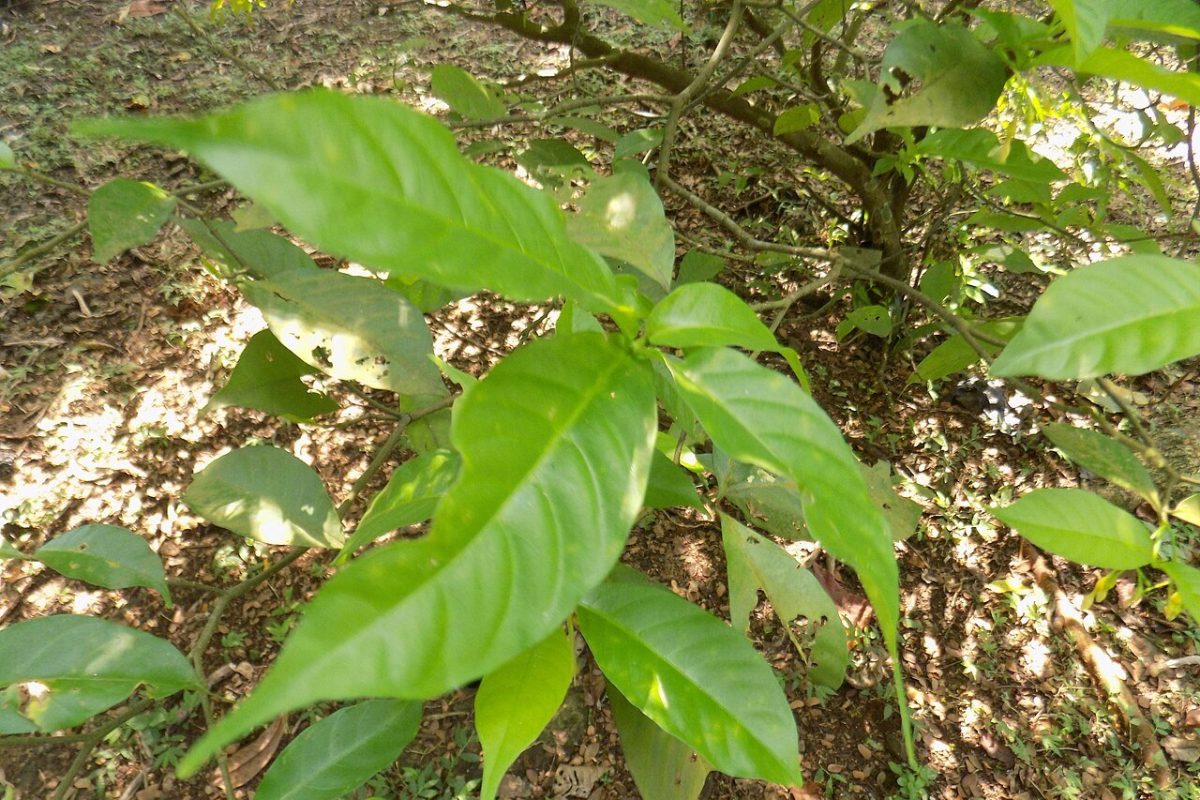
Enter a plant native to equatorial Africa. Tabernanthe iboga, found primarily in Gabon and Equatorial Guinea, contains several alkaloids; the most notable, concentrated in the root bark, is ibogaine. Indigenous populations across the region have used it for generations, and this ancestral knowledge forms the backbone of Bwiti, a syncretic religion whose central sacrament is iboga.
Unlike ayahuasca religions, Bwiti does not consume the plant on a frequent, routine basis: it is reserved for initiation rites and pivotal life transitions. The initiatory ritual can unfold over several days, involving the entire community, with the ultimate aim of strengthening collective cohesion rather than simply delivering an individual “trip.” Keeping this context in mind is essential: in its traditional setting, iboga is a collective, ceremonial tool, not an isolated compound administered in a clinical vacuum.
Ibogaine reached Europe through colonial explorers and was first isolated at the turn of the twentieth century. Like so many substances scheduled today, it once enjoyed a respectable pharmaceutical career: in France, it was marketed for decades as an over-the-counter stimulant. By mid-century, psychotherapists—including the Chilean psychiatrist Claudio Naranjo—began exploring it as an adjunct to therapeutic work, and it was later adopted underground by practitioners, especially in countries where it was subsequently outlawed.
A Chance Discovery: Howard Lotsof and the Patient Network
The discovery of its anti-addictive properties, like many breakthroughs in pharmacology, was accidental. In the early 1960s, a group of young psychonauts in New York tried ibogaine purely out of curiosity. Several of them were dependent on heroin. Once the psychoactive effects wore off, none of them experienced their anticipated withdrawal symptoms.
One of those young men, Howard Lotsof, dedicated the rest of his life to championing the discovery. Over time, this grew into a peer-led mutual aid network where former users treated with ibogaine guided others through the experience—a movement organized today around initiatives like the Global Ibogaine Therapy Alliance (GITA). It remains a persistent paradox: while the compound enjoys deep credibility within a therapeutic counterculture, academic medicine has largely kept its distance.
What the Scientific Evidence Actually Shows
In preclinical models—mice, rats, and non-human primates—the findings are remarkably consistent and have been replicated across multiple independent laboratories: ibogaine reliably reduces the self-administration of morphine, cocaine, amphetamines, alcohol, and nicotine. In humans, however, the evidentiary foundation is far more fragile, consisting primarily of observational studies and case series.
The most widely cited data come from the work of pharmacologist Deborah Mash at the University of Miami, who spent years characterizing the compound’s pharmacokinetics while treating opioid- and cocaine-dependent patients at a private clinic. Her case series documented rapid resolution of withdrawal symptoms and craving, alongside marked improvements in mood measures within weeks. Other observational reports point in the same direction. Yet the overwhelming majority of global “experience” has never been formally published: thousands of people have been treated in clinics and underground centers worldwide, in what some researchers have described as a “vast uncontrolled experiment.” That phrase captures the dilemma perfectly: extensive empirical experience exists alongside very little controlled, high-grade data.
Its pharmacological mechanism of action is equally complex. Ibogaine interacts with multiple neurotransmitter systems—serotonergic, glutamatergic, cholinergic—and modulates opioid receptors without behaving as a classical agonist; it has also been shown to upregulate neurotrophic factors linked to neuroplasticity. None of these pathways fully explains the clinical phenomenon on its own. One telling clue regarding its abuse liability: it does not trigger the characteristic dopamine surges associated with recreational drugs, which, combined with its intensely dysphoric physical effects, explains why compulsive use of ibogaine is virtually unheard of.
From a regulatory standpoint, the landscape is fragmented. Ibogaine is not scheduled under international drug treaties, but it is classified as a controlled substance in countries like the United States, France, and Australia. New Zealand stands out as one of the few jurisdictions that has regulated it as a prescription medicine under medical supervision.
A Critical Perspective and Harm Reduction
The framing of ibogaine as a “miracle cure suppressed by Big Pharma” is compelling, but it demands scrutiny. The stall in mainstream clinical development was not driven purely by institutional inertia: genuine fatalities occurred in medically unsupervised settings, and that reality cannot be relegated to fine print.
- Genuine cardiac risk. Ibogaine prolongs the QT interval and can induce fatal ventricular arrhythmias (such as Torsades de Pointes). Documented deaths have almost always involved administration without prior cardiac screening or continuous telemetry, frequently in individuals with undiagnosed cardiac conditions or those co-ingesting opioids and other medications.
- Not a DIY substance. Given its toxicity profile, any therapeutic administration demands thorough medical evaluation, a baseline electrocardiogram (ECG), and real-time medical monitoring. It is not an intervention to undertake on one’s own at home.
- Preliminary, not definitive, evidence. Promising case series do not substitute for randomized, double-blind clinical trials. What succeeds in animal models and shines in anecdotal reports does not guarantee safety or efficacy across broad patient populations.
- Relapse and ongoing integration. Even advocates who describe an “interruption” of chemical dependence acknowledge that ibogaine merely opens a neuroplastic window. It does not magically resolve the psychological trauma, socioeconomic distress, or relational dynamics underpinning chronic addiction.
That said, the core critique remains entirely valid: a substantial share of modern addiction is no longer driven solely by illicit street heroin, but by millions of individuals dependent on prescription pharmaceuticals who are labeled as chronically ill partly because it is easier than acknowledging the iatrogenic origin of their condition. If a molecule like ibogaine points toward an exit ramp, the appropriate response is neither blind boosterism nor dismissal, but rigorous, adequately funded, and well-designed clinical research.
This article draws upon and adapts educational insights and data published by researcher José Carlos Bouso and organizations such as ICEERS regarding iboga. Epidemiological figures reference reporting from US agencies, including SAMHSA and NIDA.


