

What we mean when we talk about hashish
Hashish—”haschisch” in the old spelling Escohotado used—is not a different plant, but rather concentrated cannabis resin: the cannabinoid-laden secretions that accumulate primarily on the flowers of the female plant. This resin, pressed and manipulated, has traveled across the Mediterranean and Asia for centuries. What is interesting about Escohotado’s description is that he portrays hashish less as a chemical substance than as a craft: there are good and bad preparations, distinct traditions, and, above all, a market that tends to degrade the product.
Two traditions: rubbing the plant or sieving pollen
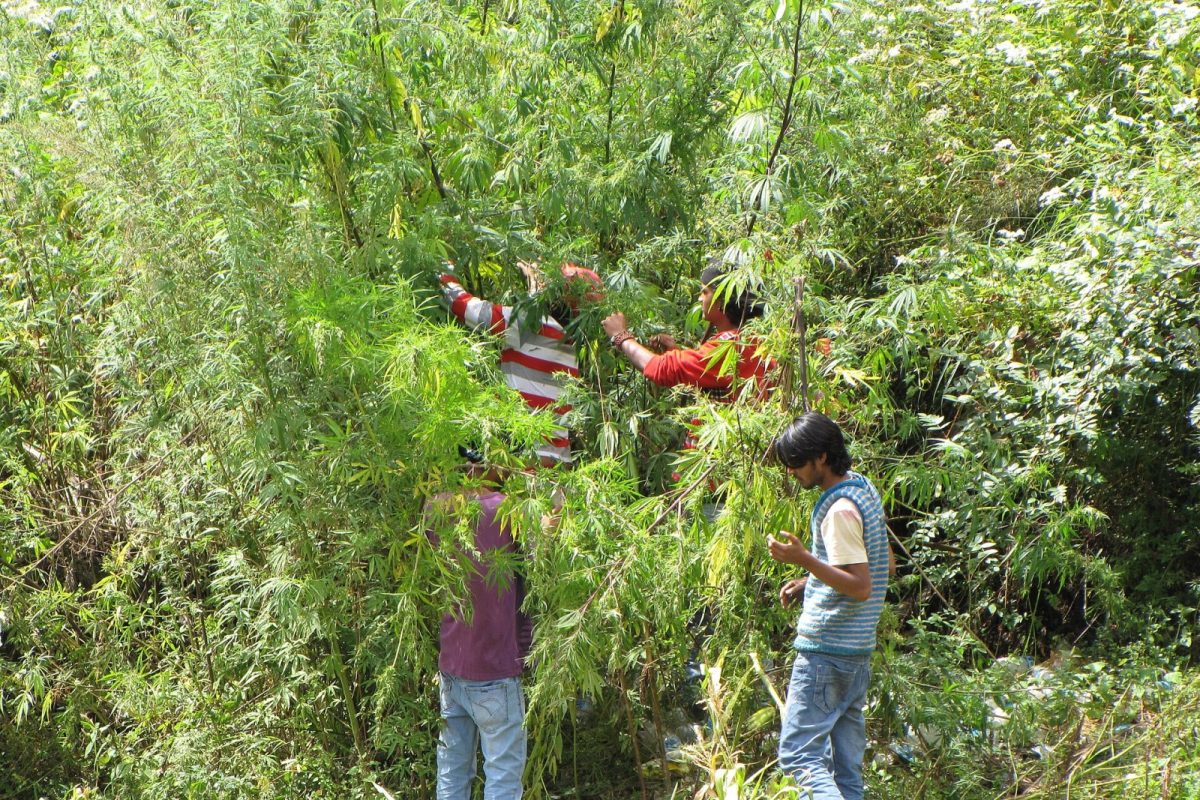
Escohotado distinguishes between two major families of production. What he calls the Eastern tradition—associated with Nepal, the former Tibet, or Afghanistan—consists, broadly speaking, of collecting the resin through direct contact with the living plant and shaping it with the heat of one’s hands. It wastes a lot of psychoactive material, but in return, it yields nearly pure resin: an aromatic, smooth product that, according to him, is difficult to match in potency.
The Mediterranean tradition—Morocco, Lebanon—starts with dried plants and separates the resin by sieving, allowing the powder to pass through increasingly fine screens under its own weight. This produced the various categories cited in the text (“00,” “first,” “second,” “third,” or pollen). We do not detail the procedure as a recipe: the relevant aspect is the cultural principle, not its reproduction.
Commercial degradation and adulterants
Escohotado’s most critical point targets the market, not the plant. He describes how, to increase weight and disguise a lack of resin, the product was cut with pulverized plant material and treated with binders—gum arabic, egg white, condensed milk—that gave it a dark color and a “select” appearance. A bit of good hashish would perfume the mixture, and skillful pressing did the rest.
Here lies the real health risk he intuited: the effects of burning and inhaling these binders are not well understood. Escohotado suspected they would be “regrettable,” and that suspicion remains valid. The toxicity of adulterated hashish does not come from the cannabinoids, but from what has been added to it and the products of its combustion.
Toxicity: a nuance worth keeping
Escohotado maintains that speaking of “hashish toxicity” in the abstract is useless, because everything depends on concentration and purity. His central observation remains solid: when smoked, a severe intoxication is highly unlikely, because the respiratory tract becomes saturated (coughing, lethargy) before a dangerous dose can be accumulated. When taken orally, the margin is less predictable, especially because the effect is delayed, which encourages redosing.
It is worth reading this with contemporary caution. The idea that hashish is “much more toxic” than marijuana because it contains more THC does not align with what we know today: cannabis has very low acute toxicity and no known lethal doses on its own. What is well-documented are the real risks he could not measure: anxiety attacks and panic states (especially when taken orally, due to the delayed effect), effects on memory and attention, links to psychosis in vulnerable individuals, and respiratory damage when mixed with tobacco.
Tolerance and subjective effects
Regarding tolerance, Escohotado places it at three or four days of continuous use, reversing with one or two days of a break, and highlights something counterintuitive: he does not describe a withdrawal syndrome comparable to that of sedatives or stimulants, but rather the disappearance of the desired effect.
Subjectively, he contrasts hashish with marijuana: he considers it more “reflective.” The playful aspect does not disappear, but—he says—it occurs at a less superficial level, and he describes three stages that would chain together with a potent product: laughter and wit, sensory modifications, and a final phase of introspection. His most interesting thesis is that cannabis does not “disinhibit” in the way alcohol does, but rather exacerbates the personality of the person taking it. Hence his criticism of those who claim a legal defense for acting under its influence: citing Baudelaire, it is not that the substance drowns judgment, but that “the inner monster emerges.” He also notes that it reduces aggression, it does not increase it.
The oil and the Munich episode
Escohotado dedicates a section to hashish oil, a much more potent concentrate, and suspects that the very rare cases of acute intoxication attributed to cannabis were related to these extracts. He illustrates this with a personal anecdote: after ingesting—due to a calculation error—an excessive amount, he and two friends spent hours inside the Alte Pinakothek in Munich watching the paintings “open up” into living landscapes, unable to move, until they had to be helped out. He recounts it as an aesthetically overwhelming experience, but acknowledges that they were “on the verge of serious poisoning.”
That nuance is, perhaps, the most honest part of the text: even someone who defended the right to use drugs describes the episode as a warning, not a model. Oral administration and concentrates completely shift the safety “ceiling” he himself attributed to smoking.
Critical reading
Escohotado’s text is valuable as a cultural document and as a first-hand testimony, but it should be contextualized:
- It is a dated portrait. It describes the hashish market of the late 20th century. Modern cannabis, extraction techniques, and concentrates have changed significantly.
- Some chemical claims do not hold up. The idea that the sun “converts THC into CBD” is inaccurate: THC degrades with light and heat primarily into CBN, and CBD is not a mere sedative byproduct, but a cannabinoid with its own profile that is highly studied today.
- His criticism of the NIDA had some merit. Judging smoked marijuana based on massive doses of oral THC in unprepared subjects skewed the results. But that does not authorize the opposite conclusion: subsequent research has identified real risks, especially in early, intensive use or in people with psychiatric vulnerability.
This piece is for educational purposes and cultural memory, not a usage guide. It does not include production instructions or dosages. If cannabis or its derivatives are part of your life, the most sensible approach is to avoid mixing with tobacco, be wary of products of unknown origin and composition, do not drive under their influence, and exercise special caution with oral use and concentrates, where the delayed effect encourages subjective overdoses. Primary source of the original account: texts by Antonio Escohotado on hashish.


