

A Plant Between Pharmacopeia and the Afterlife
When discussing drug use in early civilizations, the Egyptian case is almost always cited as an early example of a psychoactive substance administered in a regulated manner. The opium poppy appears in major medical papyri, shows up in necklaces and bouquets painted in tombs, and, according to various classical sources, traveled across the Mediterranean as a luxury commodity. The image that has reached us is that of a normalized substance, lacking the moral baggage that opium would acquire centuries later.
Written references come primarily from three documents: the Ramesseum papyri (c. 1900 BCE), the Kahun papyri (c. 1850 BCE), and, most notably, the Ebers papyrus (c. 1550 BCE). None are treatises dedicated to opium; they are compilations of recipes and ailments where the poppy shares space with hundreds of other plants and preparations.
What Is the Poppy and Where Does Opium Come From?
The opium poppy is a showy plant whose latex, once dried, constitutes opium. Traditionally, it was obtained by making incisions in the seed pod and collecting the oozing resin. From this juice come the alkaloids—morphine among them—responsible for its analgesic and sedative effects, as well as its addictive potential. We will not go into procedures here; what is relevant is to understand that we are dealing with a natural opiate with a narrow therapeutic index, something that a nostalgic view of the past tends to forget.
In Egyptian texts, the plant is associated with the term spen and is described in simple uses: as a painkiller and tranquilizer. The Ebers papyrus, for example, records the story of the goddess who relieves Ra’s headaches with an infusion of poppy heads—a scene that blends medicine and myth, making it impossible to draw a clear line between the two.
Recipes That Seem Disturbing Today
Egyptian prescriptions included oral, rectal, and topical routes for various ailments. A detail often cited—and one that should be read with a grain of salt—is the use of poppy preparations to soothe crying children. One recipe in the Ebers papyrus mixes the plant’s juice with other ingredients and promises that “the screams will cease at once.”
Beyond the picturesque, that recipe summarizes the problem well: administering an opiate to infants is, in light of modern medicine, dangerous. Equivalent practices in 18th- and 19th-century Europe (the famous soothing syrups containing opium) caused numerous infant deaths. The past did not validate the remedy; it simply lacked knowledge of its risks.
The Poppy in the Tombs
The flower took time to make its way into funerary decoration, but starting with the reigns of Thutmose IV and Amenhotep III (14th century BCE), it burst into iconography with force. The examples usually mentioned are numerous:
- The necklace of the statuette of the architect Kha, in whose tomb at Deir el-Medina a container with plant remains was also found.
- Poppy flowers in bouquets dedicated to Osiris in copies of the Book of the Dead and on funerary stelae.
- Poppy heads in funeral banquet bouquets, such as in the tombs of Ramose or Userhat, sometimes combined with lotus, papyrus, or mandrake.
- Poppies on the painted pavement of the Amarna palace, under Akhenaten.
- Jewelry with poppy capsules among the objects of Tutankhamun.
- Its appearance, in the Ramesside period, even in the tombs of simple workers like Sennedjem.
A nuance is necessary: the presence of a plant in funerary art does not by itself prove psychoactive consumption. The poppy was also an ornamental and symbolic element, just like the lotus. Attributing every painted flower to “entheogenic use” is a tempting interpretation, but it is not always supported by evidence.
Theban Opium and the Problem of Sources
Egyptian opium—called Theban opium, after Thebes—was famous as the highest quality in the Mediterranean, to the point of being counterfeited, a fact denounced by classical authors like Dioscorides and Pliny. That reputation is one of the best-supported facts in the narrative.
More slippery is the connection often made with the Odyssey. The famous nepenthes that Helen pours into the wine “to banish pain and anger,” a drug she brought from Egypt, has been identified by many commentators as opium. It is a reasonable and ancient hypothesis, but it remains a literary conjecture: Homer does not describe a specific substance, and the nepenthes could be anything, real or imaginary. Taking it as proof of the opium trade is building history on poetry.
Trade Routes and Suspicious Vessels
The ancient opium trade does have material clues. A figure of a Minoan goddess found in Gazi (Crete, c. 1300 BCE) is cited, wearing a diadem of poppy capsules marked with vertical incisions: a detail suggesting that the extraction of latex was known in the Aegean and given religious significance. Given the close commercial contact between Crete and Egypt, it is not unreasonable to think of a circulation of knowledge.
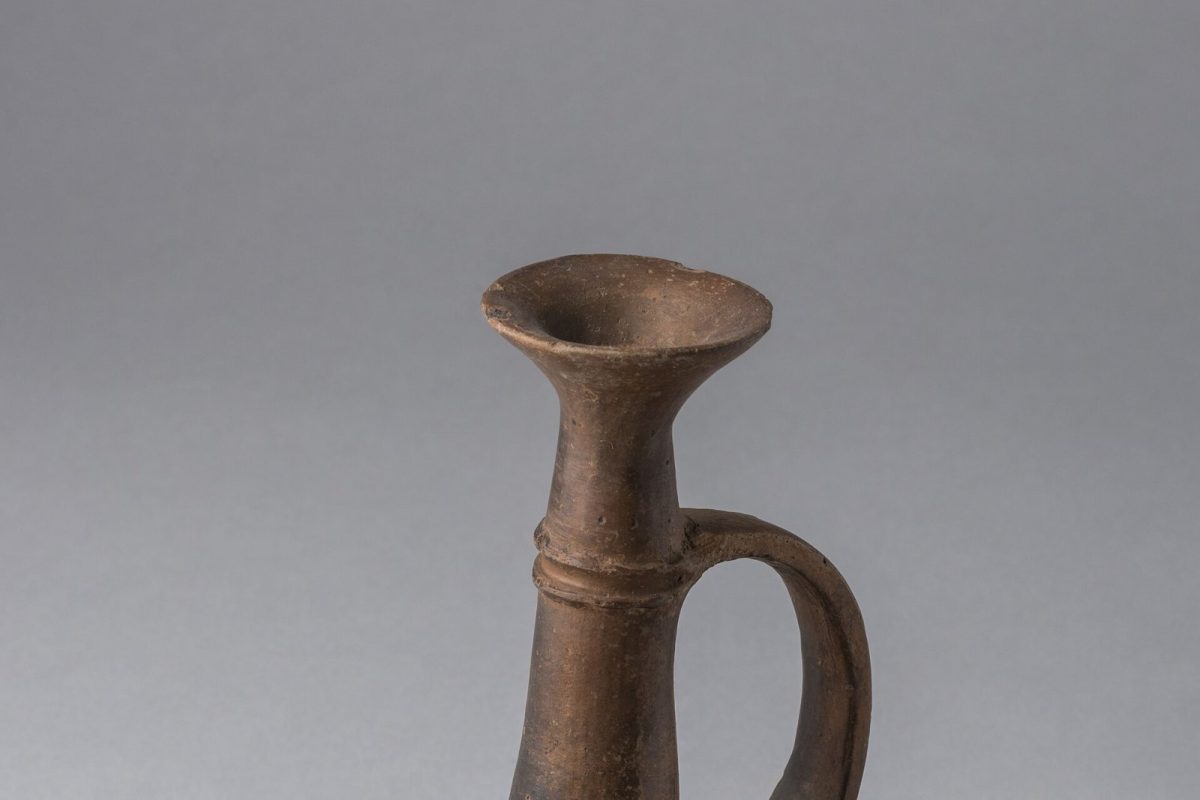
The other classic clue is the so-called Cypriot ring-base jugs found in Egypt. In the 1970s, archaeologist Robert Merrillees drew attention to their resemblance to an inverted poppy capsule and proposed that they had contained opium. It is a suggestive idea, but it should be noted that subsequent residue analyses on these vessels have yielded mixed results: some support the presence of opiates and others do not, so the hypothesis remains debated and unsettled.
Opiate-Addicted Pharaohs? Caution with Iconography
Part of the most striking narrative stems from reading the faces in Egyptian art as if they were medical diagnoses. It has been said that miosis—the constricted pupil of an opiate user—is reflected even in certain hieroglyphs in the tomb of Seti I, or that the paintings in the private tombs of the 19th Dynasty portray a “languid” and “floating” people. The writer and opium addict Thomas de Quincey even saw in a sculpture of Ramesses II “the unmistakable expression of the opium eater.”
Here, we must hit the brakes. Attributing the idealized style of Egyptian art—deliberately serene and conventional—to collective intoxication is projecting a 19th-century obsession onto the 13th century BCE. The serene smile and distant gaze are aesthetic features of a canon, not clinical records. De Quincey’s testimony says much about its author and little about the pharaohs.
The Ebers Papyrus, a Monumental Pharmacopeia
The document that best supports the medicinal role of the poppy is the Ebers papyrus. Written around 1550 BCE and preserved today at the University of Leipzig, it measures over 65 feet (20 meters) and gathers hundreds of sections on ophthalmology, gynecology, gastroenterology, and other areas, along with their prescriptions. The pharmacopeia it reflects relied on several hundred substances, mostly plants: saffron, myrrh, aloe, blue lotus, poppy juice, resins, and incense, among many others.
Opium appears, in particular, in remedies for ailments of the rectum and anus, a field to which the Chester Beatty papyrus devotes much of its content. Hemorrhoids and rectal conditions are described in detail, along with preparations for internal and external use. It is, all in all, the most solid documentary evidence that the poppy was part of the Egyptian therapeutic arsenal.
Critical Reading
The history of Egyptian opium is real, but it has grown through an accumulation of interpretations. Three ideas are worth keeping in mind:
- Distinguish proof from conjecture. Medical papyri document therapeutic use; the identification of the Homeric nepenthes, the contents of Cypriot vessels, or the “opiate-addicted pharaohs” are hypotheses of varying weight, not settled facts.
- Be wary of the “everything was better before” trope. Just because a society used opium “without problems” does not mean they didn’t exist: addiction and intoxication—especially in children—do not depend on a culture naming or recording them.
- Beware of second-hand sources. A good deal of popular science on this topic repeats claims from old books on the history of drugs without returning to the archaeological evidence, which in several points is fragile or currently under review.
As a piece of cultural history, Egyptian opium is fascinating. As an argument about the effects or safety of opiates, it demonstrates nothing that modern pharmacology does not qualify: they remain high-risk substances, with well-known potential for dependence and overdose.


