

A steppe plant with centuries of lore
Few plants gather as much mythology as harmel. Arab and Ottoman chroniclers described its seeds as a source of “delicious intoxication” and joy; Latin authors sought to identify it as the legendary aphrodisiac moly. It is best to read these accounts with distance: they are literary and commercial sources, not clinical descriptions, and they tend to idealize an experience that those who have tried it describe as heavy—often accompanied by nausea, digestive distress, and a hangover. The Catalan botanist Pío Font Quer, who documented the plant in detail in El Dioscórides renovado, does not appear to have ever consumed it himself.
What it contains and why it is called “European ayahuasca”
Modern interest in harmel is explained by its chemistry. Its mature seeds concentrate β-carboline alkaloids—especially harmine and harmaline—in remarkably high proportions, far superior to those provided by the Amazonian vine Banisteriopsis caapi, the classic ingredient of ayahuasca. Hence the label “European ayahuasca”: like caapi, harmel provides the MAO-inhibiting fraction, not the visionary substance itself.
Harmine was once dubbed “telepathine” due to the belief that it induced contemplative states and supposed telepathic abilities. Subsequent pharmacology dismantled that romanticism: it produces an introspective state with closed-eye imagery, sedation, and, in some people, a certain effect on mood. Harmaline appears to play a secondary role. None of this justifies the esoteric attributions that still circulate.
Knowledge of harmel in the Hispanic world
In the Spanish-speaking world, the plant entered psychonautic culture in the late 1970s. The Barcelona magazine Globo, in its “magic plants” section, published an article in 1979 titled “Harmala: The Catalan Yagé,” which connected Font Quer’s work with its Arabic name, harmel, and its uses in Morocco. That trail led Spanish enthusiasts to Moroccan markets, where the seeds are sold normally and the plant enjoys a reputation as a “cure-all.” It is a good example of how popular knowledge and dissemination feed back into each other, for better or worse: alongside cosmetic uses for hair, the same tradition warns of its abortifacient capacity.
The real reason for its fame: a reversible MAOI
The key to harmel is not that it “gets you high” on its own, but that it temporarily inhibits monoamine oxidase, the enzyme that breaks down certain amines in the body. By slowing it down, it prolongs and amplifies the action of other substances. This is why it appears in countless internet accounts combined with psilocybin, mescaline, LSD, or seeds containing lysergic acid amides.
This is where responsible dissemination must be firm. Inhibiting MAO is not an innocuous trick: it alters the metabolism of neurotransmitters and compounds present in food and drugs, opening the door to potentially serious interactions. Combining an MAO inhibitor with certain substances, medications (SSRIs, some analgesics, sympathomimetics), or tyramine-rich foods can trigger hypertensive crises or serotonin syndrome, conditions that can be fatal. We are not describing a safe recreational combination, but a pharmacological mechanism that should be understood precisely so it is not taken lightly. This article does not—deliberately—include quantities, recipes, or usage protocols.
Harmel in ethnomedicine
Beyond its psychoactive dimension, harmel has a long history in the traditional medicine of a vast area, from the Maghreb to India. It has been attributed vermifuge (against intestinal parasites), antirheumatic, antidiarrheal, emmenagogue—to regulate or induce menstruation—and sedative uses. In Rajasthan, the smoke from the seeds has been used as an antiseptic, which aligns with harmine showing antimicrobial activity in the laboratory.
Two essential nuances. First: just because a use is ethnographically documented does not mean it is safe or effective by current standards; many of these applications lack solid clinical backing. Second, and more importantly: harmel appears recurrently as a traditional abortifacient, and its use for that purpose is associated with severe hemorrhaging and life-threatening risk. This is a historical fact, not a recommendation.
Risks and harm reduction
Without going into doses, there are several red lines that the literature on the plant repeats:
- Pregnancy: absolute contraindication. Its emmenagogue and abortifacient effect has been described since ancient times and confirmed in experimental animals.
- Hypertension and cardiovascular pathology: the MAOI component makes it especially inadvisable.
- Psychiatric medication: those taking antidepressants or other psychotropic drugs are exposed to dangerous interactions.
- Common adverse effects: nausea, vomiting, and diarrhea are frequent; the experience is far from the “delicious intoxication” of ancient chronicles.
The argument that it is “a natural antidepressant less toxic than pharmacy ones” deserves skepticism: clinical MAOIs were largely withdrawn precisely because of their interaction profile, and a plant-based MAOI does not escape that same logic. The absence of a package insert does not equal the absence of risk.
A familiar plant of the Iberian landscape
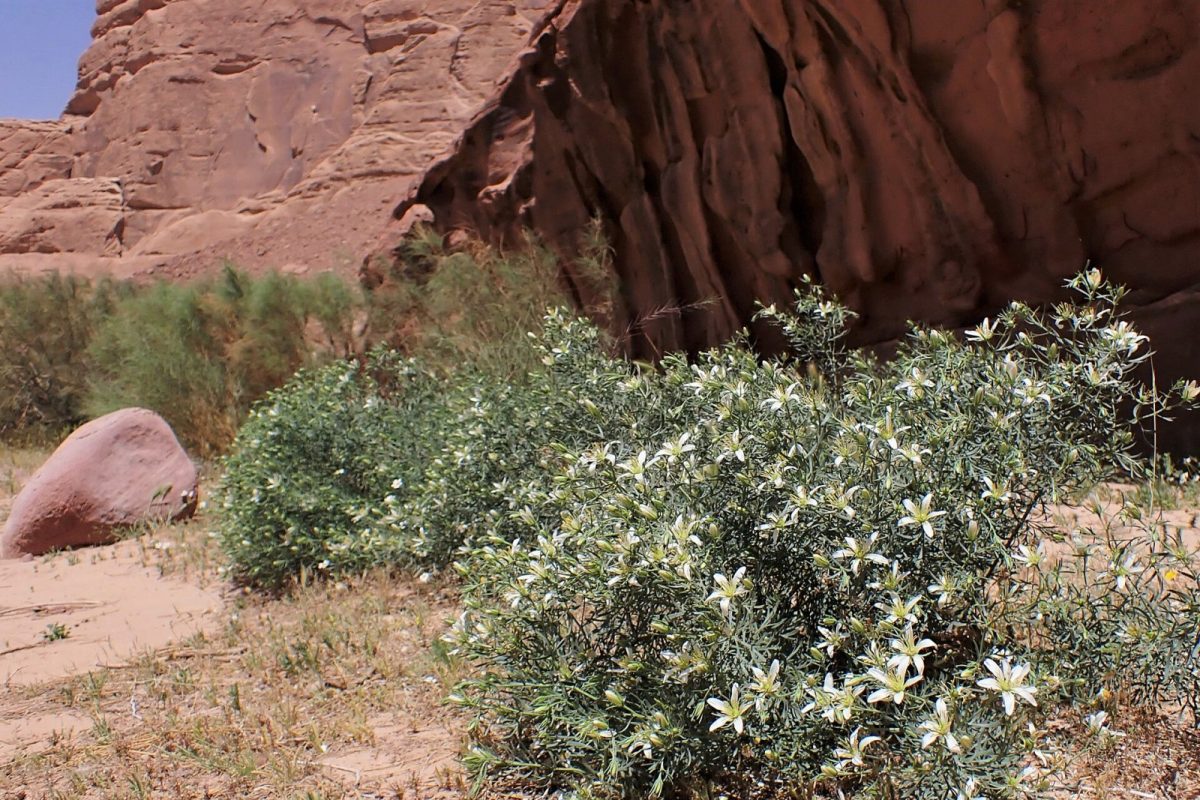
Aside from pharmacology, harmel is part of the landscape of arid Spain. It grows in wastelands, embankments, and moors of the western Mediterranean, the Ebro Valley, the Meseta, and the steppes of the southeast, and receives dozens of local names: alharma, alhargama, alfármega, garmaza, ruda borda, or armalà in Catalan, among others. It is a shrub up to one meter (3.3 feet) tall, with highly divided leaves and whitish flowers, with a characteristic odor. The species extends from North Africa to Central Asia and has even naturalized in the southwestern United States. Anyone who wants to see it can find it, for example, at the Royal Botanical Garden of Madrid.
Critical reading
The story of harmel mixes serious ethnobotany, 1970s dissemination, and a lot of myth. Authors like Jonathan Ott, Christian Rätsch, or Font Quer himself provided rigorous descriptions of its chemistry and uses, but much of what circulates today are anecdotal, uncontrolled testimonies. It is useful to distinguish three levels: the botanical (solid), the pharmacological (well-established regarding the MAOI mechanism), and the consumption practices (where unverified claims and real, poorly publicized risks abound). Treating harmel as a mere “cheap booster” ignores that its appeal and its danger are the same property: MAO inhibition.


