

One Peninsula, Three Psychoactive Worlds
Despite its modest size, the Iberian Peninsula brings together climatic species that appear far apart elsewhere: the mythical red mushroom of Siberian folklore, several small psilocybin-containing mushrooms, and, even more surprisingly, South American mescaline-rich cacti that have taken root on our coasts. It is best to approach them with the curiosity of a naturalist and the caution of someone who knows that the wilderness does not forgive identification errors.
This text is educational and botanical. It does not describe methods of preparation or consumption; its objective is to understand what grows, where, and why, and to warn of the real risks surrounding each species.
Amanita muscaria, the Mushroom of Popular Imagination
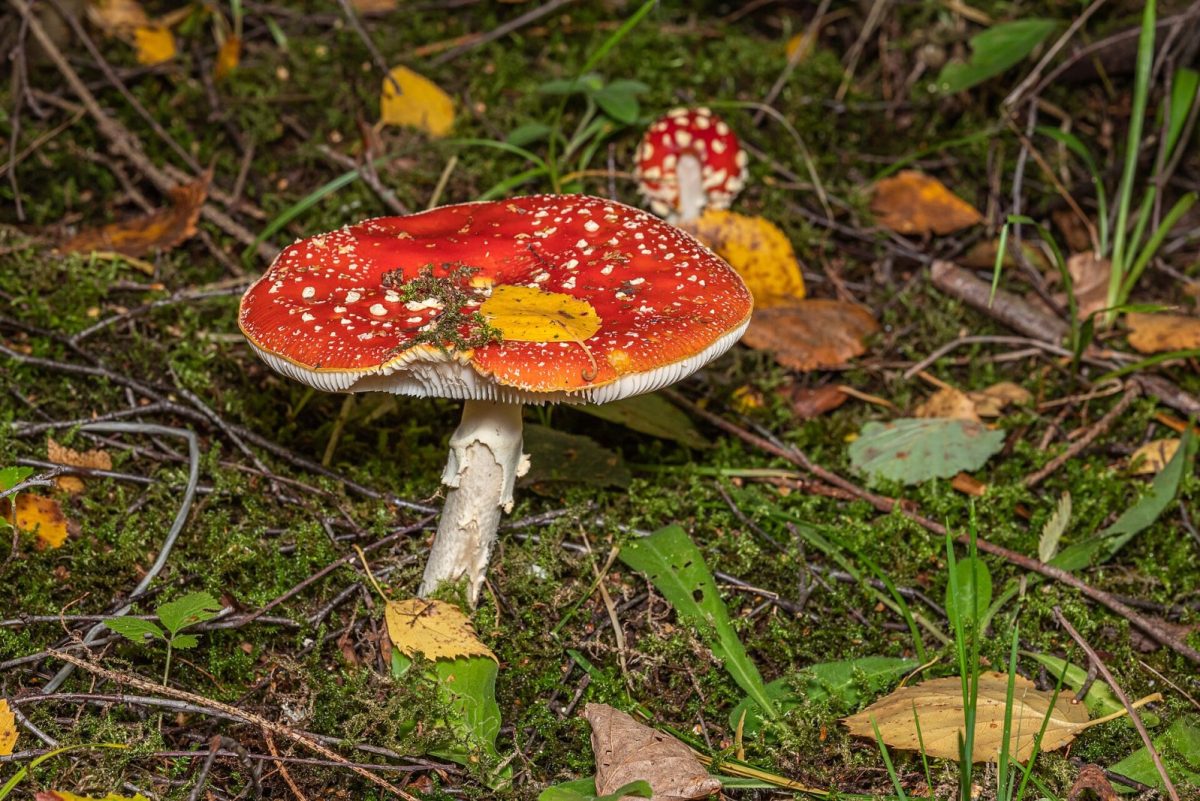
The red cap with white warts of Amanita muscaria is likely the most represented mushroom in Western culture, from children’s stories to video games. It fruits in the autumn forests of Eurasia and North America, associated primarily with the roots of birch and pine trees, though it also appears under oaks, beeches, hazels, firs, and rockroses. In Iberia, its season has shifted: what was once an October mushroom now frequently appears in November—one more detail of climate change visible at ground level.
There are classic locations: the Basque mountains and the Pyrenees, the Laciana region in León with its thousands of hectares of birch trees, or the scarce Catalan birch forests that Josep M. Fericgla documented in Cerdanya (Martinet, municipality of Montellà) in El hongo y la génesis de las culturas. The myth that the best Amanitas are always those from high-altitude birch forests should be taken with caution; their actual distribution is more capricious than the legends suggest.
From a chemical perspective, Amanita muscaria is neither a harmless nor a “recreational” mushroom in the usual sense. It contains ibotenic acid and muscimol, compounds with effects very different from those of psilocybin. Its ingestion can cause nausea, vomiting, diarrhea, salivation, tremors, muscle spasms, and, in high quantities, states of delirium or deep stupor that are difficult to reverse, which may resemble a coma and last for many hours. It is not a controllable or predictable experience, and romanticized Siberian accounts have little to do with what occurs in a specific human body.
Psilocybin Mushrooms: Small and Easy to Confuse
In the mountain meadows of the northern peninsula, several mushrooms containing psilocybin grow. The best-known and most ubiquitous is Psilocybe semilanceata—known in Basque as sorgin zorrotz, or “sharp witch”—abundant in pastures throughout Europe, North America, South Africa, and Tasmania. It is tiny: a conical, pointed cap about one centimeter (0.4 inches) wide, topped with a nipple-like point, pale yellow in color, with gills that turn from cream to a smoky purple hue (Becker, 1989) and a thin, tall stem. Alongside it appears Psilocybe hispanica, described in 1998 from findings in the Pyrenean Tena Valley (Huesca), and Psilocybe strictipes, so similar to semilanceata that for a long time it was considered a variety and can only be distinguished under a microscope.
On the coastal strip of Galicia and northern Portugal, on sandy soils, grows Psilocybe gallaeciae, related to Mexican species, which is darker and has a more expanded cap. Much rarer is Psilocybe cyanescens, native to North America and Central Europe and cited exceptionally in Spain, likely having arrived by accident. Like almost all psilocybes, these mushrooms tend to bruise blue when cut or handled.
The safety warning here is serious, not decorative. P. cyanescens and other species grow on rotting wood debris and leaf litter, the same habitat as the deadly Galerina marginata (funeral bell), which contains amatoxins capable of destroying the liver. The same occurs with coprophilous (dung-loving) species like Panaeolus subbalteatus, which are easy to confuse with equally dangerous galerinas. As a rule of thumb repeated by mycologists: among small meadow mushrooms, there are no deadly species, but among those that grow on wood or manure, there are, and an identification error cannot be corrected. Without the guidance of an expert, the prudent thing to do is look and do not touch.
San Pedro: Andean Cacti Naturalized in the Mediterranean
Perhaps the most striking aspect of Iberian psychoactive flora is that cacti of Andean origin—Peru, Bolivia, Ecuador, northern Argentina—have naturalized along the Mediterranean coast, from Girona to Cádiz, growing wild in wasteland and rocky drylands. Antonio Escohotado noted this in his General History of Drugs: after being planted in orchards and fields, the San Pedro spread on its own.
The idea circulates that cacti grown in Europe barely contain mescaline. The nuance provided by specialists is interesting: those poor analyses came from outdoor crops in central and northern Europe, rainy regions where water “dilutes” the alkaloid. In the south, and especially in wild specimens that live without irrigation or fertilizer in full sun, the content can be comparable to that of South American cacti. Anthony Henman went so far as to state that a San Pedro collected in La Torrassa (Barcelona) was as potent as those he had tried in Peru, and he pointed to the role of water stress—periods of total drought after flowering—as a key factor. These are field observations and bioassays, not controlled studies; they should be read as reasoned hypotheses, not analytical certainties.
How to Distinguish Between Pachanoi and Peruvianus
Trichocereus pachanoi (= Echinopsis pachanoi) is a large, blue-green, branched columnar cactus, reaching three to six meters (10 to 20 feet). It matures around age seven and develops buds that open at night at the top of the stems, producing large, fragrant, funnel-shaped flowers, white inside and reddish-brown outside, with green stamens (Schultes and Hofmann, Plants of the Gods). Its arms can have six to twelve ribs. An Andean legend speaks of a San Pedro with only four ribs, “the cactus of the four winds,” which no one has ever seen.
In practice, pachanoi and Trichocereus peruvianus are almost indistinguishable. The most visible difference is in the spines: young pachanoi have clusters of short spines (up to two centimeters, or 0.8 inches), yellow or brown, and in cultivation, they often lose them, while peruvianus retains long, hard, sharp spines. Andean peoples speak of “male San Pedro” (spiny) and “female San Pedro” (with short or absent spines), a distinction that recalls our Latin names. Trichocereus bridgesii, very close to peruvianus, is used traditionally and also recreationally around La Paz (Bolivia), according to Christian Rätsch.
Caution, Collector: When Green Is Not What It Seems
The genus Trichocereus includes more than eighty species. In available analyses, about thirty tested positive for mescaline, and only about five—pachanoi, peruvianus, puquiensis, cuzcoensis, and bridgesii—in appreciable amounts. Many other species have not been studied and could contain toxic compounds. Added to this is an extra problem in the Mediterranean: the hobby of ornamental cacti has introduced dozens of species and, increasingly, hybrids whose chemical profile is completely unknown. Distinguishing an authentic San Pedro from a close relative may require a taxonomic manual or the help of a cactus expert. The sensible rule is the same as always: if there is no certainty of identification, it is better to let the plant keep growing.
Critical Reading and Harm Reduction
Much of what circulates about these species comes from popular literature, ethnographic accounts, and personal bioassays rather than controlled pharmacological studies. That does not invalidate them, but it requires reading them with a critical spirit: the “potency” figures, alkaloid percentages, and doses that appear in old manuals vary enormously depending on the specimen, soil, climate, and measurement method, and should not be taken as reliable references.
From a harm reduction perspective, three ideas summarize what is important. First: the main danger of foraging is not the psychoactive effect, but confusion with toxic or deadly species, especially galerinas. Second: Amanita muscaria is not a “mild” or harmless mushroom; its effects are erratic and potentially serious. Third: correctly identifying a plant or fungus in the field is a serious skill that cannot be improvised with internet photos. In case of any doubt, the prudent course is not to consume and to consult people with proven botanical or mycological experience.


