

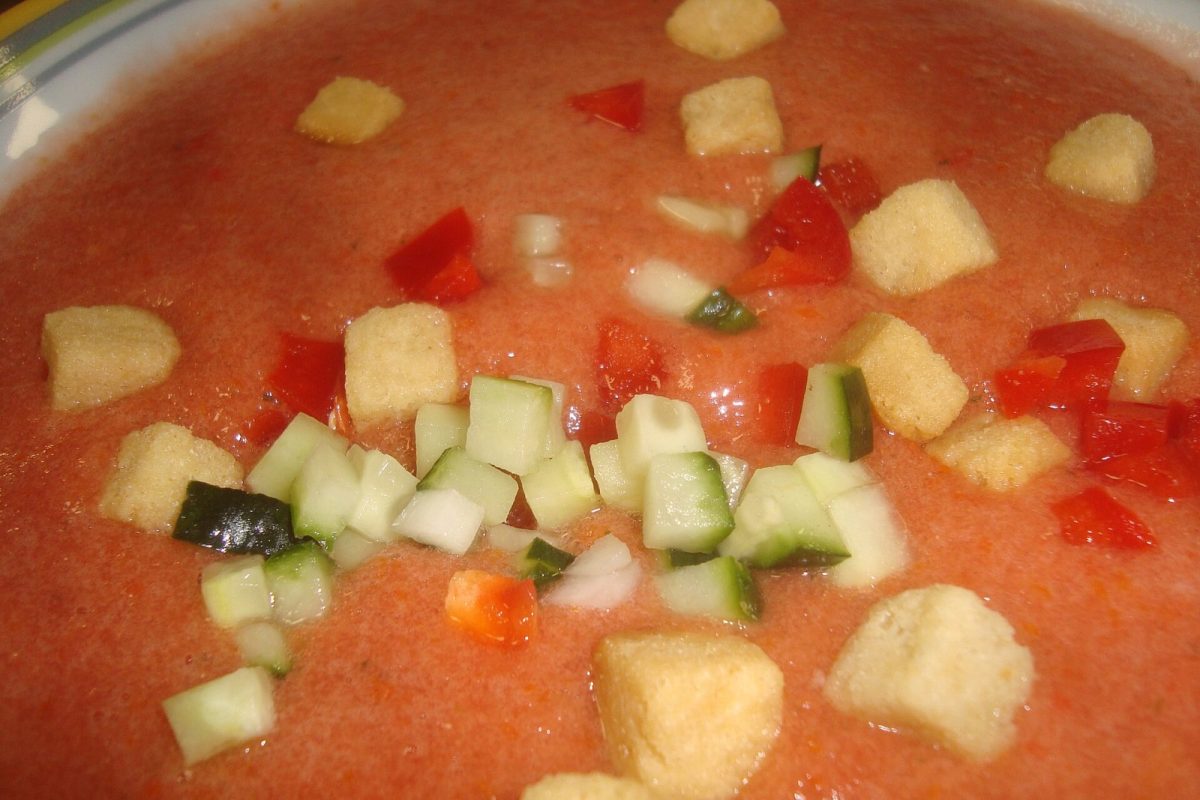
Summer, the cold spoon, and an old culinary tradition
In Southern Europe, the heat has shaped an entire family of soups served cold. Gazpacho and salmorejo are part of the Spanish gastronomic identity, the result of centuries of popular cooking that made use of what the garden and pantry offered. They are not an Iberian exception: beet borscht in Eastern Europe and leek-and-potato vichyssoise in France respond to the same idea of a nutritious and refreshing dish for long days.
These recipes have also had a second life in cannabis culture. Gastronomic columns in industry magazines have spent years proposing “infused” versions of these classics, using a cannabinoid-laden oil or milk—the well-known “Mariana Milk” among them—as a vehicle. The idea is always the same: take advantage of the fat in the dish to carry the active ingredient. It is worth understanding, however, what really happens when cannabis passes through the digestive system, because the result has little to do with smoking it.
From spoon to body: why eating cannabis is not like smoking it
THC is lipophilic: it dissolves in fat, not water. That is why edible preparations always start with a fatty matrix—oil, butter, cream, whole milk—and why a purely aqueous broth would barely serve as a vehicle. So far, the logic of “cannabis” recipes is consistent with cannabinoid chemistry.
The decisive difference is the route it follows within the body. When smoked or vaporized, THC reaches the blood through the lungs almost immediately, and the effect appears in minutes, which allows the person to soon notice “how far” they have reached. When eaten, however, the cannabinoid must be digested and pass through the liver before circulating. There, a portion is transformed into 11-hydroxy-THC, a metabolite that many sources describe as more potent and longer-lasting than THC itself. The result: a slow onset—which can take one to two hours on average—and a much longer duration.
That delay is the classic trap of edibles. Since the effect is not immediate, it is easy to think that “it didn’t do anything” and take more, so that when it finally hits, it does so in an accumulated and intense way. Overconsumption of edible cannabis is behind a good portion of emergency room visits related to the plant, especially in people with little experience.
The problem of dosage in a bowl
Traditional cannabis cooking recipes usually offer simple, homemade rules for calculating “how much to add.” In keeping with our editorial line, we do not reproduce them, but it is worth explaining why those rules are unreliable.
The cannabinoid content of the raw material varies enormously from one strain to another and from one harvest to another, so any measure based on “amounts” or consumption units is, at best, a rough estimate. Added to this is the fact that the transfer of the active ingredient to the fat is never complete or homogeneous, and that when distributing a soup among several diners, the dose is distributed unevenly: one ladle may be much more concentrated than another. In practice, the person eating does not know precisely how much they are ingesting, and the lag between ingestion and effect prevents correcting on the fly. It is the exact opposite of what any criterion of prudence would recommend.
Harm reduction
If someone is faced with a dish whose content they do not know for certain, it is worth keeping some basic ideas in mind:
- Edibles are deceptive due to their slowness. The effect can take one or two hours; noticing nothing at the beginning does not mean it won’t arrive.
- The intensity and duration are greater than when smoking, and can last for several hours.
- Labeling and consent. Serving a cannabis preparation to someone without warning is not a prank: it is exposing another person to a psychoactive substance without their knowledge, with real risks and possible legal consequences.
- Some people should abstain. People with a history of psychotic disorders, pregnant women, minors, and those taking certain medications face added risks.
- Do not mix blindly. Combining it with alcohol or other substances increases the probability of discomfort, dizziness, and anxiety attacks.
- If you feel overwhelmed, a calm environment, hydration, and company usually help; the acute discomfort of cannabis is unpleasant but subsides over time. In the event of severe or persistent symptoms, it is advisable to seek medical attention without fear of explaining what was taken.
Critical reading
The original text from which this article is based comes from a gastronomic column and does not provide scientific references; its dosage indications reflect culinary tradition more than evidence. It should be read, therefore, as a cultural document—the intersection between popular summer cooking and the cannabis imaginary—and not as a health guide.
The pharmacological data we mention (lipophilicity of THC, hepatic metabolism to 11-hydroxy-THC, delayed onset, and longer duration via the oral route) are widely covered in the literature on cannabinoids, but the quantitative detail—how much, in how long, with what intensity—depends on too many individual variables to generalize. Faced with any categorical statement about “the correct dose” in cannabis cooking, the honest answer is that no such thing exists with the precision usually attributed to it.


