

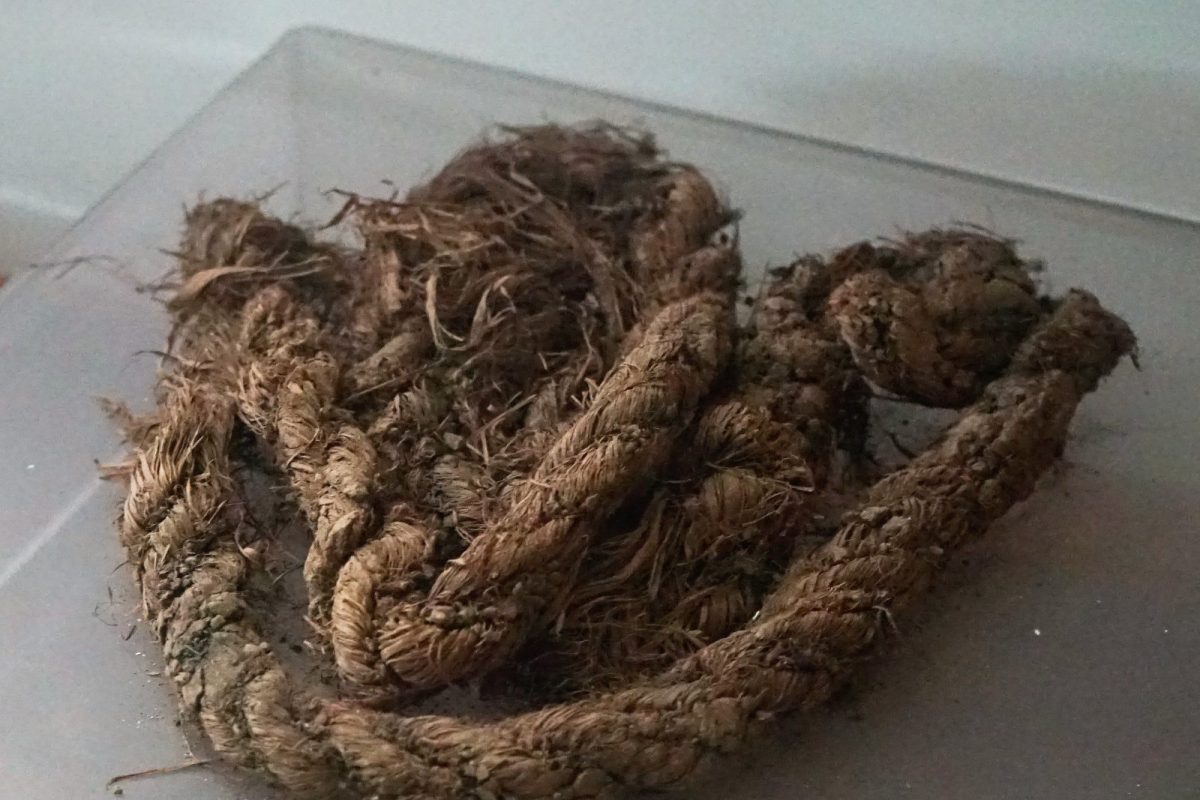
A Plant Behind a Decisive Invention
We think of hemp as fiber for rope, as a textile, or—in its cannabinoid-rich variety—as a psychoactive plant. But its most silent and enduring contribution to civilization may be something else: for centuries, it was the primary raw material for paper, the medium that made writing affordable and democratized. Without that strong, abundant fiber, the spread of knowledge would have followed a slower and more expensive path.
It is worth establishing the scale. Paper was not born in Europe or the Arab world, but in China, where it appears in documented form in the 1st century AD. The oldest known fragment of paper was recovered from a tomb near Xi’an, in Shaanxi province, dating between the 2nd and 1st centuries BC. Tellingly, a good portion of the earliest evidence—including Buddhist texts from the 2nd and 3rd centuries, or a fragment with Chinese characters found near Turpan, in Xinjiang—was made from hemp.
Before Paper: Wood, Bamboo, and Silk
Chinese writing predates paper by a long margin. Its first mediums were wood and bamboo, on which signs were traced in vertical columns, and later silk, written on with bamboo reeds. These were imperfect solutions: wood and bamboo were heavy and bulky, while silk was too expensive for everyday use. The famous destruction of tablets ordered by Emperor Qin Shi Huangdi in the 3rd century BC gives an idea of the extent to which written memory depended on fragile or costly materials.
In that context, a material that was light, cheap, and manufacturable from abundant plant fibers—including hemp—solved a real problem. The so-called “Baqiao paper,” made with hemp fibers mixed with a small proportion of ramie, represents one of those early attempts preceding the recipe that would go down in history.
Cai Lun and the Recipe That Set the Rules
Tradition places the decisive leap in the year 105, led by Cai Lun (Ts’ai Lun), an official in the service of the Han court. The formula attributed to him combined silk scraps, mulberry bark, broken fishing nets, hemp, and other remnants macerated in hot water until a pulp was obtained. This paste was agitated in water and collected with a sieve; as it drained, the fibers remained intertwined, forming a damp sheet that was then dried in the sun and pressed.
Beyond the specific anecdote, the important thing is that this procedure established the basic principles of papermaking that would remain for centuries: breaking down fibers, suspending them in water, collecting them with a mold or sieve, draining, drying, and pressing. Higher-quality paper was obtained precisely from rags of hemp, linen, and cotton, beaten until a fine, homogeneous paste was achieved. Later artisans, such as Zuo Bo, would refine the technique to obtain thinner sheets.
An Eight-Century Journey Westward
China kept the procedure secret for a long time. Paper passed first to Vietnam, Korea, and Japan, and it took nearly eight hundred years to reach the Arab world. The most repeated explanation is almost novelistic: after a clash near Samarkand around 751, the victors supposedly identified Chinese artisans among the prisoners capable of making paper, and from there, the spread began. It is a plausible account, though it should be taken as historiographical tradition rather than a closed fact.
Starting in the 8th century, workshops emerged in Baghdad, Damascus, and Samarkand, and paper spread toward Egypt and, in the 9th century, toward Morocco. In Europe, it did not begin to be used significantly until the 10th and 11th centuries, and it would take time to displace parchment. By 1150, there is evidence of paper mills on the Iberian Peninsula; the one in Xàtiva was especially famous. Córdoba, Seville, Granada, and Toledo soon followed. This is no coincidence: the success of peninsular paper relied on the abundance of hemp and esparto grass, which defined the character of that early production.
From there, the invention spread to the rest of the continent—France around 1190, and a booming Italian industry in Fabriano, Bologna, and Tuscany starting in the 13th century—until it became the standard. In the 15th century, the Gutenberg Bible was printed on hemp-based paper, and the surviving copies remain in remarkable condition, a good reminder of the durability of those fibers. Artisanal manufacturing would culminate in the 18th century, with Catalonia as one of its reference centers, before mechanization changed everything.
From Rags to Wood: The Industrial Turn
Until the beginning of the 19th century, the West continued to make paper from rags and fabrics. The invention of the continuous production machine by the Fourdrinier brothers opened the industrial era, and by the end of the century, the search for cheaper raw materials displaced hemp and linen rags in favor of chemically treated wood. That change multiplied production and made paper cheaper, but it also marks the moment when hemp ceased to be the protagonist of a history it had helped to found. As the author Zhuang Wei summarized, the Chinese method of papermaking eventually spread throughout the world and significantly stimulated the economic and cultural development of numerous peoples.
A technical detail illustrates the extent to which the craft became sophisticated: the filigree or watermark, of Italian origin and documented since the late 13th century, allowed for the identification of the manufacturer and the quality of each sheet.
The Legend of Cai Lun
Every foundational invention generates its myth, and paper is no exception. Legend has it that the court did not initially appreciate Cai Lun’s discovery, and that he faked his own death to find out who despised him. During the wake, his loved ones burned paper over the grave, convinced that this would bring him back to life; when he “resurrected,” the miracle was attributed to the magic of paper. The custom of burning paper over graves supposedly derives from this. The story adds a bitter ending: later entangled in palace intrigues, Cai Lun allegedly preferred poison to a trial.
Like all legends, it mixes a historical core with embellishment. The existence of Cai Lun and his link to the spread of paper are reasonably solid; the details of the resurrection belong to the realm of folklore. Distinguishing between the two is exactly what an honest educational reading requires.
Critical Reading
This history relies on a mix of archaeological findings, chronicles, and traditions transmitted over centuries, and not everything has the same degree of certainty. Attributing the invention of paper to a single name and an exact year—the 105 of Cai Lun—works as a narrative device, but archaeology suggests a more gradual process with earlier precedents. It is best to treat round dates, foundational episodes, and “first inventors” with caution: they usually condense into one figure what was actually a collective evolution.
The role of hemp also deserves nuance. It was, without a doubt, a central fiber in early Chinese and peninsular papermaking, but it was not the only one; it coexisted with mulberry, linen, cotton, ramie, or esparto depending on the region and the era. Claiming its importance does not require making it the exclusive protagonist of every milestone. Finally, frequently repeated stories like that of the Samarkand prisoners often circulate more for their narrative power than for firm documentation: they are good stories, and precisely for that reason, it is worth remembering them as such.


