

From the literary salons of the nineteenth century to today’s bars, absinthe has kept the status of a legend. Poetically known as the “green fairy” or the “green demon,” this drink has fascinated artists and skeptics alike. But to understand its real impact on public health today, we need to step away from literary romanticism and into modern pharmacology and toxicology.
In brief
- Scientific doubt: It has not been confirmed that thujones produce significant hallucinogenic effects at the concentrations currently allowed by law.
- Main risk: The high alcohol content (70–80%) is the immediate danger, far more than any supposed psychoactive compounds.
- Historical context: Old bottles contained thujone levels incompatible with today’s legislation.
- Cumulative toxicity: Prolonged use could theoretically reach toxic thresholds, but alcohol-related liver damage would come before any hallucinogenic effect.
- Methods of use: Techniques such as the water drip or the “Russian dolls” dilute the alcohol content, mitigating acute risks.
What Is Absinthe, Really?
Pharmacologically, absinthe is defined by a process of distillation or infusion that combines alcohol with a specific mixture of herbs. The fundamental ingredients, often called the “Holy Trinity,” are fennel (*Anethum graveolens*), green anise (*Pimpinella anisum*), and wormwood (*Artemisia absinthium*). It is the last of these that gives the drink its characteristic greenish color.
It is crucial to distinguish between the effects of ethyl alcohol and those of possible secondary compounds. While alcohol produces intoxication, sedation, and rapid cognitive impairment, the added herbs contribute complex aromas. Historically, there has been speculation about the presence of cannabis in the original mixture, although its inclusion varies with the recipe and local law.
The key plant here is wormwood (*Artemisia absinthium*). Its leaves have been used medicinally since antiquity. Although ethnobotanical studies suggest a psychoactive potential in the use of its dried leaves, its chemical profile differs from the liquid extract obtained by distillation with alcohol.
The Mystery of Thujones
The central controversy in the history of absinthe revolves around thujones. These compounds, derived mainly from wormwood and fennel, are responsible for the characteristic bitter taste. For decades, thujones were credited with the ability to induce altered states of consciousness or hallucinations.
However, contemporary science offers a more nuanced view. Although thujones have demonstrated pharmacological activity in experimental models (such as blocking GABAergic receptors), there is no conclusive evidence that they produce perceptible hallucinogenic effects in healthy humans at legal doses.
The problem lies in regulation. Today, European and Spanish law sets strict limits on the thujone content of commercial beverages (generally below 35 mg/L). These levels are designed to ensure consumer safety and sit far below the threshold needed to observe acute psychoactive effects.
The Reality of Today’s Products
Analyzing bottles from the early twentieth century is a fascinating but misleading exercise. The concentrations reported in absinthe’s golden age (some references cite levels above 200 mg/mL) are incompatible with modern standards for several reasons:
- Chemical degradation: Volatile organic compounds such as thujones degrade over time, especially if the bottle is not perfectly sealed.
- Historical adulterants: Many old brands used copper or antimony salts to imitate the natural green color. These substances are neurotoxic and may have caused the adverse effects mistakenly attributed to thujones.
- Distillation technology: Modern controlled extraction methods guarantee a consistency that did not exist in the artisanal production of the past.
Today’s consumer, then, faces a regulated product whose main risk is acute alcohol intoxication. The idea of accumulating thujones over days to reach a hallucinogenic effect is both theoretical and dangerous: before thujones could reach relevant concentrations in the body, the chronic liver damage from heavy drinking of alcohol (160 proof) would be irreversible.
Traditional Methods and Harm Reduction
Absinthe culture has developed preparation rituals that, though often presented as artistic, serve an important practical function: dilution. Below, we look at these methods from a safety perspective.
The French Method (Water Drip)
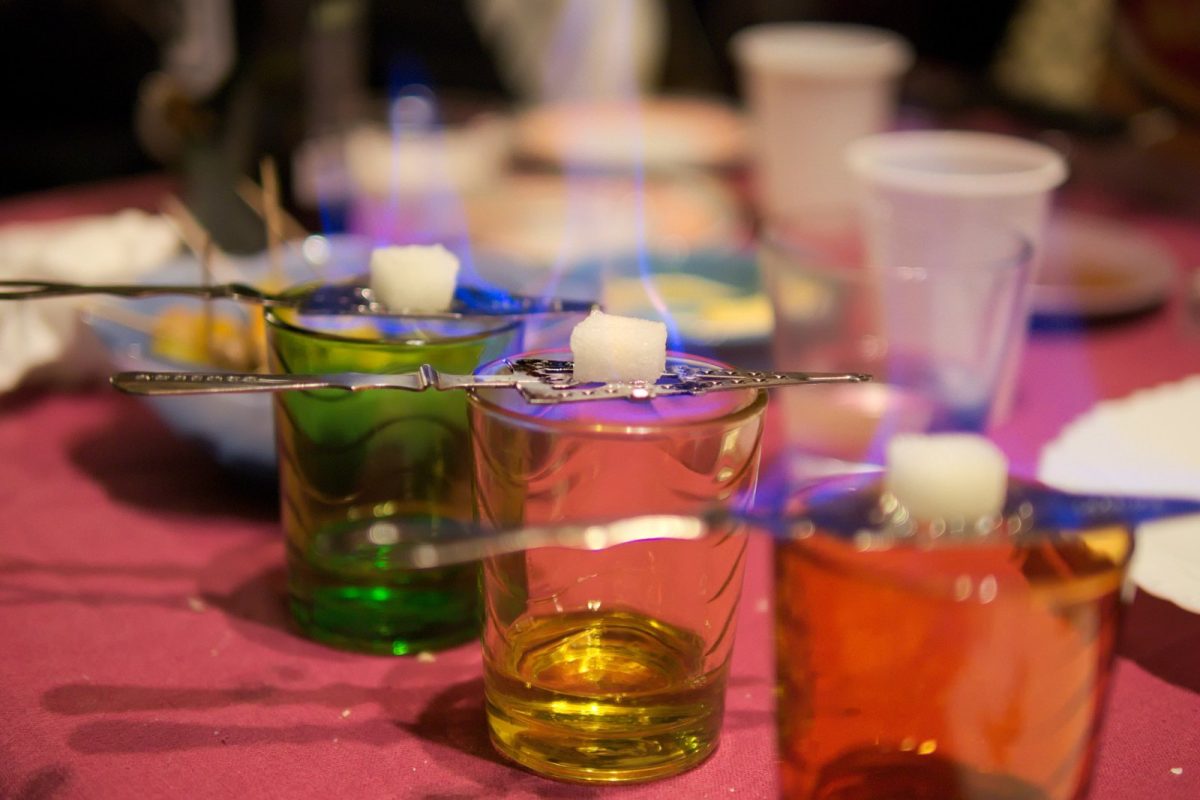
This is the most common and safest procedure. It consists of placing a sugar cube on a perforated spoon over the glass of absinthe and slowly pouring cold water until the drink turns a milky or opalescent shade (the “louche” effect).
Safety benefit: Adding water drastically lowers the concentration of ethyl alcohol, reducing the risk of acute intoxication and helping the drinker stay hydrated.
The Czech Method (With Fire)
Similar to the one above, but with an added step of controlled burning of the sugar. Although it adds a spectacular visual element, it does not significantly alter the chemical profile or the toxicological risks, as long as it is done with care and supervision.
Russian Dolls
This technique consists of nesting glasses of different sizes. By pouring water over the inner glass until it overflows into the outer one, you get a dilution of roughly 50% or more, depending on the ratio of the volumes.
A Critical Reading and Conclusion
Modern absinthe is a complex product that sits at the intersection of cultural tradition and health regulation. Although nineteenth-century romanticism painted a picture of a drink capable of opening the senses, today’s chemical reality presents a different risk profile.
The danger lies not in thujones or wormwood but in the high alcohol content and the possible presence of adulterants if products are bought outside the legal channel. Responsible use means understanding that the effects historically sought (hallucinations) are improbable with the commercial beverages now on the market.
In the context of Psiconáutica, we invite reflection on how popular culture shapes our perception of substances. What we now call the “green fairy effect” is probably a mix of alcohol, suggestion, and cultural expectations. Prudence calls for treating this drink like any other strong spirit: in moderation, with knowledge of its ingredients, and with respect for the limits of the human body.
Science teaches us that behind the legend there is real chemistry, but also persistent myths. Knowing the difference between myth and evidence is the first step toward informed, safer use.


