

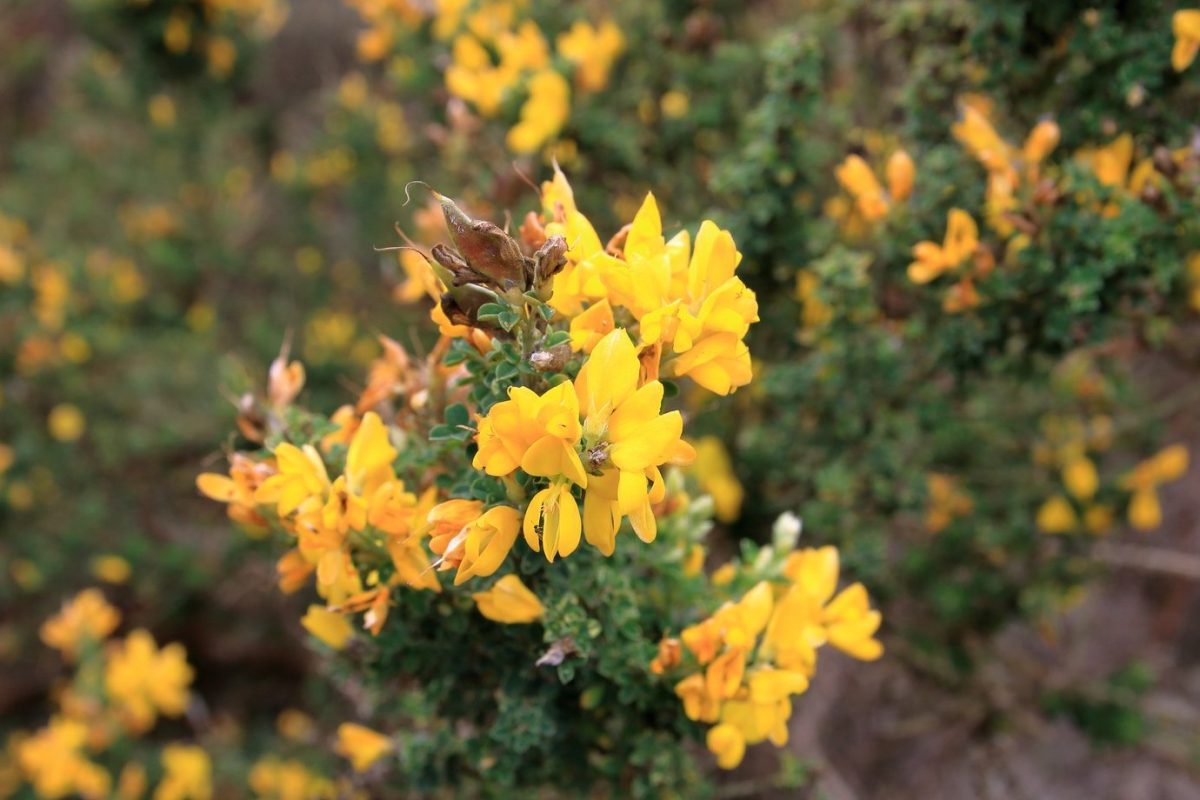
Genista canariensis—or Teline canariensis—is an endemic species of Gran Canaria and Tenerife whose botanical identity shows how science changes without the plant changing.
First installment of the series “The Canary Island Broom: Science, History, and Myth,” six articles that separate the real plant from borrowed stories.
Some plants change names without moving an inch. On an open slope of the monteverde, the Canary Island broom is still the same shrub, with green branches, tiny leaves, and yellow flowers. Yet open a herbarium or a database and it may appear as Genista canariensis, Teline canariensis, or Cytisus canariensis. The triple identity is not a whim: it sums up more than two centuries of botany, new classification techniques, and a question science keeps revisiting: where does one genus end and another begin?
In brief
- Its confirmed natural range is limited to Gran Canaria and Tenerife, not the whole archipelago.
- Kew accepts Genista canariensis; the Canary Islands biodiversity database uses Teline canariensis. Both names refer to the same species.
- The word “retama” (broom) groups together different plants and has led to errors in medicinal, chemical, and ethnobotanical texts.
Three Names for a Single Lineage
The first scientific label came in 1753. Carl Linnaeus included the plant in Species Plantarum as Genista canariensis. Almost a century later, Philip Barker Webb and Sabin Berthelot, authors of one of the great works on the natural history of the Canary Islands, moved it to the genus Teline. Later, combinations in Cytisus circulated, especially in horticulture and in part of the twentieth-century literature.
Today there is no single universal answer on its genus. Plants of the World Online, Kew’s database, accepts Genista canariensis L.; the Canary Islands Biodiversity Data Bank keeps Teline canariensis (L.) Webb & Berthel. The difference does not mean botanists are arguing over whether two plants exist. They are arguing over the most useful way to organize a lineage within the tribe Genisteae.
For a long time, genera were separated by the shape of the flowers, calyx, leaves, branches, and pods. Molecular genetics added another layer: some morphological boundaries did not fully match the evolutionary history reconstructed from DNA. Studies of the Macaronesian brooms have revealed complex trajectories, with possible episodes of ancient hybridization and different signals in the nuclear and plastid genomes. The name changes because the questions and the tools change.
The Problem Starts With One Word: “Retama”
In everyday speech, “retama” describes a silhouette more than an identity. It is applied to many shrubs with flexible branches and pea-type flowers: Cytisus scoparius, Spartium junceum, Retama sphaerocarpa, Retama monosperma, Laburnum anagyroides, and several Canary species, among others. English has the same problem with the word broom.
The ambiguity seems innocent until a source claims that “the broom” contains a certain alkaloid, cures an ailment, or produces a psychoactive effect. Without a scientific name, locality, part analyzed, and herbarium specimen, it is impossible to know whether the claim belongs to the Canary Island broom or to some other shrub. A good share of the exaggerations that have surrounded this species was born of that silent transfer.
In the Canary Islands, names such as retamón canario, retama de monte, codeso blanco, and gildana are documented. They are valuable as linguistic heritage, but they do not replace botanical identification. The golden rule is simple: the common name opens the search; the identified specimen closes it.
How to Recognize the Canary Island Broom
The retamón is a perennial, evergreen shrub. It usually grows up to three meters (10 feet), though in favorable conditions it can approach four (13 feet). Old branches take on brown or grayish tones; young ones stay green and flexible, covered by a fine pubescence that also appears on the leaves and calyces.
The leaves are alternate and trifoliate: each one bears three small leaflets. The upper surface is dark green; the underside is paler and silky. That leafy modesty contrasts with the flowering. In spring, the tips of the branches fill with yellow clusters, sometimes with close to twenty flowers. Each flower shows the typical architecture of many legumes: an upper standard, two side wings, and a lower keel.

Then come the pods. Mature pods, narrow and slightly curved, reach roughly 3 to 3.5 centimeters (about 1.2 to 1.4 inches). They usually contain six to nine dark seeds. As they dry, the tension in the walls can split them open and fling the seeds a short distance. It is not a spectacle you see every day, but it is a small dispersal machine.
Identifying it requires looking at the whole picture. In the Canary Islands it lives alongside other yellow-flowered genisteae and with high-mountain or traditional forage species. The island, the altitude, the habitat, the pubescence, the shape of the leaflets, the calyx, and the pod weigh more than the color of the flower.
“The plant did not change identity three times; the way science organizes its kinship changed.”
A Resident of Two Islands, Not the Whole Archipelago
The confirmed natural range comprises Gran Canaria and Tenerife. The precision matters. Saying it is “endemic to the Canary Islands” is correct in a broad sense, but it can suggest that it lives naturally on every island. It does not.
Its main setting is the monteverde: the laurel forest and the fayal-brezal (a heath-and-fire-tree woodland), above all on rocky edges, slopes, clearings, and areas with more light. Canary descriptions place it roughly between 400 or 500 and 900 meters in altitude (about 1,300–1,600 to 3,000 feet). On Tenerife it appears from Anaga to Teno.
That preference for open spaces explains why it is so visible along forest tracks or in disturbed areas. But it does not make the plant a mere “edge weed.” Moderate disturbance can create light and available soil; intense degradation can destroy the substrate, the symbiotic bacteria, the pollinators, and the connectivity between populations. The effect depends on scale and frequency.
A Piece of Island Evolution
The retamón belongs to a flora shaped by volcanoes, ocean, and isolation. Oceanic islands receive colonizers at different moments; some lineages disappear, others diversify, and others remain confined to certain vegetation zones. The woody form of the retamón fits a common pattern of island floras: shrubs and trees derived from groups that on the continent include smaller or herbaceous forms.
Cytogenetics adds another clue. Published data indicate 48 chromosomes, interpreted as tetraploidy. Its DNA content allows an estimated haploid genome of around 1.47 gigabases, although that figure is not the same as having an assembled genome. Polyploidy can influence fertility, cell size, or environmental tolerance, but the specific role it plays in this species has not yet been demonstrated.
Nor do we know how much the populations of Gran Canaria and Tenerife differ. They could retain a genetic structure marked by isolation between islands, or they could have maintained historical exchange. Resolving this is not an academic detail: it shapes restoration, seed collection, and the risk of mixing provenances that may have been evolving separately for a long time.
The Ornamental Journey
Outside the Canary Islands, the retamón began another life. Its intense flowering, its fragrance, and its compact habit made it attractive to nurseries and greenhouses. With the ornamental trade it reached California, Oregon, Washington, India, Sri Lanka, and other territories recorded by Kew. In some places it escaped cultivation and became naturalized.

“Introduced” does not automatically mean “invasive.” A species can survive outside its native range without spreading aggressively or causing measurable damage. Each region needs to assess its behavior. Horticulture, moreover, complicates identity: labels such as Canary broom, florists’ genista, or sweet broom can bring together material of different origins and outlive taxonomic changes.
The true story of the retamón needs no embellishment. It already contains a double island, a taxonomy in motion, a polyploid genome, flowers able to transform a hillside, and an international journey driven by gardens. Understanding that story is the first step toward not confusing it with the borrowed lives of other brooms.
Sources
- Kew Science. Genista canariensis L. Plants of the World Online.
- Government of the Canary Islands. Teline canariensis, Biodiversity Data Bank.
- CanariWiki, Government of the Canary Islands.
- Percy, D. M.; Cronk, Q. C. B. (2002). Phylogenetic studies of the Macaronesian genisteae.
- Pardo, C. et al. (2004). Phylogeny of Cytisus and related genera.
- Royal Horticultural Society (RHS).
Educational content written from a harm reduction perspective and with respect for individual freedom. It is not a substitute for advice from a healthcare professional and is not intended to encourage or condemn any drug use.


