

In brief
- A study published in Nature (2024) tracked a small group of healthy adults with dozens of MRI scans each to observe, with high precision, what psilocybin does to the brain.
- During the experience, psilocybin massively desynchronized the brain’s functional connectivity, with a change more than three times greater than that of the comparator drug.
- Weeks later, a weakened connection between the anterior hippocampus and the default mode network persisted—a candidate for a “fingerprint” of neuroplasticity; however, the sample size is tiny, and the study was conducted in a clinical setting.
The idea that psychedelics “open” something in the brain is a repeated trope. The interesting question is more concrete: what exactly changes, how long does it last, and how do we know? Recent work provides images of unusual clarity. Psilocybin does not simply turn brain regions on or off; it temporarily reorganizes how large brain networks coordinate with one another and leaves at least one mark that remains weeks later.
The study
The article, titled Psilocybin desynchronizes the human brain, was authored by Joshua S. Siegel, Nico U. F. Dosenbach, and colleagues at Washington University in St. Louis, and was published in Nature in 2024. The design is striking: instead of many subjects with one or two scans, they followed a handful of healthy adults (seven volunteers, one excluded from the main analysis) with precision functional mapping, totaling about eighteen MRI sessions per person—before, during, and up to three weeks after. It was a randomized, double-blind, crossover trial: each participant received a high dose of psilocybin (25 mg) and, on another occasion, methylphenidate (40 mg) as a comparator—a stimulant used to rule out effects caused solely by activation or alertness. Part of the group returned months later for a second dose. It is, therefore, a mechanistic study, not a therapeutic efficacy trial.
What was found
While psilocybin was active, functional connectivity (the synchrony with which different regions fluctuate together) was massively disrupted in the cortex and deep structures. The magnitude of the change was more than three times greater than with methylphenidate, so significant that, within the same person under the influence, their brain resembled itself less than it resembled another person’s brain. The authors summarize the concept as “desynchronization”: the brain disconnects from its habitual routes and reconnects in other ways. Furthermore, the more intense the alteration in each individual, the more intense their subjective experience, which ties the neuronal phenomenon to the lived experience.
Two nuances are important. First, when the person was asked to perform a simple perceptual task during the session, the magnitude of the desynchronization decreased; that is, context and activity modulate the effect—it is not a passive switch. Second, and perhaps most relevant to neuroplasticity, almost everything normalized by the next day, with one exception: a persistent decrease in the connection between the anterior hippocampus and the default mode network, which lasted for weeks. The authors propose this reduction as a possible neuroanatomical correlate of the pro-plasticity effects of psychedelics.
What it means (and what it doesn’t)
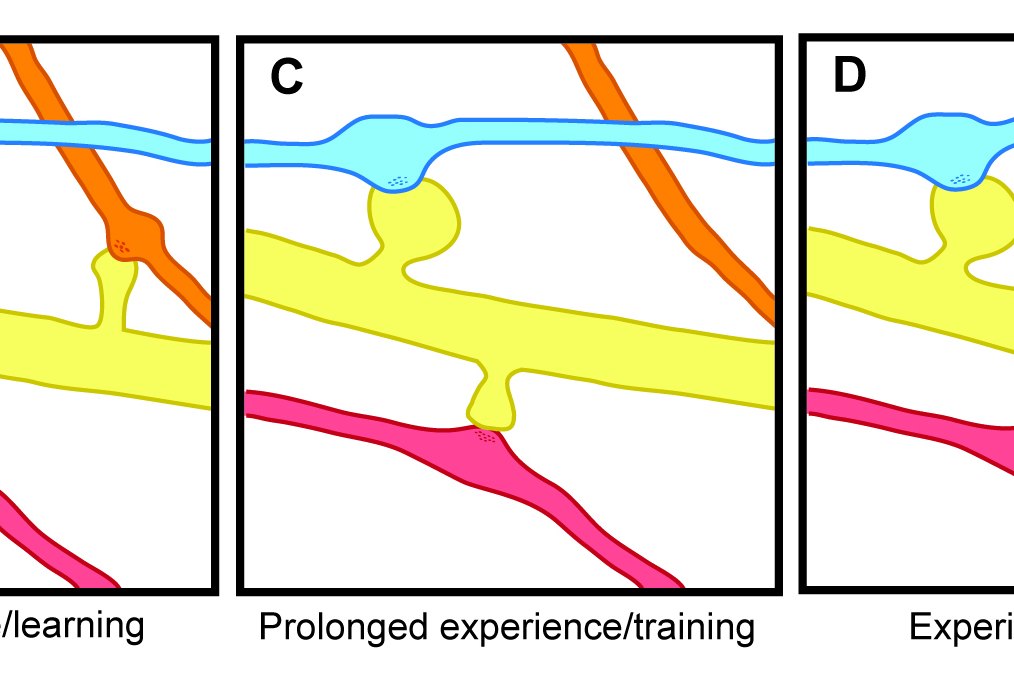
An honest reading goes in two directions. On one hand, the finding aligns with years of work in animals, where a single dose of psilocybin increases the density of dendritic spines and synaptic proteins for weeks. Seeing a measurable, lasting footprint in humans, with such careful methodology, is a serious step toward understanding why a few sessions could have effects that last. The hypothesis of a “window” of increased plasticity after ingestion gains plausibility.
On the other hand, it is wise to temper the enthusiasm. The sample is tiny: we are talking about a handful of healthy people, not patients with depression or addiction. The fact that the hippocampus-default mode network connectivity decreases does not, by itself, prove that any synapses have grown or that this cures anything; it is an indirect marker and a hypothesis, not proof of clinical benefit. Everything occurred in a controlled environment, with measured doses, prior screening, and support—conditions that do not resemble self-administered use and are an inseparable part of the result. And “plasticity” does not automatically equate to “improvement”: a more malleable brain can reorganize in any direction depending on the context, intention, and the care with which the experience is navigated.
Psilocybin is a substance with a restricted legal status in most countries, including Spain, where its use is researched within authorized clinical frameworks. That is a fact, not a judgment. What this research provides is not a verdict, but a finer image of a real and promising phenomenon, which deserves rigor precisely because of how much it promises. Neither a miracle nor a threat: a brain that, for a few hours, rehearses another way of connecting with itself, and of which we are beginning to understand what trail it leaves behind.
Source
- Siegel JS, Subramanian S, Perry D, et al. Psilocybin desynchronizes the human brain. Nature, 2024. DOI: 10.1038/s41586-024-07624-5
Educational content written from a harm reduction perspective and with respect for individual freedom. It is not a substitute for advice from a healthcare professional and is not intended to encourage or condemn any drug use.