

In brief
- A team including Brazilian neuroscientist Stevens Rehen exposed lab-grown human neural stem cells to DMT for 24 hours.
- The compound increased cell proliferation in a dose-dependent manner and elevated production of BDNF, a protein tied to brain plasticity.
- The study, published this August in ACS Chemical Neuroscience, is an in vitro experiment using cell cultures, not a living brain.
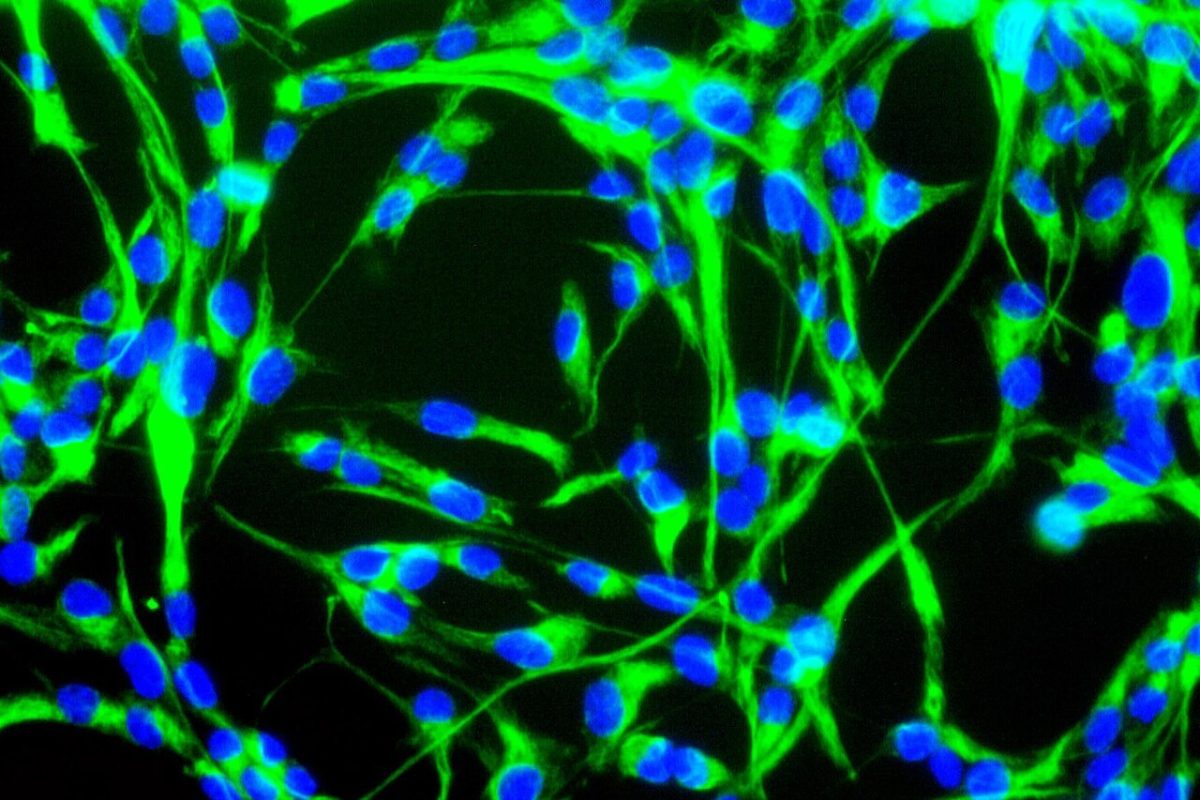
A study published this August exposed human neural stem cells to DMT and observed that the compound accelerates their replication. Led by José Alexandre Salerno and an international team that includes Brazilian neuroscientist Stevens Rehen—from the D’Or Institute for Research and Education, a pioneer in culturing human nervous tissue from stem cells—the paper appears in ACS Chemical Neuroscience as part of an issue dedicated to serotonin research.
What exactly did they do to those cells?
The neural stem cells used in the experiment did not come directly from a brain; they were generated by reprogramming ordinary human cells into the progenitor cells that give rise to neurons and other nervous system cells during development. The team exposed them to varying concentrations of DMT for 24 hours. The higher the dose, the more the cells divided, with a half-maximal effect around 59.7 nanomolar. Internally, DMT activated genes that drive a cell into the division cycle. It also shifted growth-factor gene expression: neurotrophin-3 transcripts decreased, while nerve growth factor and BDNF transcripts increased. Intracellular BDNF protein also increased—the protein that antidepressant and psychedelic research repeatedly highlights as a cornerstone of brain plasticity.
Larger neurospheres, without going off script
After washing out the DMT, the researchers allowed the cells to cluster into neurospheres—three-dimensional structures laboratories use to observe how nerve cells grow and self-organize. Those previously exposed to DMT formed larger spheres than control cultures. Ten days later, the balance of progenitor cells and immature neurons within those spheres remained virtually identical to cultures that had never encountered the compound: the measured markers did not show a composition difference at day ten, which does not establish normal complete maturation or neuronal function.
What this means
This is a petri dish, not a person. The experiment says nothing about what happens in a living human brain—shaped by context, personal history, and subjective experience—nor does it prove that neurogenesis drives the clinical improvements seen in people with depression treated with DMT. That link remains a hypothesis, albeit one with growing experimental backing; in clinical settings, evidence currently comes from small trials with inhaled DMT tracking quality-of-life gains up to a year later. What this study provides is a concrete mechanistic piece consistent with years of research into the BDNF pathway and its TrkB receptor, which other psychedelics like psilocybin and ketamine also engage. It also adds a crucial finding: the effect was confirmed in human cells, moving beyond the rodent models where DMT-induced neurogenesis had primarily been documented until now.
Source
- Salerno JA, Dominguez ER, Karmirian K, et al. Proliferative Effects of the Psychedelic N,N-Dimethyltryptamine (DMT) in Human Neural Stem Cells. ACS Chemical Neuroscience, vol. 17, no. 15, pp. 2901-2909, August 2026.
Educational content written from a harm reduction perspective and with respect for individual freedom. It is not a substitute for advice from a healthcare professional and is not intended to encourage or condemn any drug use.