

In brief
- A Brazilian study compares two esketamine protocols in 72 people with treatment-resistant depression.
- Dissociation was documented more frequently in the intravenous group.
- Differences between centers and treatments prevent any conclusion that one route is superior or equivalent.
Subcutaneous esketamine is once again part of the discussion about options for treatment-resistant depression. A paper published on October 16 in Frontiers in Psychiatry examines medical records from three Brazilian centers and provides data on response and tolerability. Its value lies in describing clinical practice, with its differences and limitations, rather than determining which route works better.
Two protocols, an uneven comparison
The study is retrospective: it analyzes treatments administered between 2023 and 2025. It includes 26 patients who received six intravenous sessions and 46 who received twelve subcutaneous sessions; 54 had recurrent unipolar depression and 18 had bipolar depression. Both injectable routes were used off-label in Brazil, under clinical supervision. The study did not evaluate the intranasal spray. At six sessions, 57.7% and 30.4%, respectively, had achieved a reduction of at least 50% on the BDI-II depression scale. At the end of the protocols, the proportion in the subcutaneous group was 45.7%. These endpoints reflect different exposures.
Dissociation was documented in 53.8% of the intravenous group and 13% of the subcutaneous group. No serious treatment-related events were recorded in the cohort analyzed. However, 54 of the 126 cases that passed the initial screening were excluded from the final analysis because of dropout, withdrawal, or other interruptions. The percentages describe those who provided the required assessments, not everyone who started treatment: excluding interruptions may bias the response estimate. There was also no standardized safety follow-up for those 54 cases, and adverse effects were collected from medical records, without a uniform prospective assessment.
What this means
A numerical difference warrants investigation; on its own, it does not explain its cause. When the center, duration, and regimen all change at the same time, it is difficult to separate the effect of each factor. The route depended on the center: two used the intravenous route and one used the subcutaneous route. Mean starting doses, the proportion of patients with bipolar depression, and some comorbidities also differed; concomitant oral treatments varied. The ordinal analysis did not adjust for these factors. Comparing six sessions with twelve also does not allow the result to be interpreted as a race with the same finish line.
Response does not mean complete recovery: halving a score may leave residual symptoms. These percentages also do not describe how long the benefit lasts.
The absence of a statistically significant difference does not establish equivalence either. Supporting that conclusion requires a specific study design, with a defined margin and an adequate sample size. Likewise, the absence of recorded serious complications in a small series does not rule out uncommon problems.
The ketamine and dissociatives pillar page provides context for this news story.
Source
- Alves and colleagues. Real-world clinical outcomes under intravenous and subcutaneous esketamine protocols for treatment-resistant depression: a multicenter, retrospective study. Frontiers in Psychiatry, October 16, 2026.
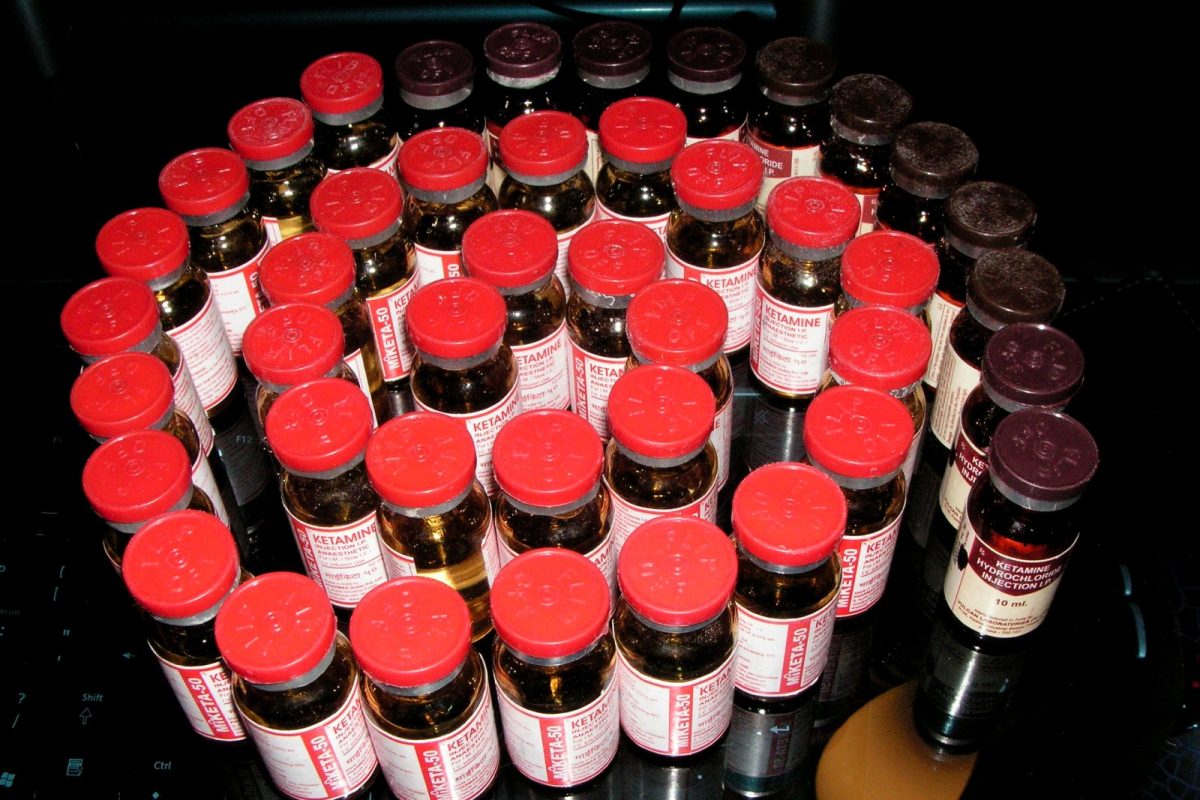
Ketamine vials, illustrative image. Photo: Psychonaught / Wikimedia Commons (CC0). Cropped from the original image.
Educational content written from a harm reduction perspective and with respect for individual freedom. It is not a substitute for advice from a healthcare professional and is not intended to encourage or condemn any drug use.