

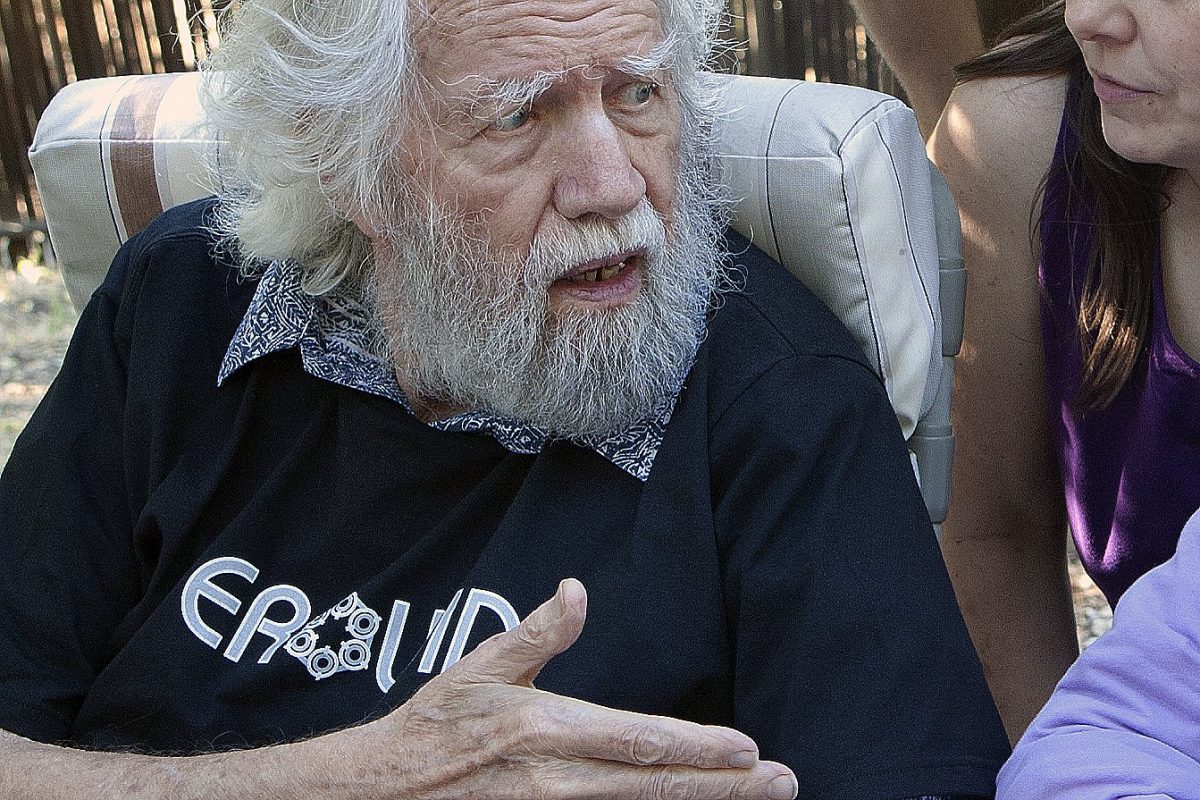
Who He Was, Before the Legend
Few figures embody as much mythology within psychoactive culture as Alexander Shulgin. Following the passing of Albert Hofmann in 2008, Shulgin stood as the living icon of a scientific methodology that wedded laboratory rigor, introspective inquiry, and natural philosophy. It is vital, however, to separate historical reality from myth: behind the “legendary chemist” lay a concrete life story shaped by genuine triumphs, personal contradictions, and a specific historical era that explains much of what he accomplished.
He was born on June 17, 1925, in Berkeley, California, the son of a Russian immigrant father and an American mother, both schoolteachers of progressive ideals in an America about to enter the Great Depression. He grew up in an intellectual middle-class household surrounded by books and expansive evening discussions with his parents’ colleagues, an stimulating cultural incubator that left an indelible mark.
A Child Prodigy Who Preferred Not to Stand Out
Young Sasha—as he was known to family—was peaceful to the point of retreating from interpersonal conflict, unconcerned with appearing timid. His intellectual aptitude vastly exceeded that of his peers: he spoke fluent Russian and French in addition to English, played the piano, viola, and violin, and wrote poetry. Even so, he made conscious efforts to blend into the background to avoid provoking resentment. He had few friends his own age, preferring the stimulating company of adults.
His basement was both sanctuary and workshop. At just seven years old, he assembled his first chemistry laboratory there, cycling to the local pharmacy—merchants that then sold raw chemical reagents—to purchase basic compounds. This precocious scientific passion coexisted with an unassuming adolescence in which he rarely showcased his talents in public.
The Turning Point: The Power of Placebo
At age sixteen, he earned admission to Harvard University, beginning studies in chemistry on scholarship. The university experience proved alienating: surrounded by privileged classmates from affluent dynasties, he felt isolated and eventually withdrew to enlist in the United States Navy as America entered World War II. Assigned to a destroyer escort in the North Atlantic, he confronted mortality firsthand without sustaining injury.
It was aboard ship that the decisive epiphany occurred. A severe thumb infection required emergency surgical drainage. Prior to surgery, a nurse administered a glass of orange juice; spotting undissolved white crystals at the bottom, Shulgin became convinced he had been given a potent sedative to induce anesthesia. Determined to resist, he drank it down while willing himself to stay awake—yet fell into deep unconsciousness within minutes. Upon awakening, he learned the crystals were merely granulated sugar. Expectation and psychological suggestion, not pharmacology, had knocked him out. The profound reality of the placebo effect stunned him; as he later recounted, that single realization prompted his lifelong devotion to psychopharmacology and the investigation of how the mind shapes subjective reality.
The Making of a Biochemist
Honorably discharged from the Navy in 1946, he enrolled at UC Berkeley after two attempts. While completing his undergraduate degree, he married his partner Helen despite family objections, and they had a son, Theo. In 1954, he earned his doctorate in biochemistry, pursued postdoctoral training at the University of California San Francisco, and worked briefly at Bio-Rad Laboratories before joining Dow Chemical.
At Dow, he handled corporate projects with distinction, synthesizing Zectran—one of the earliest biodegradable commercial insecticides—which proved a tremendous commercial triumph. In recognition, Dow granted him an extraordinary reward: near-complete academic freedom to pursue independent research in their laboratories. For a research chemist, few privileges could be greater.
Mescaline and an Enduring Epiphany
His scientific curiosity soon turned toward mescaline, a phenethylamine largely ignored during the 1940s despite earlier precedents such as Kurt Beringer’s 1927 clinical monograph on “mescaline psychosis.” For years he analyzed it purely theoretically. Then, after reading Aldous Huxley’s The Doors of Perception and Heaven and Hell, Shulgin underwent his first personal visionary experience with mescaline in April 1960. That profound afternoon permanently altered the direction of his life’s work.
From that initial journey, he derived an insight that would underpin his entire career: the molecule does not “generate” the mystical vision, but acts as an organic catalyst. It is the human psyche itself that creates the experiences, just as it constructs ordinary consensus reality. The underlying question—what hidden dimensions lie within us that remain inaccessible to ordinary awareness?—shifted the enterprise from pure organic synthesis to philosophical anthropology. In this expansive sense, and in this sense alone, he might rightly be called a modern alchemist: a researcher committed to expanding the boundaries of human self-knowledge.
His Philosophy Regarding Drugs
For Shulgin, every psychoactive compound—licit or illicit—offers potential rewards, carries inherent risks, and can be abused. He drew a sharp qualitative line around classic psychedelics: in his estimation, they do not facilitate escapism from the self, but rather compel the subject to confront their inner reality directly. In contrast, he viewed narcotics and cocaine as fleeting escapes from pain. His guiding maxim was uncompromisingly individualistic: “educate yourself and then decide.”
He was equally critical of statutory drug prohibitions, lamenting that pursuing self-knowledge through these biochemical gateways had been criminalized, when the exploratory drive to study what nature yields has accompanied human evolution since prehistory. This libertarian viewpoint was deeply intertwined with his personal ethos, though like all philosophical stances, it invites critical examination rather than uncritical dogma.
Critical Appraisal
Three essential caveats must be noted. First, Shulgin’s framing of psychedelics as tools for personal revelation is his subjective philosophy, forged through personal self-experimentation within a unique historical milieu; it does not constitute generalizable clinical proof. Second, much of what is publicly known about his career stems from autobiographical writings and interviews, meaning formative episodes—such as the navy placebo incident—function partly as founding lore. Third, and most crucially: nothing in this historical overview constitutes encouragement or advice to consume psychoactive substances. These substances entail tangible physiological, psychiatric, and legal hazards, produce highly variable reactions across individuals and settings, and carry serious clinical contraindications. This biographical profile is an educational history, not an endorsement. Anyone with medical or psychological concerns should consult licensed healthcare providers and established harm-reduction services.
This biographical essay is adapted from the educational writings on Shulgin by researcher J. C. Ruiz Franco. The second installment continues with the most renowned phase of his scientific journey.


