

Beyond the Psychonaut
People tend to remember Antonio Escohotado for his Historia general de las drogas (General History of Drugs) and for his public defense of the right to decide what to do with your own body. But reducing him to that means losing sight of an author with a large and varied body of work, who spent the last stretch of his life on a project he considered his intellectual testament. In this fourth and final installment, we look at that other side of him: the author of long-form essays, the meticulous translator, and the popularizer of ideas.
“The Work of My Life”: Los enemigos del comercio
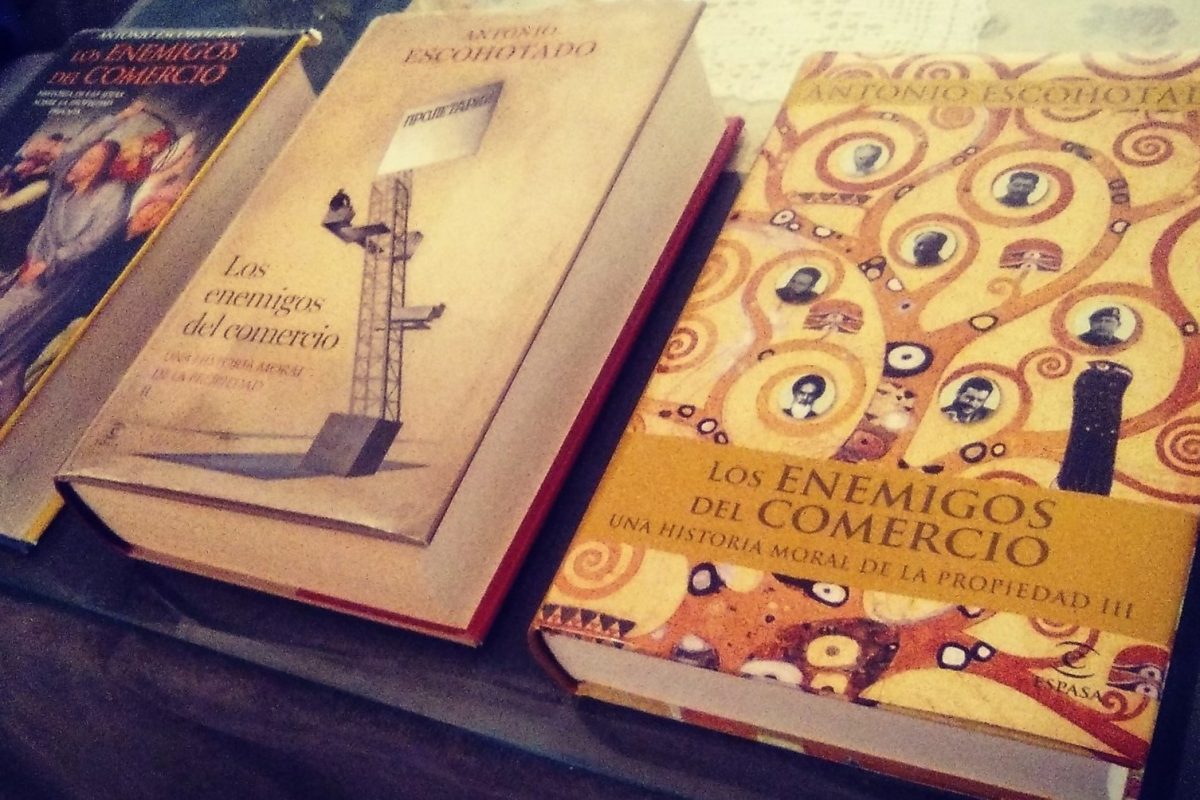
Escohotado called Los enemigos del comercio “the work of my life.” It is a history of anticapitalist ideas, published in several volumes beginning in 2008. Its starting point is ambitious: to trace what he called the “red consciousness” from its ancient roots—including Gospel passages such as the expulsion of the merchants from the temple, the image that illustrated the cover of the first volume—to its theoretical consolidation in the nineteenth century and its symbolic dissolution with the fall of the Berlin Wall.
The project has a good deal of an intellectual autobiography in reverse. As a young man, like much of the Spanish university left in the 1960s and ’70s, he was close to the Communist Party: he handed out underground press and joined demonstrations against Franco’s regime. By his own account, the distance came early; as he studied economics he took the measure of the premises of Marxism and related theories, and he turned that critique into the engine of the work. The second volume already began in the nineteenth century, with Proudhon, Marx, and Bakunin as its protagonists.
The Translator: Hobbes and Newton in Spanish
Escohotado’s work as a translator is perhaps the most underrated side of him. He produced the Spanish version of Thomas Hobbes’s Leviathan (Editora Nacional, 1979) and, above all, of Isaac Newton’s Mathematical Principles of Natural Philosophy (1982), accompanied by a long, well-documented introductory study. Rendering the capital work of classical physics into Spanish is no minor commission, and it gives a sense of the range of registers the man commanded.
The episode also had its chapter of academic controversy: shortly before a second translation of the Newtonian classic appeared, a colleague of the rival translator published a particularly harsh review of Escohotado’s version in the press. His own account invites us to read the incident as an example of the squabbles of the university guild rather than as disinterested scientific criticism. It should be taken, however, for what it is: a partial version of a conflict of which we know only one side.
Champion of Szasz and Jünger
Escohotado helped introduce two uncomfortable authors to Spanish readers. From the psychiatrist Thomas Szasz, a radical critic of the very concept of mental illness, he translated titles such as The Theology of Medicine, Ceremonial Chemistry (“Drogas y ritual” in Spanish), and Our Right to Drugs. He wrote and spoke on several occasions about the German writer Ernst Jünger, including his Retrato del libertino (Portrait of the Libertine). On top of that came contributions to the mainstream press and the direction of summer courses on drugs at the Complutense University of Madrid and the UNED, at a time when bringing that debate into the classroom was far from common.
Escohotado the Lyricist
Less well known is his foray into music. He wrote the lyrics of De la piel pa’dentro mando yo (“I Rule From the Skin In”), an antiprohibitionist proclamation recorded by the experimental rock band Mil Dolores Pequeños, and he contributed to Nunca es igual (“It’s Never the Same”), from Andrés Calamaro’s 1997 album Alta suciedad. The lyrics sum up his central idea in poetic form: sovereignty over one’s own body as the last, inviolable frontier.
“I rule only from the skin in. […] I am a state, ruler and sovereign without a currency, and the borders of my skin are more sacred to me than the frontiers of any country.”
A Critical Reading
Much of what is said about Escohotado comes from interviews and his own texts, where he is both protagonist and narrator. That calls for some caution in reading the episodes of grievance—the university feuds, the hostile reviews—which tend to be presented from his point of view. As a thinker, his antiprohibitionism rests on a solid and coherent liberal principle of personal autonomy, but it does not exhaust the debate: regulating substances also raises questions of public health, inequality, and harm to third parties that his approach tends to downplay.
It is also worth not confusing a defense of the right to decide with an invitation to use drugs. Recognizing that everyone is sovereign over their own body does not eliminate the pharmacological, legal, or psychological risks of drugs; it moves them into the realm of individual responsibility and honest information. Anyone who wants to dig deeper has Escohotado’s own work at hand, along with that of the authors he popularized—Szasz and Jünger—which can be checked against the abundant scientific and harm reduction literature published since.


