

One Family of Plants, Many Names
Few plants have gathered as many names as peyote. The most widespread term derives from the Nahuatl peyotl, but each culture that has lived alongside it has named it in its own tongue: hikuri among the Huichol, ciguri among the Rarámuri (Tarahumara), kamaba among the Tepehuán, hualari among the Cora, and wokow among the Comanche. This linguistic diversity is not merely anecdotal: it reflects a plant woven into ritual and healing systems long predating its “discovery” by European science.
Something similar occurs with the Andean San Pedro cactus, also called aguacolla or gigantón. Tradition attributes its Christian name to a metaphor: like the saint who guards the gates of heaven, the cactus opens a gateway. Whether that folk etymology is historical or not, it illustrates how colonial Catholicism overlaid ancient ceremonial practices without entirely erasing them.
What Lies Within: Basic Chemistry Without Recipes
The bitter taste of peyote reveals its chemical complexity: it contains around fifty different alkaloids. The primary agent is mescaline, a phenethylamine; it is accompanied by other molecules such as hordenine (a tetrahydroisoquinoline) and peyotine, which appears to contribute distinctive qualities to the subjective experience. Consequently, chewing the whole cactus is not identical to ingesting pure isolated mescaline: the ensemble of alkaloids modulates the overall effect.
Mescaline shares structural similarities with norepinephrine and acts upon neurotransmission, altering perception—especially visual perception—as well as the sense of time and emotional state. Beyond peyote (Lophophora williamsii), it is synthesized in substantial amounts by the South American San Pedro cactus (Trichocereus pachanoi) and, in lesser or trace quantities, by other species of the genera Trichocereus, Aztekium, and Pelecyphora. One should be skeptical of the notion that “any columnar cactus will do”: alkaloid concentration varies immensely across species and even within the same individual plant.
A Milestone in the History of Pharmacology
In 1896, German pharmacologist Arthur Heffter isolated mescaline from dried peyote buttons—then known in Europe as “mescal buttons,” whence the compound derived its name. It was the first chemically isolated hallucinogen, decades before LSD was synthesized. That achievement positions peyote at the very dawn of modern psychopharmacology regarding altered states of consciousness: much of what would later be investigated concerning serotonin, human perception, and model psychosis began taking shape around this compound.
Botany of Peyote: Slow, Fragile, and Heavily Targeted
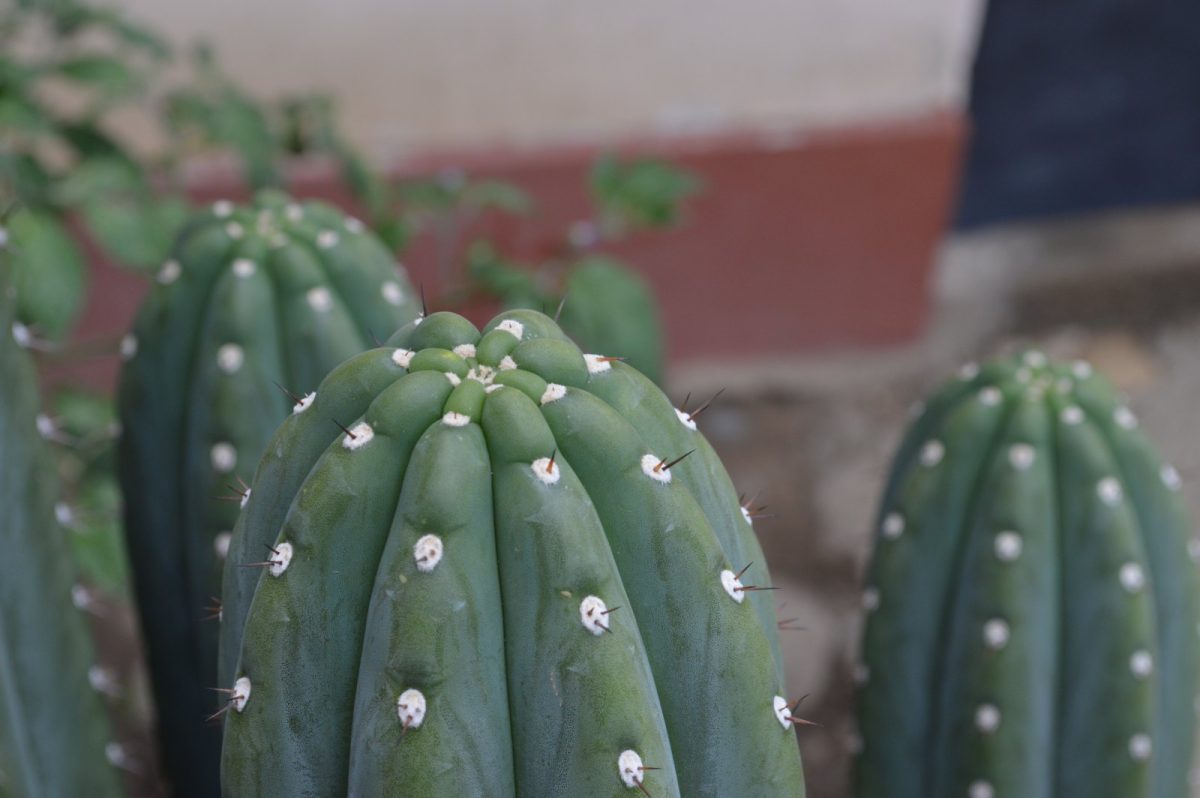
Peyote is a small, grayish-green cactus with a large taproot that anchors deep into arid soils. It grows in clusters—often referred to as colonies or patches—frequently sheltered beneath spiny shrubs that shield it from intense sun and foraging animals. Its most defining characteristic for understanding its precarious modern status is its slowness: it can take more than fifteen years to reach maturity. Its whitish-pink flowers are diminutive, as are its tiny black seeds.
This slow biology explains why uncontrolled harvesting causes profound ecological damage. A plant that requires more than a decade to reproduce cannot withstand intensive commercial gathering. Peyote is classified among endangered cacti, and several closely related species share similar conservation threats. In discussions of “psychonautic tourism” and commercial demand, conservation ceases to be a minor ecological detail and becomes a primary issue, including an ethical responsibility toward indigenous peoples for whom the plant is sacred.
San Pedro and “False Peyotes”
In contrast to the languid pace of peyote, San Pedro is a fast-growing columnar cactus that thrives naturally across regions of Peru, Bolivia, and Chile. That difference in growth rate has made it the less vulnerable mescaline-bearing species, though harvesting pressure on wild populations remains a legitimate concern.
A folklore of plant substitutions has also grown around peyote. Several cacti from the Mexican high plateau—often dubbed “peyotillos,” such as Pelecyphora aselliformis or Ariocarpus retusus—have been sold or passed off as peyote to inexperienced seekers. These are not adulterations in the chemical sense, but botanical misidentifications that carry consequences: differing chemistry, unpredictable safety profiles, and in several instances, threatened species that are equally protected by conservation laws.
Traditional Uses: Far Beyond “Hallucinogen”
Reducing these plants exclusively to their visionary effects distorts their heritage. In traditional medicine, peyote served predominantly pragmatic purposes: the Huichol applied poultices to wounds to prevent infection, and it was employed against joint aches, physical fatigue, and insect stings. Several cacti contain compounds exhibiting antiseptic activity, providing empirical support for these topical uses. Other species were applied for digestive upset or as anti-inflammatory compresses.
Here an important clarification is warranted: demonstrating “antibiotic activity” in an academic laboratory does not convert a plant into a safe, easily measured home medicine. Ethnobotany documents cultural practices; it does not prescribe treatments.
What Users Describe
Accounts of experiences with peyote or San Pedro share certain common features: waves of shifting color visions, sensations of weightlessness or lightness, temporal distortion, heightened sensory sensitivity, and an experience of deepened internal processing. Yet every account underscores that the qualitative content is deeply shaped by psychological state and environmental setting: there is no uniform effect, but rather a terrain sculpted by context.
Physically, an uncomfortable initial phase is common—nausea, occasional vomiting, chills, tremors, or headaches—before perceptual changes emerge. This is not an incidental detail: it is an intrinsic part of the experience and should not be romanticized.
Real Risks and Harm Reduction
The most significant clinical risk associated with mescaline is typically not organ toxicity at recreational doses, but the potential to provoke an anxiety crisis or a psychotic episode, particularly in individuals with a genetic vulnerability or history of psychiatric disorders. Emotional headspace, physical setting, and social surroundings can tip the balance between a manageable experience and a psychological crisis.
From a harm reduction perspective, and without this constituting an encouragement to consume, the following considerations are essential:
- Dangerous interactions. Mescaline is not inert in combination. Mixing it with other medications or psychoactive substances can unpredictably exacerbate toxicity; several documented drug interactions are potentially severe.
- Medical conditions and pregnancy. Pre-existing cardiovascular or psychiatric conditions fundamentally alter the risk profile. During pregnancy, no evidence supports safety, making complete abstention the only prudent choice.
- When it is an emergency. Symptoms such as cardiac arrhythmias, chest pain, acute hypertension, or unrelenting panic cannot be “managed at home”: they require prompt medical attention. Attempting blind self-medication to abort a difficult trip can worsen complications.
- Identification. Misidentifying species—the problem of “false peyotes”—introduces entirely avoidable danger. A plant that is not identified with complete certainty is unknown.
Regarding addictive potential, pharmacological literature generally agrees: tolerance builds rapidly, and mescaline does not induce the physical dependence characteristic of other drug classes. This does not mean it is harmless; it means its hazards are of a different nature, rooted in mental health and psychological setting rather than compulsive seeking.
Critical Reading
Much popular writing on entheogenic cacti repeats figures and assertions circulating for decades without rigorous verification. Readers should approach them critically:
- Reported mescaline percentages, duration estimates, and “equivalencies” between species found online often originate from outdated or secondhand literature. Actual potency depends heavily on species, age, and growing conditions, and varies considerably.
- Certain lingering historical claims—“it damages chromosomes,” “it does not damage chromosomes,” or exhaustive lists of diseases it allegedly cures—reflect historical milestones in scientific debate rather than modern consensus. Current psychedelic research is promising yet circumscribed, and offers no endorsement of unregulated self-treatment.
- Legal status matters: in Spain and across most jurisdictions, mescaline is a strictly controlled substance. The legal status of live ornamental plants and indigenous ceremonial exceptions is distinct, intricate, and variable.
This article is intended for educational and historical purposes. It intentionally omits dosage amounts, extraction procedures, and administration guides: our purpose is to explore what these botanical species are and the place they occupy in psychoactive history, not to provide consumption instructions.


