

Santa Claus, Flying Reindeer, and Amanita muscaria: The Shamanic Origins of Christmas
Once again, this Christmas, we have seen the streets invaded by Santas. Without a doubt, he is a distinctive character who filled our childhood with wonder and our adulthood with indignation and disillusionment at such an elaborate fable. Gifts no longer thrill us the same way; they fall into the cold reality of knowing they are given to you by normal people, just like you or me.
I preferred to think when I was a little person—not a mythical one, but a child—that the gifts were brought by Santa Claus from the North Pole. That figure with the prominent abdomen, dressed in his red suit with white cuffs and trim matching his thick hair and beard, riding his gleaming silver-runner sleigh pulled by eight flying reindeer, would traverse the frozen winter sky to deliver gifts to all the children of the world, slipping into houses to leave them in the fireplace (the rich version) or under the PVC Christmas tree (the poor version).
This mysterious being who travels so much back and forth on the night of December 25 at speeds exceeding that of sound, squeezed into his sleigh, delivering gifts to more than 400 million Christian children and making a tremendous effort to slide down chimneys like a skilled chimney sweep—known throughout the world in various forms and names, such as Santa Claus, Saint Nicholas, Father Winter, or “Danta Kurosu” in Japanese, among others—is part of an ancestral myth that has a bit of legend and a bit of reality.
I am not going to present quantum theories that explain his probable existence and his challenge to classical physics through wormholes or tachyons. What I intend in this article is to stick to reliable and proven facts that have their cradle in Siberia and whose origin dates back more than 6,000 years.
The most plausible theory that best fits the myth of Santa Claus is, probably, his shamanic origin and his relationship with the consumption of Amanita muscaria, although this character has undergone variations and transmutations over time to reach the colorful commercial formulas of today that Coca-Cola proposes to us.
The Winter Solstice and the Pagan Roots of Christmas
The Christian tradition of Christmas is of pagan origin, since the night of December 21 marks the winter solstice. This event has been celebrated across the planet for millennia by peoples who lived as observers of celestial phenomena, for as the 21st arrives, the nights are longer, and it is precisely this night—the longest of the year—when the eternal cycle of death and rebirth is worshipped: the slow death of the sun toward the solstice and its rebirth with increasingly longer days. The Petite Mort. The Phoenix. Christianity simply adapted its calendar to overlap this event with the birth of Christ, another clear example of death and rebirth.
But what leads us to think that Santa Claus comes from practices as remote as shamanism in Siberia? What parallels make us think there is any resemblance?
Siberian Shamanism and Amanita muscaria
We must remember that great migrations occurred from Siberia throughout prehistory, spreading shamanic practices throughout Europe, Asia, and America, and there are numerous vestiges representing the ritual or symbolic consumption of Amanita muscaria.
Northern European and Siberian peoples, above all—such as the Sakha, Koryak, Chukchi, Sami, Yukaghir, or Kamchadal—have and in some cases still maintain the custom of eating A. muscaria both to get intoxicated and in shamanic practices. Shamans, great mycophagists, entered a trance through the ingestion of the mushroom in order to access the Mundus Imaginalis, the Axis Mundi, and to contact spirits in search of answers.
It is very likely that the Siberian peoples learned this practice from observing reindeer, due to their habit of “getting drunk” on the amanita. This is how Adolf Erman described the reindeer’s experience with the mushrooms in 1833:
The wild reindeer that have ingested them are often so stupefied that they can be tied up and used as a means of transport, and their meat also intoxicates whoever eats it.
On the other hand, a century earlier, a Swedish army colonel named Filip J. von Strahlenberg, after twelve years of imprisonment in Siberia and after studying the customs of the Siberian peoples, made perhaps the first account of amanita ingestion recorded in modern literature.
When they celebrate a feast, they pour water over some of these mushrooms and boil them. Then they make a liquor, which intoxicates them.
And he added:
Those poorer ones who cannot afford to store their own mushrooms station themselves, on such occasions, near the huts of the rich, waiting for the guests to come out to urinate. At that moment, they hold out a wooden bowl to receive the urine, which they drink greedily, as if it still contained part of the mushroom’s virtue, so that they get drunk too.
The Red and White Mushroom: Active Principles and Symbolism
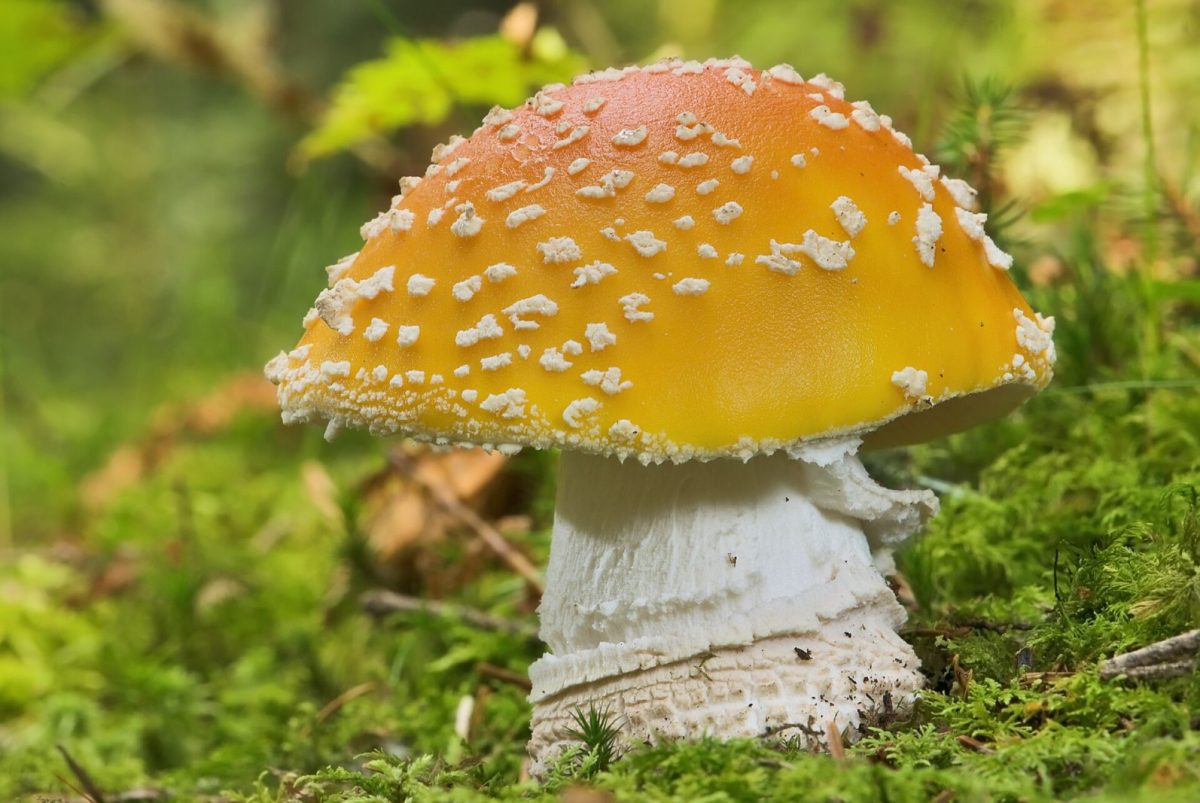
Amanita muscaria is a psychoactive mushroom with visionary qualities whose effects range from euphoria to deep sleep, passing through all sorts of perceptual alterations. Its active principle is ibotenic acid, which, once ingested, transforms into muscimol. It usually grows in forests in autumn, and the most valued species for their potency are those that grow among the roots of conifers, such as pines or firs. There are numerous studies and archaeological findings that highlight the importance this mushroom has had in the genesis of cultures and religions: the “Soma” for the Hindus, the “Tree of Knowledge” for the Christians, the “Tree of Life” for the shamans, or the “Mushroom of Immortality” for the Taoists. It also tends to have a wide representation in children’s stories, and its presence in the forests usually awakens a certain sympathy.
Well then, days before December 25, when the winter solstice occurs, the shamans would collect these mushrooms in the pine forests—which were normally frequented by reindeer—to distribute them among the members of their tribe. Usually, the entrance to the huts in winter was blocked by snow, so they were forced to access them through the roof to leave this precious gift for the inhabitants. The mushrooms were usually dried near the fire in small bags. When the mushrooms were consumed, the people lived and understood the trance the Sun went through, to finally be reborn and ascend to the sky once again (Malagón, www.sindioses.org, 2003).
Parallels with Santa Claus
Without a doubt, there are more than enough parallels to trace the beginning of this myth, understanding the concept of myth not only as a story with anchors in reality but as the embodiment of values and virtues in living characters and sequences of their lives.
So far, we have seen that the shaman was an intelligent being, usually with a thick beard, a reflection and symbol of wisdom in many cultures. Dressed in extravagant and striking garments, his visit before the December solstice was highly anticipated, especially for the “gifts” he carried. He collected amanitas in the pine forests where they grow thanks to their mycorrhizal relationship with the roots of these trees. He would sneak in through the roofs to distribute them. They were dried in bags near the fire. Reindeer ate amanitas, and their effects made them “fly.”
Curious, isn’t it? Our Santa Claus dresses in red and white—like the amanitas—has a long beard, and distributes gifts on the night of December 25, leaving them by the fireplace or under the tree once he has passed the test of entering through the roof. He is carried through the skies in his sleigh thanks to his flying reindeer with names like Dasher, Dancer, and Prancer. And let’s not forget the pine or fir tree that presides over our homes, adorned with red balls and gifts.
Without a doubt, this is not the only tradition or story that has an origin related to entheogens (god generated within), to inebriation, or to the eternal cycle of death and rebirth.
Perhaps after reading this, you won’t look at a Santa Claus with that same expression when you see him stationed at the corner of a shopping mall; maybe after seeing him, you’ll only feel like eating him.
Raúl del Pino