

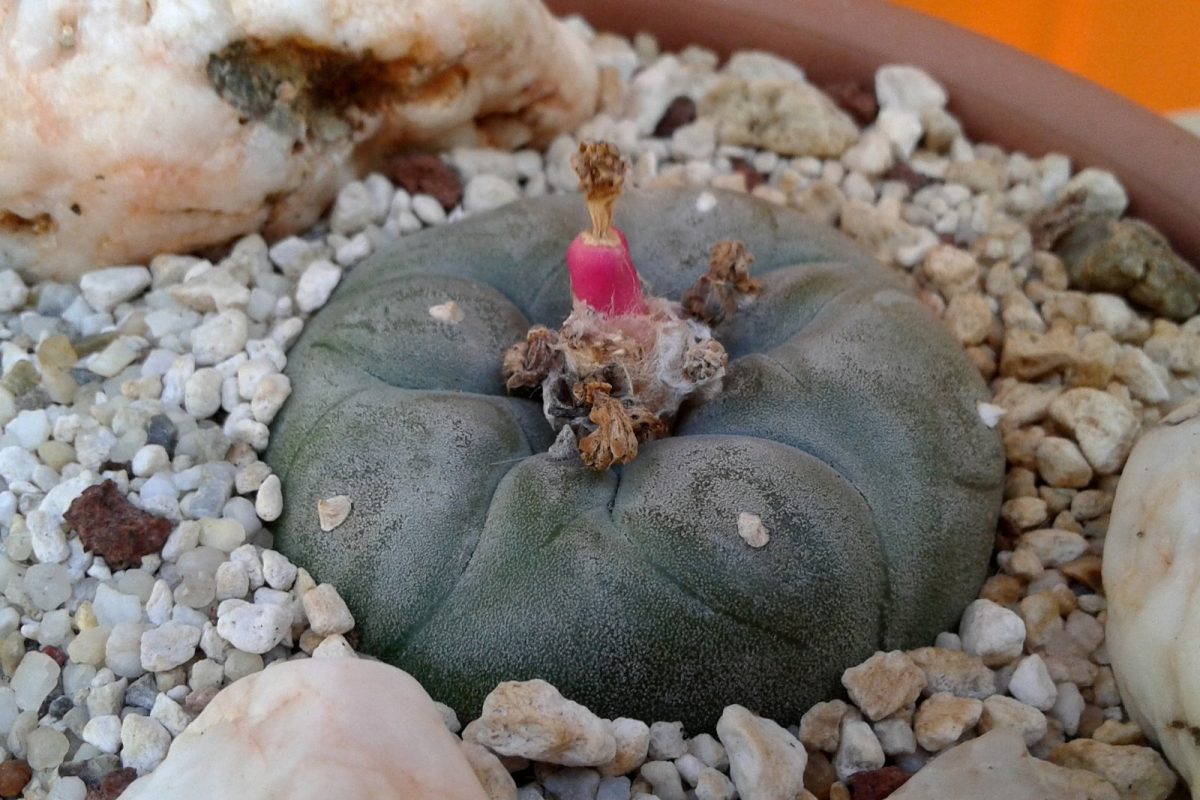
A Small Cactus with a Massive History
Lophophora williamsii is a tiny, spineless cactus with a flattened, rounded body that grows flush with the ground in the limestone deserts and river valleys on both sides of the Rio Grande. Its range spans southern Texas and much of northern and central Mexico—Coahuila, Nuevo León, Tamaulipas, Zacatecas, San Luis Potosí—almost always under the cover of shrubs that protect it from the harshest sun.
The portion visible above ground, the crown or “button,” is what is harvested. It grows extremely slowly; in its natural habitat, it can take more than a decade to mature. This slow growth, combined with decades of intensive harvesting, is a genuine conservation problem today, not a minor detail.
Its cultural and scientific significance is hard to overstate. In 1896, German chemist Arthur Heffter isolated mescaline from the plant, making it one of the most studied psychoactive species and the gateway for hallucinogens into European psychiatry and culture at the turn of the 20th century. Artists, doctors, and occultists became fascinated by a substance that, for the first time, had a name and a formula.
How Early Studies Described Its Effects
In 1927, French physician Alexandre Rouhier titled his book La plante qui fait les yeux émerveillés (“The plant that makes the eyes marvel”). He distinguished two phases: an initial period of excitement, euphoria, and talkativeness, followed by a second phase of sedation and physical lethargy, the latter “almost entirely filled with color visions.”
Classic accounts agree on the essentials. After ingestion, nausea appears first—participants in native ceremonies interpret this as “purification,” while pharmacology, less poetically, calls it gastrointestinal distress—and only later does the visual component arrive. Hence the common saying about peyote: the hangover comes before the trip.
In 1900, physiologist Walter Dixon described an experience that remains recognizable: pupils that are widely dilated and sluggish to light, a staggering gait similar to drunkenness, tremors when focusing, a sensation of swelling in the face and lips, distortions of time and space—such as the ground appearing to tilt—extreme difficulty concentrating, and, above all, a “kaleidoscope of colors” that moves incessantly behind closed eyes, adopting geometric shapes and shifting figures. Decades later, the authors of Plants of the Gods (Schultes, Hofmann, and Rätsch) continued to describe that same “kaleidoscopic play of colorful visions of indescribable beauty.”
These testimonies should be read as what they are: observations of specific individuals in very different contexts, not a guaranteed script. Visionary phenomenology varies enormously from one person to another and depends as much on mindset as it does on the environment.
A Plant Not to Be Taken Lightly
Peyote is intensely bitter and contains around sixty alkaloids, several of which are responsible for the nausea and vomiting. Physically, it increases heart and respiratory rates, dilates pupils, and can cause temporary headaches. Mescaline concentrates in the liver, pancreas, and spleen, and it is significantly more toxic than other classic visionaries like LSD or psilocybin; furthermore, in the cactus, it is accompanied by numerous poorly characterized secondary substances.
Psychologically, Antonio Escohotado warned that a “bad trip” cannot be ruled out: authoritarian, paranoid, markedly depressive, obsessive, or highly ambivalent personalities tend to struggle more with the experience, and without an exploratory disposition, the result can be “trivial or uselessly terrifying.” This is not a guarantee of catastrophe or epiphany; it is a reminder that context and the individual weigh as much as the substance itself.
All of this said from a harm reduction perspective: peyote interacts with the cardiovascular system and numerous medications—particularly MAOI antidepressants and, as a precaution, serotonergic drugs in general. It does not combine well with heart conditions, prior psychiatric issues, or other substances. This article is educational and historical: it does not contain guidelines for dosage, preparation, or consumption, and it will not contain them.
Medicine and Ritual: Seven Thousand Years of Use
Long before it interested European chemistry, peyote was already medicine and a sacrament. Archaeological evidence points to several millennia of use in northern Mexico and the American Southwest. Indigenous pharmacopeias attributed a wide variety of applications to it: for joint and rheumatic pain, fevers, respiratory conditions, wounds, and insect bites, among many others. Francisco Hernández, physician to Philip II of Spain, noted that it “provides relief when applied crushed to aching joints.”
Some studies on hordenine, one of its alkaloids, suggested antiseptic properties that would align with the traditional use of the cactus juice to wash wounds; these are old and limited data, not modern clinical validation. The most documented chapter is that of the Native American Church, which has used peyote in a structured ceremonial framework and, according to various observers, with notable results in addressing alcoholism within their communities. Today, it brings together hundreds of thousands of members from dozens of tribes across Mexico, the United States, and Canada, and for many of them, it is a protected sacrament, not just another “psychedelic.”
Critical Reading
Much of what is repeated about peyote comes from highly disparate sources: medical testimonies from over a century ago, classic ethnography, popular handbooks like those by Christian Rätsch or Jonathan Ott, and authors like Escohotado—valuable, but not neutral. It is best to treat figures regarding mescaline content, lists of medicinal indications, and accounts of effects as historical approximations, not definitive data.
There is also an unavoidable ethical dimension. Lophophora williamsii is a species threatened by overharvesting and habitat loss, linked to living indigenous traditions. Its collection and trade are regulated, and in many countries—including Spain—mescaline is a controlled substance. Speaking about peyote seriously means recognizing that behind the “visionary plant” lies a fragile ecosystem and cultures that consider it sacred.
(To be continued in a second part dedicated to mescaline and the legal and cultural context.)


